Florida Rules · The Boathouse
Florida Sales Tax on Boats, PWCs, Motorcycles, and ATVs: What You Will Actually Pay in Lee and Collier
Nobody in Southwest Florida pays "seven percent." Here is the arithmetic, the county surtax cap, and the one cap that only applies to boats.
By The Outpost CrewUpdated 6 min read
Six percent to the state, plus a county surtax that stops at the first $5,000. In Lee County that surtax is half a percent, which caps out at $25 per item. In Collier it is zero. So the honest answer to “what is the tax rate in Southwest Florida” is: 6 percent, plus at most twenty-five dollars.
That is a smaller number than most people expect, and it is the number that gets misquoted more than any other on this side of the state. What follows is the arithmetic, worked on real machines, plus the one cap that applies to boats and to nothing else on the lot.
The three numbers that decide the bill
Every powersports or marine purchase in this county runs on the same three inputs.
- The taxable price. What you actually pay for the machine, including dealer-charged freight, prep, and accessories fitted at the sale. Trade-in allowances reduce it.
- The 6 percent state rate, applied to the whole taxable price.
- The county surtax, applied to the first $5,000 of the item and nothing above it. Lee: 0.5 percent, a $25 ceiling. Collier: none.
The Department of Revenue’s sales and use tax page (accessed September 2026) states the general rate plainly — “Florida’s general state sales tax rate is 6%” — and confirms that for certain transactions “only the first $5,000 of a taxable sale or purchase is subject to the discretionary sales surtax.”
One wrinkle worth knowing before you shop across county lines: for motor vehicles and mobile homes, § 212.054, Fla. Stat. (2026) ties the surtax to the “county identified as the residence address of the purchaser,” not the dealer’s county. A Naples buyer does not pick up Lee’s surtax by driving to Bonita Springs for a motorcycle. Vessels are handled by the Department of Revenue on a comparable basis, but we could not confirm that treatment on a live Department publication in September 2026 — ask your county tax collector how they will assess a boat before you sign.
Worked examples
All figures below are the machine’s price, not the out-the-door total: title, registration, and dealer fees are separate and are covered further down.
| Machine (as listed or MSRP) | Price | 6% state tax | Lee surtax | Lee total tax | Collier total tax |
|---|---|---|---|---|---|
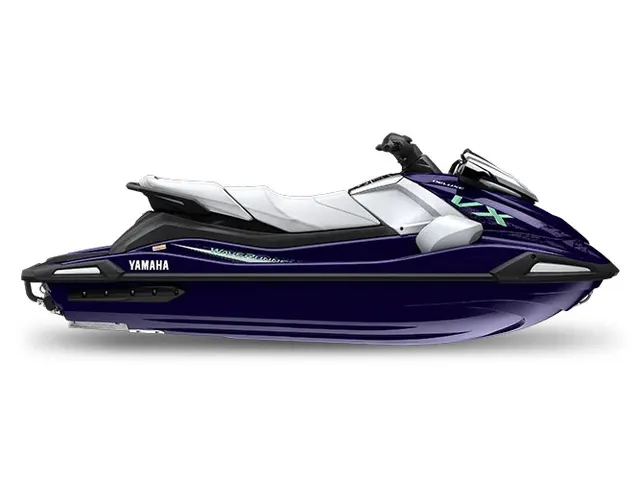
| 2026 Yamaha VX Deluxe, MSRP | $12,899 | $773.94 | $25.00 | $798.94 | $773.94 |
| 2026 CFMOTO CFORCE 600, as listed | $6,799 | $407.94 | $25.00 | $432.94 | $407.94 |
| 2026 Can-Am Defender MAX Limited HD11, as listed | $37,799 | $2,267.94 | $25.00 | $2,292.94 | $2,267.94 |
Notice what the surtax does across that range. It is the same $25 on a CFORCE 600 listed at $6,799 as of September 2026 as it is on a Defender MAX Limited HD11 at its $37,799 listed price, because the surtax only ever reaches the first $5,000. Anyone quoting a flat “6.5 percent” on that side-by-side is overstating the tax by $164 — and on the VX Deluxe’s $12,899 MSRP, by $39.50.
The $18,000 cap is a vessel rule
§ 212.05(5), Fla. Stat. (2026) caps the tax on a boat: the tax on a sale or use “may not exceed $18,000 and on each repair … $60,000.”
Two things people get backwards about it. First, the cap is on the tax, not on the price — at 6 percent, $18,000 of tax corresponds to a $300,000 boat, so the cap is irrelevant to almost every hull that leaves a Southwest Florida dealership. Second, it is a vessel provision. It does not apply to a motorcycle, a personal watercraft trailer, an ATV, or a side-by-side. Off-highway vehicles are ordinary tangible personal property and are taxed the same way a refrigerator is; the titling side of that is on our Florida OHV title and registration guide.
A boat and its trailer are one item
If you buy a boat and its trailer from the same dealer, to the same buyer, at the same time, § 212.054, Fla. Stat. (2026) says they “must be taxed as a single item.” That means one $5,000 surtax base for the pair, not two — a small saving, but a real one, and a reason not to split the purchase across two invoices for tidiness.
Titles, tags, and the fees that are not tax
Sales tax is only part of the counter total. The FLHSMV fee schedule (accessed September 2026) lists $77.25 for a new title and $85.25 for a used one, before statutory add-ons and the county service charge. Annual registration runs $10 for a motorcycle and $5 for a moped; a private trailer under 500 pounds is $6.75.
Three fee facts that save arguments:
- Trailers under 2,000 pounds net weight are registered but not titled. § 319.20, Fla. Stat. (2026) puts chapter 319 out of reach of “any trailer … having a net weight of less than 2,000 pounds.”
- The $225 initial registration fee does not apply to motorcycles or trailers. § 320.072, Fla. Stat. (2026) attaches it to cars, trucks, and motor homes, and it is waived when you transfer an existing plate.
- Vessel registration fees are set by hull length class, from $5.50 for a Class A-1 under 12 feet up to $189.75 for 110 feet and over, before county and service fees. The mechanics are on our Florida boat registration and titling guide.
Where all of this lands in a monthly payment is the subject of our powersports financing walkthrough.
Private-party sales are not tax-free
The most persistent piece of parking-lot wisdom in this state is that buying a titled boat or four-wheeler from a private seller avoids the tax. It does not. Florida does not exempt casual sales of titled vessels and vehicles; the tax is assessed when the title transfers, which means it is collected at the tax collector’s window rather than the seller’s driveway.
We were unable to reach the Department of Revenue’s own consumer publications on the collection mechanics in September 2026 — the guides that describe the procedure returned errors — so treat the procedure as something to confirm with your county tax collector, and treat the liability as settled. Bring a bill of sale with a real price on it and budget the tax into your offer.
Nonresidents, and buying here to take it home
Florida law does provide exemptions for certain nonresident purchasers who remove a boat from the state within a defined window, and there are parallel rules for out-of-state vehicle buyers. We are deliberately not printing the conditions or the day counts here: the Department of Revenue publications that spell them out were not reachable when we checked, and this is not an area to work from a half-remembered number.
If you are a seasonal resident buying in Bonita Springs and taking the machine north, get the exemption confirmed in writing by the Department of Revenue or your tax professional before the sale, not after. Our snowbird guide covers the registration side of the same question.
What changed in 2025 and 2026
Nothing in the rate structure. The 6 percent state rate, the $5,000 surtax cap, and the $18,000 vessel cap all survived the 2025 and 2026 sessions untouched. Lee County’s 0.5 percent levy runs through December 31, 2028 per the DR-15DSS table, and Collier’s surtax has expired rather than been renewed — which is why a Naples buyer and an Estero buyer of identical machines pay different totals by exactly $25.
The DR-15DSS is reissued annually. The edition available to us in September 2026 was the CY2025 form; because Lee’s levy is dated through 2028 and Collier’s line reads “None,” the Southwest Florida figures carry forward, but pull the current form before you rely on a rate for any other county.
The crew’s take
Work the tax off the price on the invoice, not off a percentage somebody quoted you at a boat ramp. On anything over five thousand dollars the county’s share is a rounding error, and the difference between Lee and Collier is the price of a tank of fuel. What actually moves the out-the-door number is freight, prep, and title work — which is where to spend your attention when you are comparing two quotes.
Laws current as of September 2026; verify with FWC/FLHSMV before you ride or launch. General information, not legal advice.
Live inventory and today's pricing, 20 minutes from the Estero and Naples exits.
Quick answers
- How much is sales tax on a boat in Florida?
- Six percent of the sales price under § 212.05, plus your county discretionary surtax on the first $5,000 only. In Lee County that is another 0.5 percent, capped at $25. Collier levies none. Total state tax on a single vessel sale is capped at $18,000.
- What is the sales tax on an ATV or side-by-side in Florida?
- Six percent state tax on the full price, plus the county surtax on the first $5,000 — $25 maximum in Lee County, nothing in Collier. Off-highway vehicles are ordinary tangible personal property, so the $18,000 cap that applies to vessels does not apply to them.
- Is Southwest Florida sales tax 6.5 percent or 7 percent?
- Neither, on a big-ticket purchase. The state rate is 6 percent on the whole price, and the county surtax applies only to the first $5,000. A Lee County buyer of a $30,000 machine pays 6 percent plus $25 — an effective rate of about 6.08 percent, not 6.5.
- Do you pay sales tax on a private-party boat sale in Florida?
- Yes. Florida does not exempt casual sales of titled boats and vehicles; the tax is collected when the title transfers at the county tax collector. Budget it into what you offer rather than discovering it at the counter.
- Does the $18,000 Florida boat tax cap mean boats under $18,000 are tax-free?
- No. The cap is on the tax, not the price. Section 212.05(5) says the tax on a boat sale or use "may not exceed $18,000" — which only starts to bite around a $300,000 boat. Repairs are capped separately at $60,000 of tax.