Florida Rules · The Trailhead
Do You Have to Title an ATV or UTV in Florida? OHV Titles, Fees, Sales Tax, and Public-Land Rules
A title, not a tag. What chapter 317 requires, what your county tax collector charges, and why the surtax stops at five thousand dollars.
By The Outpost CrewUpdated 7 min read
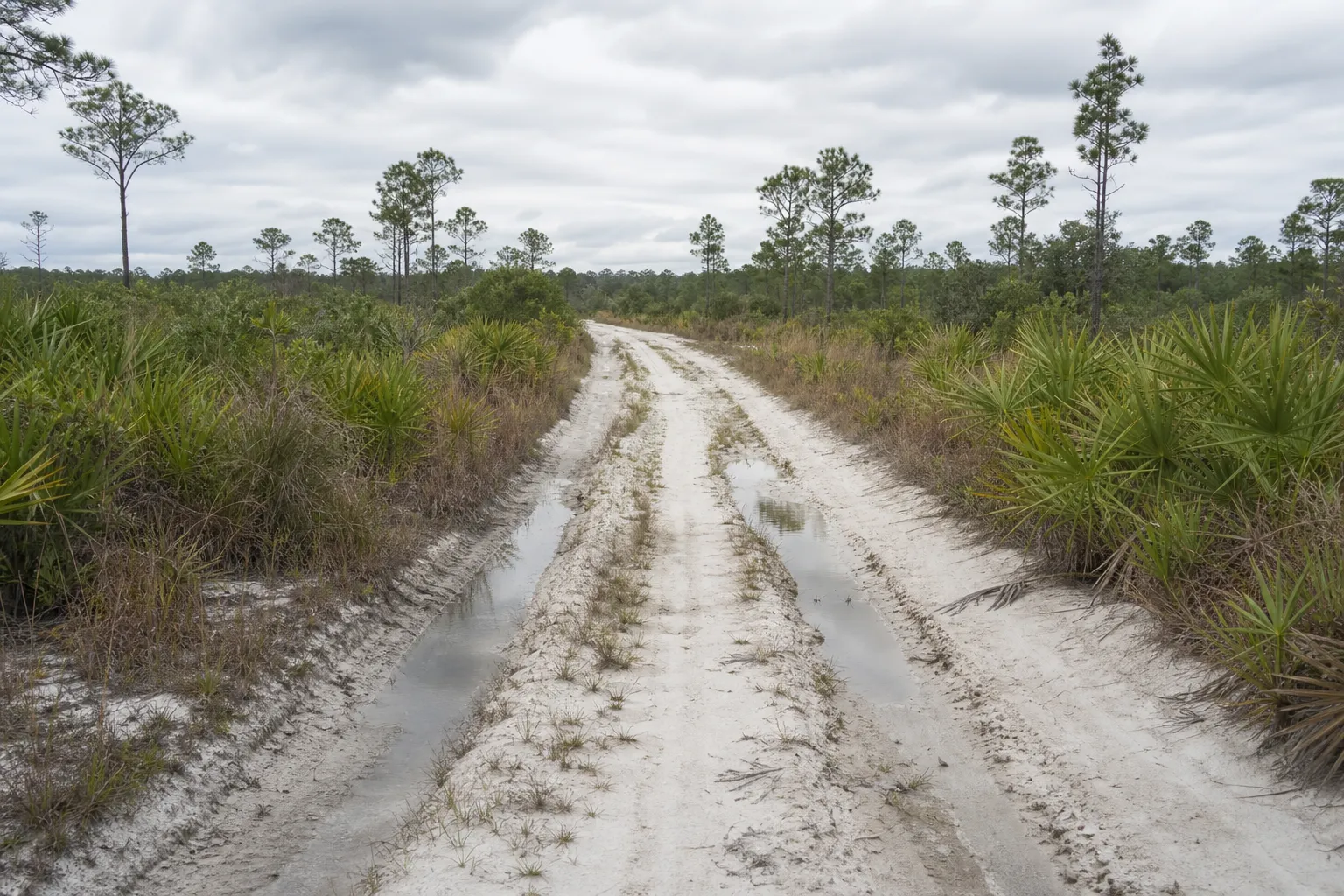
Yes — and it is a title, not a tag. Florida requires off-highway vehicles to be titled under chapter 317, which means your four-wheeler or side-by-side gets a state title document and nothing else: no license plate, no highway registration, no annual renewal sticker. That surprises people who assume “registered” and “titled” are the same errand.
The whole process is cheaper and faster than titling a truck. What follows is what the chapter requires, what the counter costs, how the sales-tax math works in Lee and Collier, and the handful of rules that attach once the machine leaves your own property.
Who this applies to
§ 317.0003, Fla. Stat. (2026) sorts every off-highway machine into three buckets, and the bucket decides more than you would think:
| Class | Florida definition | What it usually is |
|---|---|---|
| ATV | 55 inches or less wide, 1,500 pounds or less dry, three or more non-highway tires | Utility and sport quads |
| ROV | Up to 80 inches wide, up to 3,500 pounds dry | Side-by-sides and UTVs |
| OHM | Off-highway motorcycle | Dirt bikes |
All three are OHVs, all three are titled the same way, and none of them is registered for the road. The class matters most for the road question — Florida’s one narrow unpaved-road exception covers ATVs only, which we break down on are UTVs street legal in Florida.
What you need at the counter
A new machine bought from a dealer arrives with a manufacturer’s certificate of origin, and the paperwork is normally handled at the sales desk before you tow it home. For a private-party purchase you are the one standing in line, and you want:
- The title, signed over by the seller — or the manufacturer’s certificate of origin if the machine has never been titled.
- A bill of sale with the purchase price, the VIN, and both parties’ details.
- Your driver license or state ID.
- Payment for the title fee and any sales tax due on the transfer.
Florida’s general vehicle title schedule lists $77.25 for a new title and $85.25 for a used one on the FLHSMV fee page (accessed September 2026) — the state publishes no OHV-specific line — before statutory add-ons and the service charge your county collects. Ask the tax collector for the all-in number for an off-highway title when you get there rather than budgeting off the base figure.
How to do it
Title work runs through your county tax collector’s office or a licensed service agent — Lee County for most of our Bonita Springs and Estero customers, Collier for Naples and Marco. Bring the documents above, pay the fee and the tax, and the title is issued to you. There is no inspection step, no emissions test, and no plate to screw onto anything.
One thing that trips up truck-buyers: a dealer temporary tag under § 320.131, Fla. Stat. (2026) is a 30-day bridge to a highway registration. An off-highway vehicle never receives a highway registration, so there is nothing for a temp tag to bridge and none is issued. The same logic kills the $225 initial registration fee — that one attaches to cars, trucks, and motor homes, not to OHVs.
What it costs in tax
Off-highway vehicles are ordinary tangible personal property for sales-tax purposes: 6 percent state tax on the full purchase price, plus your county’s discretionary sales surtax on the first $5,000 only — § 212.05, Fla. Stat. (2026) and § 212.054, Fla. Stat. (2026), with the county rates published in the Department of Revenue’s DR-15DSS surtax table (accessed September 2026).
For Southwest Florida that comes out to:
- Lee County: 6 percent, plus 0.5 percent on the first $5,000 — a maximum of $25 in surtax, no matter how big the machine.
- Collier County: 6 percent. Collier’s surtax has expired, so there is no county add-on at all right now.
Work it on a real number. A 2026 Honda Pioneer 700 carries a $12,899 MSRP; a Lee County buyer at that price pays $773.94 in state tax plus the $25 surtax cap, and a Collier buyer pays the $773.94 alone. Two things people get wrong: the surtax is not charged on the whole price, and the $18,000 tax cap you have heard about applies to boats, not to anything with tires. The full breakdown for both sides of the building is on our Florida sales tax guide for boats and powersports.
Buying private-party, or bringing one from out of state
Two situations deserve their own warning. The first is the casual sale. A common piece of parking-lot wisdom holds that private-party sales are tax-free in Florida; they are not. Sales tax on a titled machine is assessed when the transfer happens, which means the tax collector’s window, not the seller’s driveway. Bring the bill of sale with a real purchase price on it, and budget the tax into what you are willing to pay rather than discovering it at the counter.
The second is the machine that followed you down from Ohio. Chapter 317’s titling requirement reaches an off-highway vehicle “owned by a resident” that “is operated on the public lands of this state” — so once you are a Florida resident, riding it at Big Cypress, Croom, or any other public land means a Florida title first. If the machine will only ever see your own property, the statute is less explicit about a vehicle bought elsewhere, so ask your county tax collector how they want it handled. Either way, bring the out-of-state title, the bill of sale if there is one, and your identification, and expect the office to want the VIN legible on the frame. A machine whose VIN plate has been sanded off by ten years of mud is a much longer conversation, so photograph it before you power-wash it.
Insurance, warranties, and the fine print
We found no Florida statute requiring insurance to title or to operate an OHV off-road. Read that narrowly — it means the tax collector will not ask, not that you should ride uninsured. Most homeowner policies treat an off-road machine differently from a car, and some exclude it entirely off-premises. Call your agent before you assume.
The Florida lemon law is another one worth knowing before you need it. § 681.102(14), Fla. Stat. (2026) writes off-road vehicles, motorcycles, and mopeds out of the definition the act runs on, so chapter 681 is not your remedy on a side-by-side. The manufacturer’s warranty and federal Magnuson-Moss protections still apply, which is a real argument for buying where there is a service department that will fight the claim with you.
Riders under 16 on public land
Titling gets you legal. The youth rules get your kid legal. § 261.20, Fla. Stat. (2026) requires an under-16 rider on public lands to wear a DOT or Snell helmet, eye protection, and over-the-ankle boots, to be under adult supervision, and to carry an OHV safety-course certificate. § 316.2074, Fla. Stat. (2026) applies the helmet and eye-protection requirement to under-16 ATV riders more broadly.
What changed in 2025 and 2026
Chapter 317’s titling scheme was not amended in the 2025 or 2026 sessions, and neither was the ATV road rule. The headline powersports changes out of Tallahassee in that window were marine — the Boater Freedom Act and Lucy’s Law, both effective July 1, 2025. If a page tells you Florida started plating side-by-sides, it is wrong.
The crew’s take
Title it the week you buy it, even if the machine is only ever going to see your own back forty. It costs less than a set of tires, it is the difference between selling the thing in an afternoon and selling it never, and the day you decide to trailer it to Big Cypress or Croom — see where to ride an ATV or UTV in Southwest Florida — the paperwork is already done.
If you bought used off a Facebook listing and the title situation is murky, bring what you have to the Trailhead counter in Bonita Springs. We would rather sort it out with you than watch you find out at a trailhead gate.
Laws current as of September 2026; verify with FWC/FLHSMV before you ride or launch. General information, not legal advice.
New ATVs and side-by-sides with the paperwork handled at the counter.
Quick answers
- Do you have to register an ATV in Florida?
- Not the way you register a car. Florida titles off-highway vehicles under § 317.0006 — you receive a title, not a license plate, and there is no highway registration. Machines bought after July 1, 2002, or operated on public lands, are the ones the chapter reaches.
- How much is sales tax on a UTV in Florida?
- Six percent state tax on the purchase price, plus your county discretionary surtax on the first $5,000 only. Lee County adds 0.5 percent, capped at $25. Collier's surtax has expired, so Collier buyers pay the 6 percent alone. The $18,000 tax cap applies to boats, not off-highway vehicles.
- Do you need insurance to title an ATV in Florida?
- We found no Florida statute requiring insurance to title or to operate an off-highway vehicle off-road. That is not the same as not needing coverage — a side-by-side is a five-figure machine that can hurt someone. Confirm what your policy covers with your insurer.
- Can kids ride an ATV on public land in Florida?
- With conditions. Section 261.20 requires riders under 16 on public lands to wear a DOT or Snell helmet, eye protection, and over-the-ankle boots, to be supervised by an adult, and to carry an OHV safety-course certificate.
- Does the Florida lemon law cover an ATV or side-by-side?
- No. Section 681.102(14) excludes off-road vehicles, motorcycles, and mopeds from the definition the lemon law runs on. Your manufacturer warranty and federal Magnuson-Moss remedies still apply — ask the selling dealer to walk you through the coverage in writing.