Review · The Stable
Honda CB650R E-Clutch Review: The Four-Cylinder Naked With a Clutch That Works Itself
One of the last inline-fours under $9,000, fitted with the one piece of automation that does not take the motorcycle away from you.
By The Outpost CrewUpdated 7 min read
How this review was built: from Honda's published specs, professional road tests, owner reports, and what the Power Lodge crew sees on the showroom floor and in the service bay — not a first-hand test ride. Prices are MSRP unless the live listing below says otherwise.How we review →
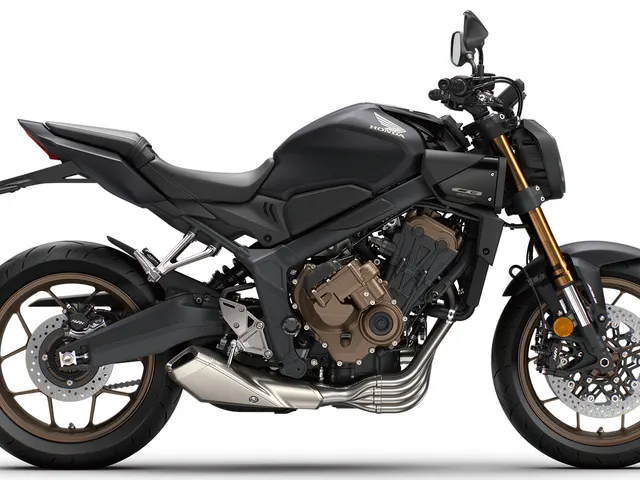
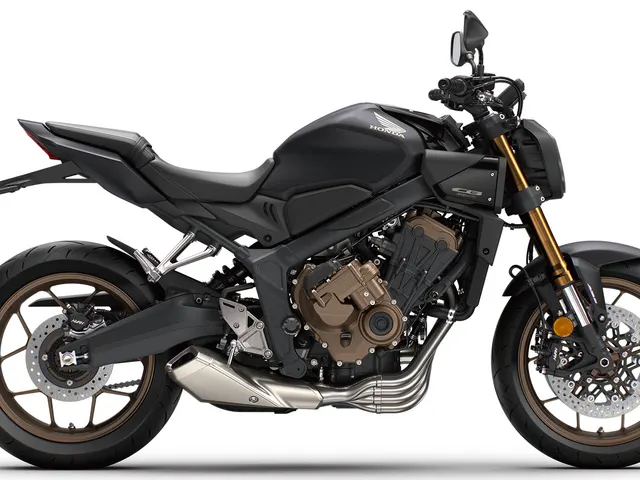
The 2026 Honda CB650R E-Clutch is a 649cc inline-four naked bike that no longer requires you to use the clutch lever, while leaving the clutch lever exactly where it was. Two electric motors handle engagement for launches, shifts, and stops. You still choose every gear with your left foot.
Who it is for: a rider who wants the sound and the top-end rush of a four-cylinder in a bike that is genuinely usable in traffic. Who it is not for: someone who wants low-down torque, in which case a 755cc twin costs less and delivers more.
The one thing to know is that this is not an automatic. Nothing about the way you ride it changes except that your left hand stops working. If you wanted the bike to choose gears too, that is DCT, and it is a different motorcycle.
What the Honda CB650R is
Honda’s middleweight naked four, in Neo Sports Café dress — round LED headlight, exposed trellis-look frame, four short header pipes stacked where you can see them. Style matters here more than usual, because the reason to buy a four-cylinder middleweight in 2026 is partly that you like looking at it.
Mechanically it sits between Honda’s twins and its litre bikes: more revs and more noise than the CB750 Hornet, considerably less bike than a CB1000 Hornet. In the current range it is the entry point to the four-cylinder experience, and it is close to the last affordable one anyone builds.
E-Clutch is standard on the 2026 bike, not an option. That matters when you shop used later — a CB650R from an earlier model year is a different specification.
Its twin sits next to it on our floor: the CBR650R E-Clutch, the faired version of exactly this motorcycle, listed at $9,199. If you want the same engine with a fairing and a 32.3-inch seat, that is the bike, and $500 is the whole difference.
| Engine | 649cc liquid-cooled DOHC inline-four, four-stroke |
|---|---|
| Horsepower (press figure) | About 94 hp |
| Torque (press figure) | About 46 lb-ft |
| Transmission | Six-speed with Honda E-Clutch |
| E-Clutch weight penalty | About 4 lb |
| Clutch lever | Fitted; overrides the system instantly |
| Seat height | 31.9 in |
| Curb weight | About 458 lb |
| Fuel capacity | 4.1 gal |
| Rider aids | Honda Selectable Torque Control, ABS |
| Display | TFT |
| Listed on our floor, 2026 model year | $8,699 |
Source: rideapart.com. Specs and pricing are the manufacturer's published figures and can change by model year.
Engine and performance: what an inline-four buys you
An inline-four of this size makes its case at the top. Below 6,000 rpm the CB650R is polite and slightly uninteresting compared with a modern parallel twin. Above 8,000 it turns into the reason people still want four cylinders, and it keeps going toward 12,000 rpm with the intake noise that no twin produces.
That is the honest trade and the press has been consistent about it: the four-cylinder charm is real, and the midrange loses to twins of similar displacement. If your riding is mostly rolling on in top gear at 50 mph, a 755cc twin will feel stronger for less money. If you want a reason to use the gearbox, this is the bike.
Press and European figures put the engine around 94 horsepower and 46 lb-ft. We flag those as press numbers because that is what they are — the character here is not captured by a peak figure anyway.
E-Clutch changes how you access all of that. Upshifts through the range happen without a lever and without a throttle lift-off that unsettles the chassis. Downshifts are managed for you into a corner or a light. And the moment you decide you want the mechanical connection back, you pull the lever and have it.
On the road
The riding position is the quiet strength. Flat bars, a 31.9-inch seat, pegs that are sporty without folding you in half — it is a bike you can commute on Monday and ride to Everglades City on Saturday without renegotiating with your back.
At 458 pounds it is not light, but it is well balanced, and the weight sits where you want it. The 4.1-gallon tank gives real range, which matters east of Naples where the gas stations are far apart and the ones in between are not there.
In traffic, E-Clutch does the thing it was built for. The Tamiami Trail through Bonita Springs and Estero is signal after signal for six months of the year, and this bike deletes the clutch work from that trip without deleting the gearbox. That is a narrower promise than an automatic makes, and it is the one most riders actually wanted.
One local caveat. Four cylinders make more August heat than two, and stop-and-go gives it nowhere to go but up at you. Mesh gear, hydration, and route timing are the answer, and our Florida heat and rain playbook has the rest.
What reviewers and owners say
Honda’s own framing, from American Honda’s Colin Miller at the US announcement, was that removing clutch-lever work at starts, gear changes, and stops simplifies riding for beginners and experts alike — the full quote and the system’s mechanics are in our E-Clutch explainer.
Press coverage since has landed in a consistent place. The four-cylinder top end is the draw, the E-Clutch is more convincing in use than it sounds on paper, and the midrange is where the bike gives ground to twins.
Owners on Honda forums report two things worth repeating. The first is straightforward affection for the noise — this is a bike people buy with their ears. The second is a real observation about the system: switch E-Clutch off for a spirited backroad run and it will be back on after the next stop. Honda built it that way on purpose, so treat the off switch as a per-ride choice rather than a setting.
Living with a CB650R in Southwest Florida
Salt. Gulf air within a few miles of the beach shortens the life of the chain and every exposed fastener. Rinse and lube on a schedule tighter than the book’s.
Heat. Follow Honda’s published service intervals rather than stretching them, because year-round riding in this climate means you accumulate hours faster than a rider in a state with a winter.
Storms. Hurricane season runs June 1 to November 30, and a four-cylinder with electronics and a TFT dash is not a machine to leave under a carport for a week in September. Get it indoors, stabilized, and on a tender before the storm watch, not during it.
Service on the E-Clutch itself. It is Honda hardware on a Honda bike, and the dealer that sold it is the one set up to diagnose it. Ask what the system adds to the maintenance chart for this model before you buy — it is a normal question with a specific answer.
Recalls and known issues
For the 2026 Honda CB650R, none found in the NHTSA database as of September 2026.
Worth knowing for context: NHTSA does carry campaigns against CBR650R units from the 2023 and 2024 model years, which predate the E-Clutch bikes. They do not apply to the 2026 machines here, but they are a good reminder that model names persist across specifications.
Run the actual VIN of the actual motorcycle at nhtsa.gov/recalls before you sign anything, new or used. It takes thirty seconds and a model name is not a machine.
Price and what is on the floor
Two 2026 Honda CB650R E-Clutch units are listed at $8,699 each on the Power Lodge floor as of September 2026, which matches the MSRP carried in our inventory feed for that model year. Freight, prep, tax, and tag are separate and real — ask for the out-the-door figure, because that is the number you are actually comparing against anything you saw online.
How it compares
Honda CB750 Hornet E-Clutch, listed at $7,999, is the value argument against this bike and a serious one: a 755cc parallel twin with about 90 press horsepower, roughly 35 pounds lighter, throttle-by-wire, and $700 less. It out-torques the four everywhere that is not the top of the rev range. Choose the CB650R anyway if what you want is four cylinders — but ride the Hornet first so the choice is deliberate.
Honda CBR650R E-Clutch, $9,199, is this motorcycle with bodywork and a slightly taller, more committed riding position. If most of your miles are highway, the fairing earns its $500; if they are around town, that is $500 of plastic between you and the engine you bought this bike to look at.
Yamaha MT-09 SP is the step up in every direction — an 890cc triple, more electronics, listed on our floor from $11,999. Different money and a different bike, but the natural next rung for someone who finds the CB650R’s midrange thin. See the Yamaha MT-09 SP review.
Cross-shoppers will also look at the Suzuki SV650 for a cheaper twin. It is a good motorcycle and it is not a four-cylinder, which is the entire reason anyone is reading this page.
Highs
- A genuine inline-four under $9,000, which is now a rare object
- E-Clutch removes clutch work without removing the gearbox
- Lever override is instant and needs no mode change
- Neutral, comfortable riding position with a 31.9-inch seat
- 4.1-gallon tank gives real range between stops
Lows
- Midrange gives ground to same-price twins
- About 458 lb — not a light middleweight
- Four cylinders make more heat in August stop-and-go
- E-Clutch re-enables after a stop, so switching it off is per-ride
- Horsepower figures are press numbers, not a published US spec
Everything on this page comes from published specifications, professional coverage, owner reports, and what the crew sees on the floor and in the service bay. Our standard is on how we review. The system itself is explained in full in our Honda E-Clutch guide, and if you are weighing it against every other clutchless option, start with the automatic motorcycles guide.
Two 2026 units. Live inventory and today's price.
Quick answers
- Is the Honda CB650R a good motorcycle?
- For a rider who wants inline-four character in a middleweight, yes — it is one of very few four-cylinder nakeds left under $9,000. The engine rewards revs and gives away midrange to a twin, which is the trade you are making and the one to be honest with yourself about.
- How does E-Clutch work on the Honda CB650R?
- Two electric motors operate the standard clutch for pull-aways, gear changes, and stops. You still select every gear with your foot, and pulling the clutch lever at any point returns full manual control instantly.
- Can you stall a Honda CB650R with E-Clutch?
- Not in normal riding — E-Clutch disengages as the bike slows to a halt, which is where stalls happen. Because a real lever is still fitted, a rider who takes manual control back can still stall it the old-fashioned way.
- How much horsepower does the Honda CB650R have?
- Press and European figures for the 649cc inline-four sit around 94 horsepower and 46 lb-ft. Treat those as press numbers rather than a published American specification, and note that the character of this engine is in the top of the rev range rather than in the peak figure.
- What is the difference between the Honda CB650R and CBR650R?
- The same 649cc inline-four and the same E-Clutch system in different clothes. The CB650R is the naked bike with a 31.9-inch seat; the CBR650R is faired and sportier, with a 32.3-inch seat. Both are on the Power Lodge floor as 2026 units.
- How much is the Honda CB650R E-Clutch?
- Two 2026 units are listed at $8,699 each on the Power Lodge floor as of September 2026, which matches the MSRP in our inventory feed for that model year. Freight, prep, tax, and tag are additional — ask for an out-the-door figure.