Buyer's Guide · The Trailhead
ATV vs UTV: Which Should You Buy for Florida Land, Mud, and Work?
Two seats or one, a trailer or a truck bed, and one narrow line in Florida law that only four-wheelers get to cross. Start there, not with the spec sheet.
By The Outpost CrewUpdated 9 min read
Honda at Power Lodge →Yamaha at Power Lodge →Kawasaki at Power Lodge →Can-Am at Power Lodge →CFMOTO at Power Lodge →

Start with two questions, not with a spec sheet: how many people ride with you, and how wide can the machine be? Answer those honestly and the ATV-versus-UTV decision usually makes itself. A quad is narrower, cheaper, lighter, easier to haul, and — uniquely in Florida — eligible for the one legal exception that lets an off-highway machine touch a public road. A side-by-side carries passengers and cargo, has a dump bed and a roll cage, and asks for a bigger trailer and a bigger check.
Most people who ask us this question have already decided and want permission. Here is the framework anyway, plus what each side looks like on the floor in Bonita Springs right now.
How to think about it: five variables that actually decide it
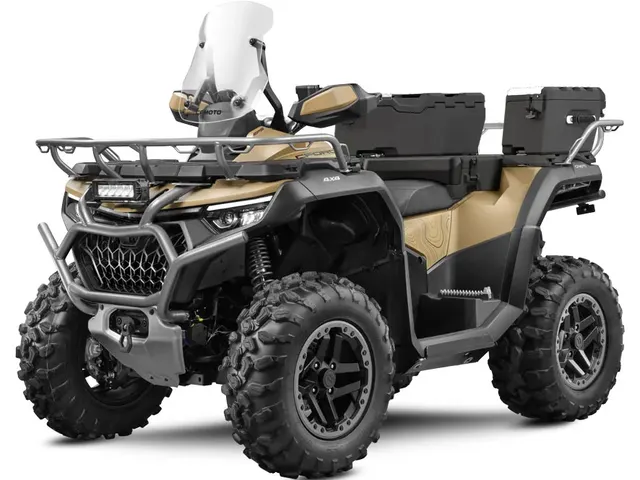
1. Passengers. A utility quad carries one rider. Two-up “Touring” versions exist — CFMOTO’s CFORCE 600 Touring and 800 Touring add a passenger seat and grab bars — but that is the ceiling. A side-by-side starts at two and goes to six. If a spouse, a kid, or a hired hand rides with you regularly, the argument is basically over.
2. Width, and where you ride. Florida’s own definitions draw the line at 55 inches: § 317.0003, Fla. Stat. (2026) defines an ATV as 55 inches or less wide and 1,500 pounds or less dry, and a recreational off-highway vehicle as up to 80 inches and 3,500 pounds. That is not trivia. Some designated trails are cut for quads, some public land is easier to move a narrow machine through, and a 65-inch six-seater simply does not go some places a 47-inch quad goes.
3. What you haul. A quad’s racks are measured in tens of pounds — a CFMOTO CFORCE 600 carries 75 pounds front and 100 rear per its spec sheet. A side-by-side’s bed is measured in hundreds: a Honda Pioneer 700 carries 1,000 pounds in a tilt bed. Towing narrows the gap less than you would expect — that same CFORCE 600 is rated to pull 1,500 pounds, identical to the Pioneer — but nothing on two racks replaces a dump bed.
4. How you will move it. With one exception — the 50-inch Honda Pioneer 520, which is sized to haul in a full-size pickup bed — a side-by-side is a trailer conversation. Several utility quads will load into a full-size bed with ramps. For a first-time buyer that is a real, immediate difference of a few thousand dollars in equipment.
5. Florida road law. This is the variable nobody outside the state weighs, and here it may be decisive. § 316.2123, Fla. Stat. (2026) permits an ATV — and only an ATV — on certain slow unpaved roads in daylight, subject to county opt-out. Side-by-sides are not in that exception. If moving between parcels on a dirt county road is part of your week, the quad is the only machine that can even be argued for. Read are UTVs street legal in Florida for every condition before you rely on it, and check your county.
Laws current as of September 2026; verify with FWC/FLHSMV before you ride or launch. General information, not legal advice.
The case for the ATV
You are one rider on tight ground with a budget. A quad puts your weight where you can move it, which is why a good rider on a 750-pound machine gets through ruts and roots that stop a 2,000-pound side-by-side. It is cheaper to buy, cheaper to insure, easier to store, and it fits through a gate.
Three on our floor make the case at different price points.
CFMOTO CFORCE 600 — the value argument, and the deepest stock in the building at 17 units. A 580cc single making 44 horsepower, 1,500 pounds of towing, and power steering, a 3,500-pound winch, alloy wheels and LED lighting standard, at $7,799 MSRP for the 2026 model. Listed at $6,799 to $7,149 for 2026 units as of September 2026. Full write-up: CFMOTO CFORCE 600 review.
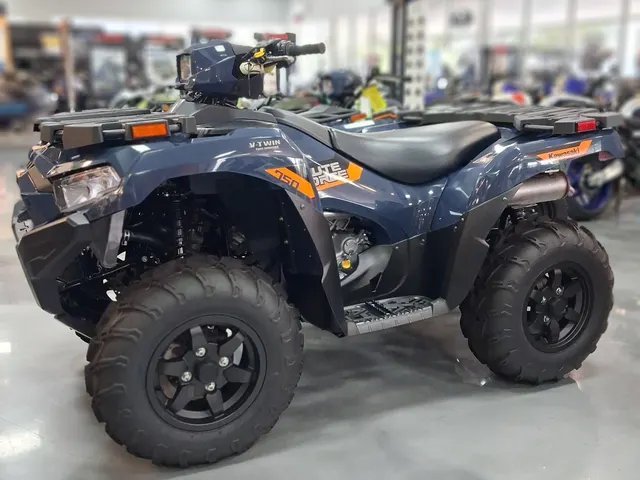
Honda FourTrax Foreman Rubicon 4x4 DCT EPS — the longevity argument. A 518cc single with a five-speed automatic DCT, no drive belt, independent rear suspension, a locking front differential, and a 1,322-pound tow rating. MSRP is $10,299, or $10,799 for the Deluxe (2026 models); the floor holds four DCT EPS units listed at $9,799 to $10,199 and five Deluxes at $10,299 to $10,649 as of September 2026. It is the machine grove and lease crews here have bought for twenty years.
Yamaha Kodiak 450 — the light-duty pick, a 421cc Ultramatic CVT quad rated for 1,322 pounds of towing, $6,699 MSRP for the 2026 model, listed from $6,199. Less machine than the two above, and enough for a lot of properties.
The case for the UTV
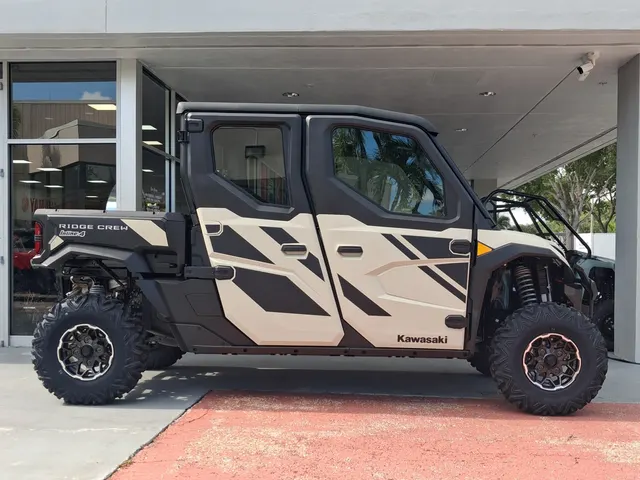
You carry people, or you carry things, or both. A side-by-side gives you seat belts, a roll cage, a bed that dumps, doors or nets, and the ability to hand somebody a ride without them clinging to a rack. It is also the only format where a windshield, a roof, and — at the top of the market — air conditioning are real options.
Honda Pioneer 520 — the narrow one, and the answer for people who want a side-by-side but ride quad-width trails. Two seats, 1,000 pounds of towing, a 450-pound bed, $10,999 MSRP with five 2026 units on the floor listed at $10,999 as of September 2026. Details in our Pioneer 520 review.
Honda Pioneer 700 — the do-everything work machine. A 675cc single driving a torque-converter automatic with no CVT belt, a 1,000-pound tilt bed, and 1,500 pounds of towing, at $12,899 MSRP for the 2026 model and listed at $11,899. In a state that spends half the year wet, the belt-free driveline is the argument: Honda Pioneer 700 review.
Can-Am Defender MAX HD7 — the six-seat entry point. A 650cc Rotax single making 52 horsepower, a 2,500-pound tow rating, a 1,000-pound bed, and six seats via flip-up benches; a 2025 unit is listed at $15,199 as of September 2026. Above it the range runs all the way to the air-conditioned Defender MAX Limited HD11 at $37,799 as listed.
CFMOTO UFORCE 800 XL — the value four-seater, 1,500 pounds of towing and a 660-pound bed at $13,499 MSRP, and Kawasaki MULE SX 4x4 at $9,199 MSRP for the 2027 model is the cheapest work-focused side-by-side we stock — only CFMOTO’s runout ZFORCE 800 Trail sport units list lower, from $8,999. More options in that bracket: best side-by-side under $15,000.
Mud, sand, and the Florida-specific stuff
Sugar sand favors the light machine. A quad floats over soft ground that bogs a heavy six-seater, and you can physically move a quad when it does get stuck — try that with 2,645 pounds of Defender.
Deep mud reverses it. Water is the enemy in both formats, but a side-by-side’s engine and CVT intakes sit higher off the ground, and the mud-specific trims are almost all side-by-sides and big sport quads with factory snorkels. If mud weekends are the plan, buy a machine built for it rather than plan to modify one — the reasoning is in our Redneck Mud Park guide and the mud and sand setup guide.
Hurricane season, June 1 through November 30, is its own use case. Either format with a winch is worth its price the week after a storm; the side-by-side’s bed is what makes debris hauling bearable.
Work, play, and hunting: which format wins each job
Property chores on acreage. Side-by-side, and it is not close. Fence posts, feed, sand, mulch, a chainsaw and the mess it makes — a dump bed does in one trip what a quad does in four. The exception is a property cut with narrow gates and old citrus rows, where a 48-inch quad goes places a 65-inch machine cannot.
Trail riding for its own sake. Quad, if you ride alone and you like the physical part of it. A rider who leans, weights the pegs, and picks a line is more involved on a four-wheeler than in any side-by-side, and the machine will follow you through gaps a cage will not fit.
Hunting. Split decision, and it comes down to how far the deer is from the truck. A quad with racks and a gun scabbard is quiet, narrow, and easy to hide. A side-by-side hauls the whole party plus a cooler, a stand, and the animal, and its bed makes the drag out a lift instead of an ordeal. Big Cypress adds a hard constraint here: the Preserve requires permitted machines to be 4x4 capable, which rules out two-wheel-drive bargains.
Family riding. Side-by-side, with seat belts and a cage, every time. Putting a passenger on the rack of a one-up quad is how people get hurt, and a Touring two-up seat is designed for an adult, not for a stack of kids.
Post-storm cleanup. Whichever one has a winch. Both formats earn their price the week the power is out; the side-by-side just hauls more debris per trip.
Mistakes people make
Buying for the trip you take twice a year. The machine that gets ridden is the one that fits your weekly Saturday, not the annual trip to Ocala.
Underbuying on seats. People who buy a two-seater when the household has three people end up buying twice. Seats are the hardest thing to add later.
Overbuying on width. A 65-inch machine has to fit through your gate, down your trail, onto your trailer, and into your garage. Measure all four before you fall in love.
Forgetting the trailer, the ramps, and the tie-downs. They are not optional, and they arrive as a surprise bill on delivery day.
Assuming the road exception applies to a side-by-side. It does not, and no bolt-on kit changes it.
Skipping the youth rules. Florida requires under-16 riders on an ATV to wear a DOT helmet and eye protection under § 316.2074, Fla. Stat. (2026), with boots, adult supervision, and a safety-course certificate for any under-16 OHV rider on public lands. Put kids on a youth-sized machine with a speed limiter, not on the family quad — our best youth ATV guide covers the four youth models we stock.
What it costs
Bands as listed on the Bonita Springs floor as of September 2026, before freight, prep, and tax:
| Segment | Typical price | Examples |
|---|---|---|
| Youth quads | From $3,449 as listed; see today’s price at Power Lodge on the Grizzly 110 | Kawasaki KFX90, Yamaha Raptor 110, Honda TRX90X |
| Value utility ATV | $6,199–$7,149 as listed | CFMOTO CFORCE 600, Yamaha Kodiak 450 |
| Legacy utility ATV | $7,849–$11,399 as listed | Honda Rancher and Foreman, Yamaha Grizzly EPS XT-R |
| Entry side-by-side | $9,199–$12,499 as listed | Kawasaki MULE SX, Honda Pioneer 520 and 700-4 |
| Mid utility side-by-side | $13,499–$20,499 as listed | CFMOTO UFORCE 800 XL, Can-Am Defender MAX HD7 and HD9, Kawasaki MULE PRO |
| Premium and cab | $26,299–$37,899 as listed | Can-Am Defender MAX XT and Limited HD11, Kawasaki RIDGE CREW HVAC |
The rough rule: expect to pay $3,000 to $5,000 more for the side-by-side version of comparable capability, then add the trailer.
Where to go next
If you have landed on a quad, start with the CFORCE 600 review and then the value-versus-legacy question in CFORCE 600 versus Honda Rancher. If you have landed on a side-by-side, Pioneer 700 versus Defender HD7 is the decision most of our customers actually make, and best side-by-side under $15,000 frames the budget end.
Before you buy either one, read where to ride an ATV or UTV in Southwest Florida — because the honest answer to “which should I buy” partly depends on where the thing is legally allowed to go, and in this state that list is shorter than people expect. Everything mentioned here sits under one roof on the Tamiami Trail; the fastest way to settle it is to sit in both and see which one your knees, your gate, and your budget agree with.
Live inventory and today's price on everything on this page.
Quick answers
- What is the difference between an ATV and a UTV?
- You straddle an ATV and steer with handlebars; you sit in a UTV and steer with a wheel. Florida also draws a legal line: an ATV is 55 inches or less wide and 1,500 pounds or less dry under § 317.0003, while a UTV is a recreational off-highway vehicle up to 80 inches and 3,500 pounds.
- Is a UTV better than an ATV?
- For carrying people and cargo, yes. For price, width, trailer size, and Florida's narrow unpaved-road exception, the quad wins. Buy the UTV if passengers or a dump bed are part of the job; buy the ATV if it is one rider, tight ground, or a tighter budget.
- Can a UTV fit in a truck bed?
- Almost never. The one exception we stock is the 50-inch-wide Honda Pioneer 520, which is built to haul in a full-size pickup bed; every other side-by-side means a trailer. Some utility quads will also load into a full-size bed with ramps, which is a real cost difference for a first-time buyer.
- Are ATVs or UTVs safer for kids?
- Neither is a toy. Florida requires a DOT helmet and eye protection for under-16 riders on ATVs under § 316.2074, and § 261.20 adds boots, supervision, and a safety-course certificate for any under-16 OHV rider on public lands. Youth-specific machines with speed limiters matter more than the ATV-versus-UTV question.
- How much does a UTV cost compared to an ATV?
- On the Bonita Springs floor as of September 2026, four-wheel-drive utility quads run from about $6,199 to $11,399 as listed, while side-by-sides start at $8,999 and climb past $37,000. Expect to spend roughly $3,000 to $5,000 more for the two-seat version of comparable capability.