Review · The Stable
Honda CRF125F Review (and Big Wheel): The Trail Bike Kids Grow Into Instead of Out Of
One engine, two wheel sizes, and the moment a kid stops riding an automatic. Honda has been selling this idea for decades and has not needed to change much.
By The Outpost CrewUpdated 8 min read
How this review was built: from Honda's published specs, professional road tests, owner reports, and what the Power Lodge crew sees on the showroom floor and in the service bay — not a first-hand test ride. Prices are MSRP unless the live listing below says otherwise.How we review →
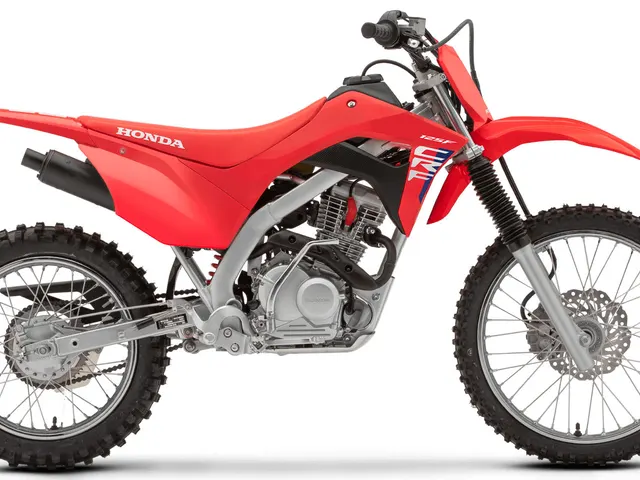
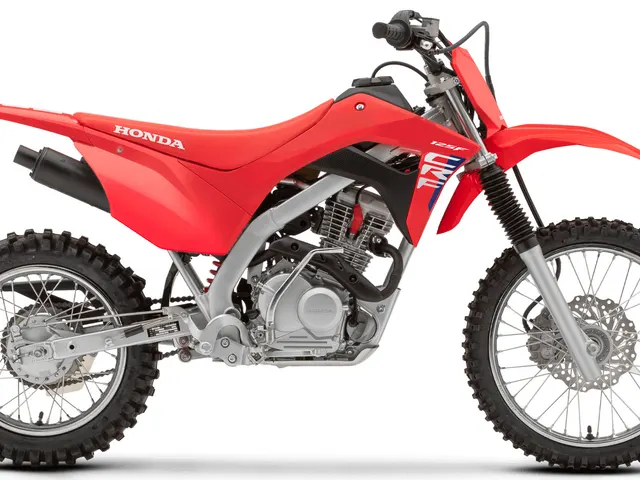
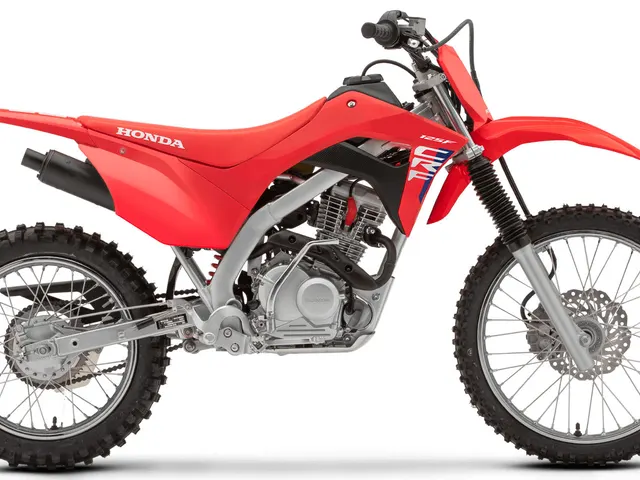
The 2027 Honda CRF125F is the bike a kid buys when the automatic-clutch 110 has stopped being interesting. It is a 125cc air-cooled four-stroke with programmed fuel injection, electric start, and a four-speed gearbox with a real clutch lever — the first machine in this ladder where the rider has to coordinate a left hand with a left foot.
Two versions sit on the floor, and the only differences between them are wheel diameter and how far off the ground the seat is. The standard CRF125F rolls 17-inch front and 14-inch rear wheels with a 29.1-inch seat. The CRF125F Big Wheel rolls 19 and 16 inches with a 30.9-inch seat and two more inches of ground clearance. Same engine, same transmission, same everything else.
Who it is for: a rider who has outgrown a 110 and is ready for a clutch, with an inseam that matches one of those two seats. Who it is not for: a first-time rider, and a teenager who wants to go fast — this bike is deliberately soft, and that is the review, not a complaint.
What the Honda CRF125F is
It sits in the middle of Honda’s CRF trail family: above the CRF110F with its automatic clutch, below the full-size trail bikes, and a long way below the CRF250R race bike. Its whole reason to exist is the clutch lever. Everything else on the machine is arranged so that learning the lever is the only hard thing happening.
The engine is a two-valve SOHC single displacing 125cc, bore and stroke 52.4 by 57.9 millimeters, fed by programmed fuel injection through a 22-millimeter throttle body. Fuel injection matters more than it sounds on a kids’ bike: no choke, no fiddling, no bike that will not start in February because it sat since Thanksgiving. Push the button and it runs.
The Big Wheel is not a different model so much as a different size of the same one. The gearing changes with the wheels — the standard bike runs a 13T/46T final drive, the Big Wheel 13T/49T — so Honda has compensated for the taller rolling diameter rather than leaving the bike overgeared.
| Spec | CRF125F | CRF125F Big Wheel |
|---|---|---|
| Engine | 125cc air-cooled SOHC two-valve four-stroke single | 125cc air-cooled SOHC two-valve four-stroke single |
| Bore and stroke | 52.4 x 57.9 mm | 52.4 x 57.9 mm |
| Fuel system | PGM-FI, 22 mm throttle body | PGM-FI, 22 mm throttle body |
| Starter | Electric | Electric |
| Transmission | Four-speed, manual clutch | Four-speed, manual clutch |
| Final drive | Chain, 13T / 46T | Chain, 13T / 49T |
| Seat height | 29.1 in | 30.9 in |
| Ground clearance | 8.3 in | 10.3 in |
| Wheelbase | 48.0 in | 49.4 in |
| Curb weight | 194 lb | 199 lb |
| Front tire and wheel | 70/100-17 | 70/100-19 |
| Rear tire and wheel | 90/100-14 | 90/100-16 |
| Brakes | 220 mm front disc, 95 mm rear drum | 220 mm front disc, 95 mm rear drum |
| Suspension travel, front and rear | 5.9 in and 5.5 in | 6.7 in and 6.6 in |
| Fuel capacity | 1.0 gal | 1.0 gal |
| Listed price, September 2026 | $3,599 (MSRP $3,599, MY27) | $3,999 (MSRP $3,999, MY27) |
Source: powerlodgefl.com. Specs and pricing are the manufacturer's published figures and can change by model year.
Both spec sheets are Honda’s own, read on the units’ Power Lodge listings on September 3, 2026, because powersports.honda.com blocks automated retrieval.
Engine and performance: soft on purpose
Honda publishes no horsepower figure for the CRF125F, and no top speed. That absence is itself informative — this is not a machine sold on numbers.
What the 125cc single delivers is a wide, flat spread of torque with no step in it anywhere. A rider who lets the clutch out badly gets a lurch and a stall rather than a wheelie into the fence line. A rider who forgets to downshift on a climb gets a bike that lugs down and keeps pulling. Both of those behaviors are engineering choices, and both are why a nervous twelve-year-old gains confidence on this bike faster than on something with more character.
The four speeds are enough. On a trail bike geared for 17 or 19-inch front wheels and a 125cc engine, a fifth ratio would sit unused. Where you notice the four-speed box is against the Yamaha TT-R125LE’s five, which spaces its ratios a little more finely for a rider who has started to care about that.
Electric start deserves its line. A kid who drops the bike in a rut and cannot restart it is a kid waiting for help. A button turns that into a five-second event.
On the trail
The two wheel packages ride differently enough to matter, and the difference is not subtle once you know what to look for.
The standard CRF125F, on 17/14-inch wheels with 5.9 and 5.5 inches of travel, is the lower, more manageable bike. It turns tighter, it is easier to plant a foot on, and it rewards a rider who is still figuring out where the front wheel is. The trade is ground clearance: 8.3 inches disappears fast in ruts and over roots.
The Big Wheel, on 19/16-inch wheels with 6.7 and 6.6 inches of travel and 10.3 inches of clearance, rolls over things instead of into them. Bigger wheels carry more momentum across chop and hold a line better in sand, which is most of what Southwest Florida riding is. It is also 1.8 inches taller in the seat and five pounds heavier, and those five pounds all sit high.
The braking setup is worth understanding before you hand a kid the keys. A 220-millimeter hydraulic disc up front and a 95-millimeter drum at the rear is a deliberate imbalance: the strong brake is on the lever the rider is learning to modulate, and the rear is soft enough that locking it is a slide rather than a spill. It is a good arrangement for a learner and an underwhelming one for a fast teenager, which is the same sentence as everything else about this bike.
What owners say about the Honda CRF125F
The consensus on the Honda mini four-stroke forums, ThumperTalk chief among them, has been the same for years and it comes in two halves.
Reliability is the headline. Owners describe these engines as effectively unbreakable within any normal use, needing oil, a chain, and an air filter and very little else. That reputation is the main reason resale on a CRF125F is strong enough that a family often gets most of their money back when the kid moves up.
The power is the complaint. The same owners note that an aggressive teenager will find the bike soft inside a season. That is a real limitation and worth planning around: if your rider is already fast and already comfortable with a clutch, the CRF125F may be a one-year bike rather than a three-year one.
Both halves point the same direction. This is a machine for the learning phase, executed about as well as anyone has executed it, and it is not trying to be a machine for the phase after that.
Living with a CRF125F in Southwest Florida
Air cooling is the first thing that shapes ownership here. There is no radiator, no coolant, and nothing to boil over — but there is also nothing keeping the engine cool at a walking pace. On a tight, slow, humid trail in July, an air-cooled single is working hard. Let it breathe on the fire roads rather than idling it in the shade.
Fuel injection removes the seasonal headache that used to define these bikes. A carbureted mini that sits from May to October in a Florida garage often needs the bowl cleaned before it will run; the PGM-FI system on the CRF125F does not. What still matters is fuel age in a 1.0-gallon tank — a tank that small turns over slowly, so use fresh gas and stabilize what sits.
Sand and salt air are the maintenance clock. The rear drum brake is a sealed unit and largely indifferent to grit, but the chain and the air filter are not. Southwest Florida riding is sandy riding, and a filter serviced on the manual’s schedule in a dusty climate is a filter serviced late. Check it more often than the interval says, and follow Honda’s published service schedule for oil and valve clearance rather than a number from a forum.
One storage note that is specific to this machine rather than to motorcycles in general: at 194 or 199 pounds with a 48-inch wheelbase, a CRF125F fits in the bed of a mid-size pickup or stands upright in a corner of a garage. When a storm is on the way, that is a two-person, two-minute job — genuinely easier than moving almost anything else in the building.
Recalls and known issues
For the 2027 Honda CRF125F and CRF125F Big Wheel, none found in the NHTSA database as of September 2026.
Two notes on how to check this yourself, because off-road motorcycles sit in an awkward spot between registries. Start at nhtsa.gov/recalls with the VIN off the steering head — that is where Honda files motorcycle campaigns. Then, because youth off-road machines have also been recalled through the Consumer Product Safety Commission, run a second check at cpsc.gov/Recalls. Neither search takes a minute, and on a used bike bought from a stranger, both are worth doing.
Price and what is on the floor
As of September 2026 the Power Lodge floor holds one 2027 CRF125F listed at $3,599 and two 2027 CRF125F Big Wheels listed at $3,999, each at its MSRP for that model year. Freight, prep, tax, and the OHV title work are on top — ask for an out-the-door number, since that is the figure you are actually comparing against a used bike.
The $400 between the two versions buys wheels, not performance. If your child fits the taller seat, the Big Wheel is the better long-term buy because it is the version they will still fit in two years. If they do not fit it today, the $400 is irrelevant.
How the CRF125F compares
Yamaha TT-R125LE is the direct cross-shop and it is also on our floor, listed at $3,399 for the 2026 model against a $3,599 MSRP. It matches the Big Wheel’s 19/16-inch wheels, adds a fifth gear, and sits taller still at 31.7 inches with 11.6 inches of ground clearance and a 198-pound wet weight. Yamaha undercuts Honda on price; Honda answers with fuel injection, where the TT-R125LE runs a Mikuni carburetor. For a bike that will sit through a Florida off-season, that is a real argument.
Kawasaki KLX110R L is the cheaper way to reach the same skill. Same manual clutch, but on a 112cc chassis with a 28.7-inch seat and 167.5 pounds, listed at $3,099. If your rider needs the clutch but not the size, it is the smarter buy.
Honda CRF110F, the automatic-clutch bike below this one, is not on our floor. If your child is not ready for a lever, the machines to look at here are the Yamaha TT-R110E at 26.4 inches or the Kawasaki KLX110R at 26.8 inches.
Where all of these sit relative to each other, by seat height and by skill, is laid out in the kids’ dirt bike size guide.
Highs
- Fuel injection means it starts after a Florida off-season without a carburetor cleanup
- Two wheel sizes cover nearly two inches of inseam on one platform
- Manual clutch and electric start together — learn the lever, keep the button
- Owner-reported reliability is the strongest argument in the category
- Big Wheel ground clearance of 10.3 inches handles sand and roots properly
Lows
- Deliberately soft power that a fast teenager will outgrow quickly
- Four speeds where the Yamaha rival offers five
- Rear drum brake is adequate rather than good
- 1.0-gallon tank is small for a long trail day
- Off-road only — no lights, no plate, no road use in Florida
Everything on this page comes from Honda’s published specifications, owner reports, and what the crew sees on the floor and in the service bay. Our standard is on how we review. Before the first ride on public land, read what § 261.20, Fla. Stat. (2026) requires of a rider under 16 — helmet, eye protection, over-the-ankle boots, adult supervision, and a safety-course certificate in their pocket — and check where you can legally ride in Southwest Florida before you buy the trailer.
Bonita Springs — both wheel sizes on the floor with today's price.
Quick answers
- What is the difference between the Honda CRF125F and the CRF125F Big Wheel?
- Wheels and seat height. The standard CRF125F runs 17-inch front and 14-inch rear wheels with a 29.1-inch seat and 8.3 inches of ground clearance. The Big Wheel runs 19-inch front and 16-inch rear wheels with a 30.9-inch seat and 10.3 inches of clearance. Same 125cc engine, same four-speed manual clutch.
- Does the Honda CRF125F have a clutch?
- Yes. Honda's spec sheet lists a four-speed transmission with a traditional manual clutch on both the standard and Big Wheel models. That is the point of the bike — it is the rung above an automatic-clutch 110, and learning the lever is the skill it exists to teach.
- What age is the Honda CRF125F for?
- Honda publishes a seat height, not a rider age, on the spec sheets we read. Size by inseam: 29.1 inches on the standard bike, 30.9 on the Big Wheel. A rider who can plant the balls of both feet in riding boots and hold the 194-pound bike up unassisted fits it.
- How fast does a Honda CRF125F go?
- Honda does not publish a top speed or a horsepower figure for the CRF125F. It is geared and tuned for trail riding rather than outright speed, and owners consistently describe the power delivery as soft — which is deliberate on a bike built for a rider learning a clutch.
- Is the Honda CRF125F street legal?
- No. It is an off-road-only motorcycle with no lighting package and no highway equipment. In Florida it is titled under chapter 317 as an off-highway motorcycle — a title, no plate, no highway registration — and riders under 16 on public land have gear and supervision requirements under § 261.20.