Florida Rules · The Trailhead
Are UTVs Street Legal in Florida? What § 316.2123 Actually Allows for ATVs and Side-by-Sides
The statute everyone quotes at the gas pump says ATV. Your side-by-side is not an ATV, and no bolt-on kit changes that.
By The Outpost CrewUpdated 6 min read
No. A side-by-side is not street legal in Florida, and the statute people quote at each other in the gas station parking lot does not say what they think it says. Florida has exactly one narrow road exception for off-highway machines, and it is written for ATVs. A UTV — what Florida law calls a recreational off-highway vehicle, or ROV — is not in it.
That is the whole answer. The rest of this page is the useful part: which machine is which under Florida law, what the exception actually permits for the riders it does cover, why a “street-legal kit” changes none of it, and where you can put a side-by-side to work legally in Lee and Collier counties instead.
What Florida counts as an ATV, and what it counts as a UTV
The line is drawn by width and dry weight, not by how the machine looks or how you use it. § 317.0003, Fla. Stat. (2026) defines an ATV as an off-highway vehicle 55 inches or less in width with a dry weight of 1,500 pounds or less, riding on three or more non-highway tires. A recreational off-highway vehicle is the side-by-side class: up to 80 inches wide and up to 3,500 pounds dry. An off-highway motorcycle is a dirt bike. All three are “OHVs,” and the chapter defines an OHV as a vehicle “not registered and licensed for highway use.”
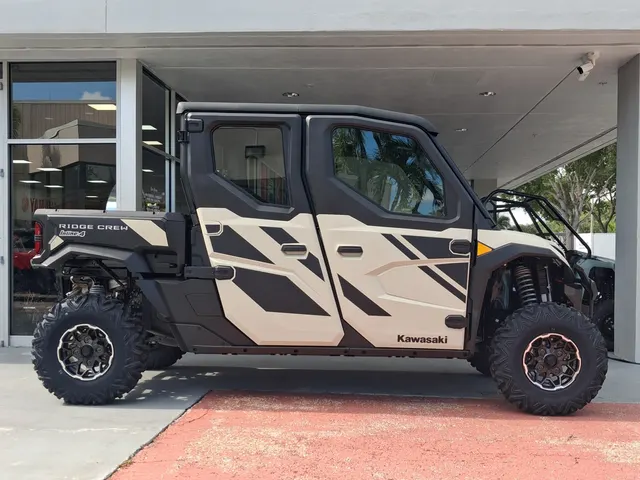
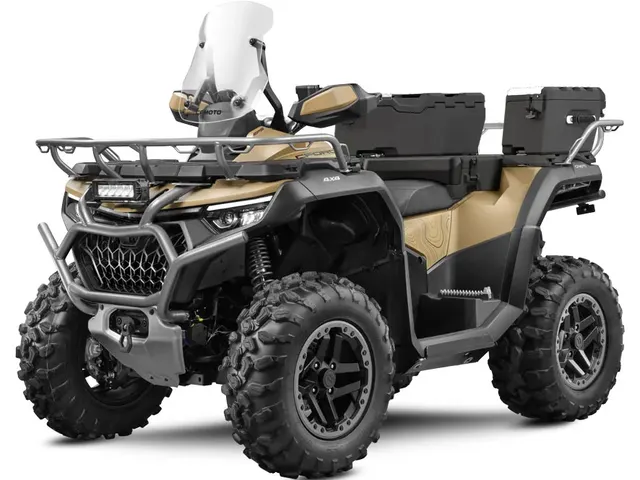
Run the tape measure over what is actually on a Southwest Florida trailer and the sorting is not close. A 2026 Honda Pioneer 700 measures 59.9 inches wide on Honda’s own spec sheet. A 2026 Can-Am Defender MAX Limited HD11 measures 65 inches. Both clear the 55-inch ATV ceiling comfortably, which puts them in the ROV column, which puts them outside § 316.2123. Meanwhile a utility quad like the CFMOTO CFORCE 600 — 753 pounds dry, narrow enough to thread a fence line — is the machine the exception was written around.
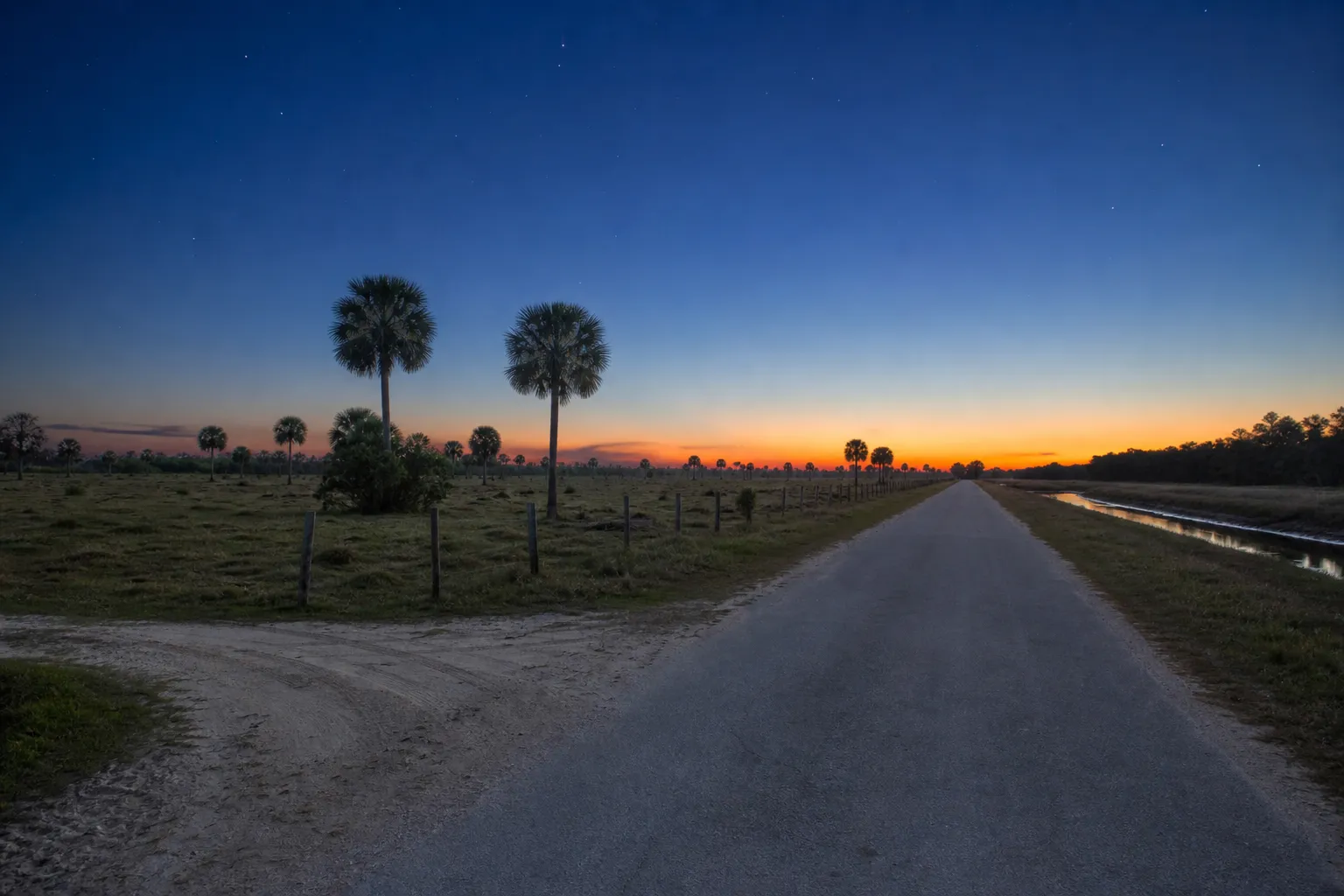
The practical translation: the rider you see on the shoulder of a Hendry County dirt road on a four-wheeler may well be inside the law. The same road, same speed, same dust, on a six-seat side-by-side is a different statute and a different answer.
The one exception, and exactly what it permits
Section 316.2123 is narrow on purpose. Every condition has to hold at once:
- The vehicle is an ATV as § 317.0003 defines it — 55 inches or less, 1,500 pounds or less dry.
- The road is unpaved.
- The road is posted at less than 35 miles per hour.
- It is daytime.
- The operator holds a valid driver license, or is a minor under the supervision of a licensed driver.
Miss any one of those and you are back under the general rule in § 316.2074, Fla. Stat. (2026), which states plainly that an all-terrain vehicle “may not be operated upon the public roads, streets, or highways of this state, except as otherwise permitted by the managing state or federal agency.” The carve-outs written into that section cover law enforcement on designated beaches and on public lands — not recreational riders. A violation is a noncriminal traffic infraction, punishable as a nonmoving violation under chapter 318.
There is one more wrinkle worth taking seriously. Section 316.2123 lets counties opt out of the exception or designate roads under their own ordinance, and we have not verified the current position of Lee, Collier, Hendry, or Charlotte county. Check your county before you ride a public dirt road, and treat any answer you got from a forum three years ago as expired.
Do “street-legal UTV kits” make a side-by-side legal here?
No. A kit sells you turn signals, mirrors, a horn, a windshield, and a DOT-ish set of lights. Florida’s road exception turns on the class of vehicle, defined by width and weight in chapter 317 — not on the equipment bolted to it. Adding a horn does not move a 65-inch machine under a 55-inch ceiling.
The related question people ask next is whether a side-by-side can be converted and registered as a low-speed vehicle. We could not confirm the mechanics of that path against a primary source, so this page does not tell you it works, and it does not tell you it doesn’t. If someone is selling you a conversion, ask them to put the statute and the FLHSMV registration path in writing before money changes hands.
What people get wrong
“Side-by-sides can use unpaved county roads like ATVs.” The most common error on the internet, and the one every competing page seems to make. The daytime, under-35-mph, unpaved-road exception is ATV-only.
“I bought it here, so it must be road legal somewhere.” Florida titles off-highway vehicles and stops there — no plate, no highway registration. Titling, fees, and the sales-tax math live on our Florida OHV title and registration guide.
“It’s private land, so nothing applies.” Different question, different statute, and the youth rules below still matter. Titling obligations and the public-lands rules are covered on the registration page.
“The trail crosses a paved road, so a quick hop is fine.” The exception says unpaved. There is no fifty-yard grace written into it.
Riders under 16
Two provisions stack. § 316.2074, Fla. Stat. (2026) requires that no person under 16 operate or ride an ATV without a helmet meeting United States Department of Transportation standards and eye protection. On public lands, § 261.20, Fla. Stat. (2026) adds over-the-ankle boots, adult supervision, and an OHV safety-course certificate in the rider’s possession.
Buy the helmet that fits the kid today rather than the one they will grow into. A loose helmet is a decoration.
What changed in 2025 and 2026
Nothing here. Florida’s 2025 and 2026 sessions were busy on the water — the Boater Freedom Act and Lucy’s Law both took effect July 1, 2025 — but the ATV road rule in § 316.2123 has not been amended since 2019, and chapter 317’s titling scheme is unchanged. If a page you are reading cites a 2025 “new UTV law” in Florida, it is describing something that did not happen.
Where to ride a side-by-side legally instead
This is the part that makes the answer livable. Within a few hours of Bonita Springs there are real, legal places to run a machine that has no business on a county road: the ORV trails inside Big Cypress National Preserve, the mud weekends at Redneck Mud Park in Punta Gorda, Croom’s 2,600 acres in the Withlacoochee State Forest, and the OHV systems in the Ocala National Forest. Each one has its own permit, hours, and rules, and we have laid them out with sources on where to ride an ATV or UTV in Southwest Florida and in the Big Cypress ORV permit walkthrough.
The crew’s take
The road question is usually the wrong question. People ask it because they want to move a machine two miles between a house and a lease without loading it, and the honest answer is that Florida did not build a legal path for that on a side-by-side. What it did build is a titling system that is cheap and quick, a handful of genuinely good public riding areas, and no patience at all for the guy running a 65-inch machine down a paved shoulder at dusk.
If the two-mile hop is the actual use case, buy the trailer. If width is what is keeping you out of the exception, look hard at a utility quad instead of a side-by-side — that trade-off is the whole subject of our ATV versus UTV buyer’s guide. And if you are not sure which class your machine falls into, bring the title to the Trailhead side of the showroom on the Tamiami Trail in Bonita Springs and we will read the width off the spec sheet with you.
Laws current as of September 2026; verify with FWC/FLHSMV before you ride or launch. General information, not legal advice.
Live inventory, widths, and today's price.
Quick answers
- Can you drive a UTV on the road in Florida?
- No. Florida's only off-highway road exception, § 316.2123, is written for all-terrain vehicles — 55 inches or less in width and 1,500 pounds or less dry. A side-by-side is a recreational off-highway vehicle under § 317.0003 and is not covered, so public roads are off-limits.
- Can you ride an ATV on dirt roads in Florida?
- Sometimes. Section 316.2123 permits ATV operation during daylight on an unpaved road posted under 35 mph, by a licensed driver or a supervised minor. Counties may opt out or designate their own roads, so confirm your county's position before you ride.
- Do street-legal UTV kits work in Florida?
- Adding turn signals, mirrors, a horn, and a windshield does not change what the statute covers. Florida's road exception is defined by vehicle class, not by equipment, and off-highway vehicles are titled without highway registration under § 317.0006.
- What is the difference between an ATV and a ROV in Florida?
- Width and dry weight. Section 317.0003 defines an ATV as 55 inches or less wide and 1,500 pounds or less dry; a recreational off-highway vehicle is up to 80 inches wide and 3,500 pounds dry. Nearly every side-by-side sold today lands in the second bucket.
- Can a 15-year-old ride an ATV in Florida?
- Riders under 16 must wear a DOT-compliant helmet and eye protection under § 316.2074. On public lands, § 261.20 adds over-the-ankle boots, adult supervision, and an OHV safety-course certificate carried on the rider.