Ownership · The Trailhead
Setting Up a UTV or ATV for Florida: Mud, Sand, Water Crossings, and Heat
Four changes matter and the rest is decoration. Here is what Florida ground actually asks of a machine, in the order it asks for it.
By The Outpost CrewUpdated 9 min read
Honda at Power Lodge →Yamaha at Power Lodge →Kawasaki at Power Lodge →Can-Am at Power Lodge →CFMOTO at Power Lodge →
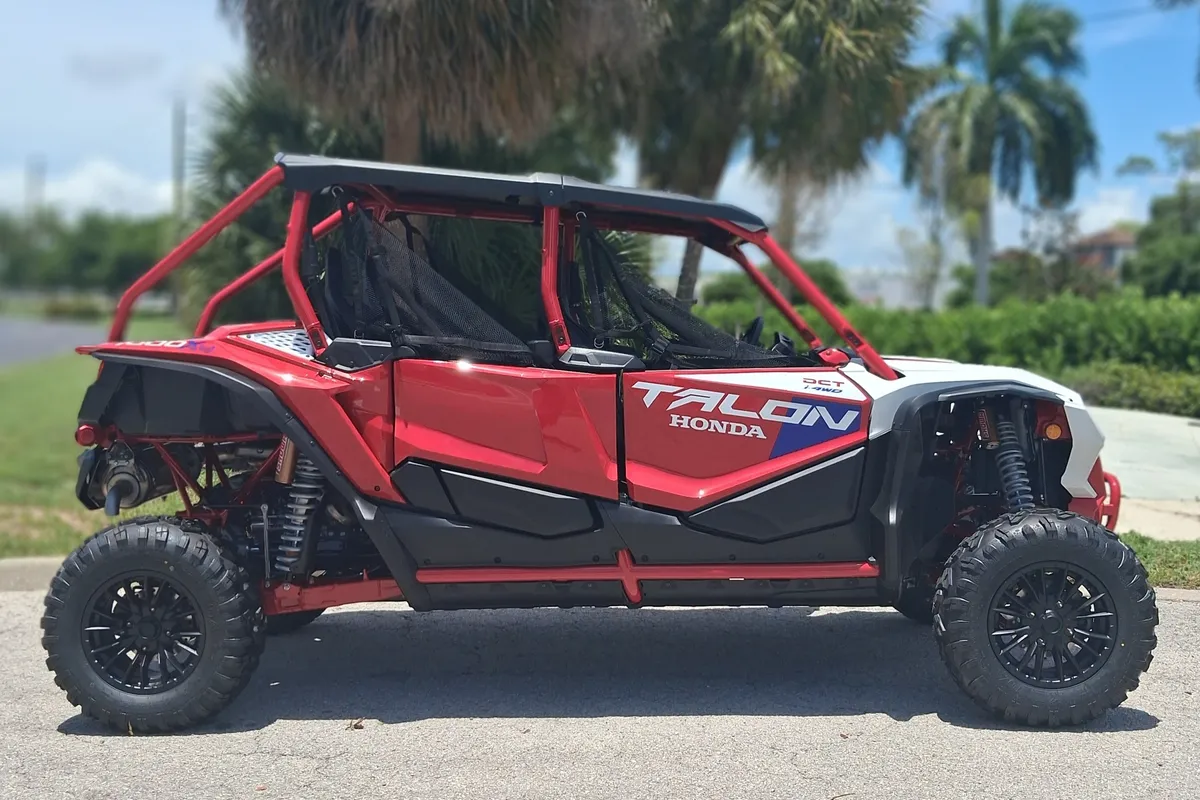
Four changes decide how a machine handles Southwest Florida, and everything else is decoration: tires, what the engine and the CVT breathe through, how you get unstuck, and what you do to the machine the same day you get home.
This page is product-agnostic. It does not matter whether you bought a Honda, a Yamaha, a Kawasaki, a Can-Am, or a CFMOTO — the ground here does the same things to all of them. Where a factory mud trim solves a problem particularly well, we use it as an engineering example, not a recommendation.
One framing note before the list. Florida is not a mud state or a sand state; it is both, in the same afternoon, at 95 degrees. That combination is what makes setup here different from setup anywhere with hills.
1. Tires: the change that matters most
Nothing you bolt to a machine changes it more, and nothing gets chosen worse.
All-terrain is the right answer for most people and it is what almost everything ships with — 24 to 27 inches on utility machines, 30 inches on the big ones. A 6-ply AT tire handles sugar sand, wet grass, and graded lease road without punishing you on the ride home. If your riding is chores and trails, buy better all-terrains, not specialist tires.
Mud tires are tall, with deep, widely spaced lugs designed to sling out what packs into them. They work spectacularly in a hole and they are noisy, heavy, quick-wearing, and vague on hardpack. Can-Am’s factory mud builds run 30-inch XPS Swamp Kings on the Defender X MR and the Maverick X3 X MR, and 30-inch ITP Cryptids on the Renegade X MR — that is the shape of a real mud tire.
Paddles are for sand and nothing else, and they are a trailer-only proposition: a paddle tire on hardpack is useless and disposable.
Three things to understand before you go bigger:
- A taller, heavier tire is a load on the driveline. On a CVT machine it makes the clutches work harder and shortens belt life unless the clutching is changed to suit. On a geared machine it loads gears, shafts, and axles instead. Neither is free.
- Your speedometer will read low once the rolling diameter changes.
- Beadlock wheels exist for a reason. Low pressure is how a tire floats in sand and conforms in mud, and low pressure is also how a tire unseats from the rim. Beadlocks clamp it. The Renegade X MR’s 14-inch beadlocks are the factory acknowledging exactly this.
2. Snorkels and what the CVT breathes
The mistake here is thinking of a snorkel as one part. It is usually three.
The engine air intake is the obvious one, and raising it is the difference between a deep crossing and a hydrolocked engine. But almost every machine except the geared Hondas also has a CVT housing that breathes — an intake to pull cooling air across the belt, and an outlet to push hot air back out. Water finds both. A machine with a raised engine snorkel and a stock CVT intake will happily drown its own belt while the engine keeps running.
That is why factory mud trims relocate all of it. Can-Am’s Renegade X MR lists a snorkeled engine plus a relocated CVT intake and outlet; the Defender MAX X MR HD11 raises the CVT intakes and the exhaust; the Maverick X3 X MR snorkels the engine and the CVT together. Read any bolt-on kit against that list, and ask what it does to your factory coverage before you cut anything — a factory mud trim keeps that hardware inside the warranty, which is a real part of what the trim costs.
Then there is the third breathing point almost nobody addresses: the differential and gearcase vents. More on those below.
3. Radiator, cooling, and the Florida duty cycle
Heat here is not a hill-climbing problem, it is a low-speed problem. The worst thing you can do to a machine in this state is work it hard at walking pace with a load and no airflow — which is precisely what a grove road, a food plot, or a mud line asks for.
Two practical consequences.
Keep the radiator open. A front-mounted radiator packs with mud and grass and then cools nothing. Clean the fins while the mud is still soft — a hose-end sprayer does it in minutes; baked-on clay takes an afternoon. Machines built for deep mud raise the radiator or move it; if yours has not, a fine-mesh screen keeps the worst of the vegetation out and needs cleaning more often than you would like.
Give the CVT air. The clutch housing dumps a lot of heat, and its inlet and outlet have to stay clear. If you have been sitting in low range at 5 mph pulling a drag for an hour, the belt is the hottest thing on the machine, and it is worth a few minutes at a normal speed with the housing breathing before you shut it down.
4. Winch, recovery, and getting home
Assume you will be pulled out, and that you will pull somebody out.
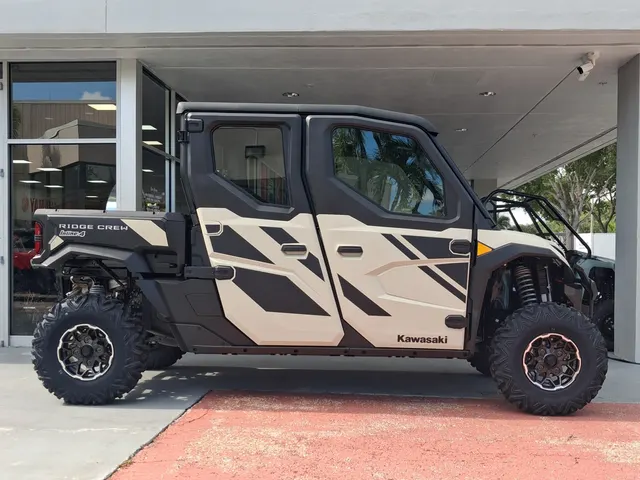
Rating. Factory winches on our floor run from 3,500 pounds on a CFMOTO CFORCE 600 and a Can-Am Renegade X MR to 4,500 pounds on the UFORCE 800 XL, the RIDGE CREW, and the Defender Limited and X MR. Those machines weigh from roughly 750 to 2,600 pounds. That headroom is not marketing — a machine buried to the floorboards in suction mud pulls far harder than its own weight, and a winch working at the top of its rating heats up and slows down.
Line. Synthetic rope is lighter, easier to handle wet, and stores much less energy if it lets go. Steel cable resists abrasion and heat better. Most factory winches now ship with synthetic, and most owners are glad of it.
Mounting height. This is the part people miss. A winch mounted low is a winch underwater, and a submerged winch motor is a warranty conversation. The Defender X MR’s high-mounted winch is Can-Am solving that problem at the factory; if yours is low, know where the drain is and expect to service it after deep water.
And carry the rest of it: a strap, a shackle, gloves, and tow points you can find by feel under six inches of muck. A winch alone recovers nothing if there is no tree.
5. Belt care after water
If your machine has a CVT — and everything on our floor except the geared Hondas and the Maverick R’s dual-clutch does — this is the maintenance habit that saves the most money.
Find the CVT drain plug on your machine, and find it now, at the parts counter, not at dusk in a field. After any crossing deep enough to reach the housing, drain it. Then run the machine, in a gear and at a speed that keeps air moving, to dry the belt and the sheave faces.
Why it matters: a wet belt glazes. A glazed belt slips. A slipping belt under load gets hot enough to fail in minutes and takes the sheave surfaces with it if you keep going. The whole mechanism, and the honest case for and against belts, is on CVT belt versus gear drive, explained.
Carry a spare belt and the tools to fit it if you ride anywhere you would not want to walk out of. Ask the parts counter for the correct belt for your exact machine and model year — this is not a part to guess at.
6. Driveline and hub service after brackish crossings
This is the section that separates machines that last from machines that do not, and it is invisible until it is expensive.
Breather vents. Differentials, gearcases, and transmissions vent to atmosphere through small hoses or caps. Drive a hot gearcase into cold water and the air inside contracts and pulls water in through that vent. Extending the breathers up high is a standard mud-build step for exactly this reason. If you do deep water on a stock machine, check the gear oil after: milky, coffee-colored oil means water got in, and the fix is a fluid change now rather than a bearing later.
CV boots and axles. A torn boot in a grit-and-water environment destroys a joint quickly. Look at all four every time you wash the machine; a split boot found on a Sunday is a boot, and a split boot found in November is an axle.
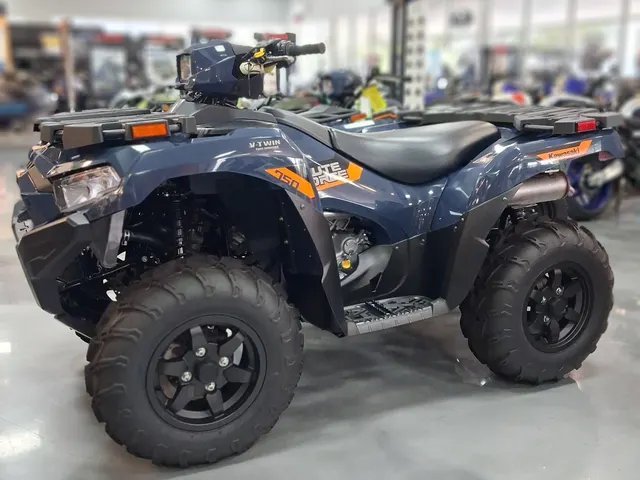
Bearings and brakes. Wet mud plus sand works like lapping compound. Rinse wheels, calipers, and hubs thoroughly the same day; a wheel bearing that has started to growl is already finished. Some machines help here — Kawasaki’s Brute Force 750 lists a sealed rear brake, which is exactly the sort of specification worth looking for if you ride wet.
Salt. Brackish water counts as saltwater for corrosion purposes, and Southwest Florida has a great deal of brackish water. Rinse fasteners, electrical connectors, and the underside, then dry it — salt left damp does more harm than salt rinsed off late.
7. Storage, sun, and where this all gets used
Florida UV is patient and it always wins eventually. Seats, plastics, graphics, and rubber age faster in the open than under a roof, and a cover costs less than a seat. Between rides, grease what the manual lists, set tire pressures against the placard rather than against how they look, and keep the battery maintained if the machine sits between seasons. Come June, a winch-equipped machine with a bed is one of the most useful things on a property the week after a storm — the rest of that kit is on our hurricane prep guide.
If the destination is a mud park, read the Redneck Mud Park guide before you tow — the gate rules catch people out more often than the machines do. For trails rather than holes, the where to ride roundup and the Big Cypress ORV permit guide cover the legal options. And if you are still deciding what to buy, start with best UTVs under $15,000, where every MSRP is labeled by model year.
When to call the service department
Some of this is a Saturday morning with a hose. Some of it is not.
Bring the machine in if the gear oil in any case looks milky, if the belt smells burnt or the machine has lost top speed, if a CV boot is split, if a wheel bearing growls or a wheel has play, if the winch motor has been submerged, or if the engine ingested water — that last one is a stop-riding-now situation, not a next-weekend one. Also bring it in before a big trip if you want the mud hardware checked over by somebody who has seen what the parks do to machines.
Our parts counter can pull the correct belt, filters, and gear oil for your exact machine and model year, which is a better use of an afternoon than guessing from a forum post.
Or call Power Lodge Florida — (239) 799-2229
Quick answers
- What tires should I run on a UTV in Florida?
- For mixed use, a 6-ply all-terrain tire is the right answer and it is what most machines ship with. Add a dedicated mud tire only if you actually ride deep holes, and add paddles only for pure sand — both are specialist tires that wear quickly and behave poorly on hardpack.
- Do I need a snorkel on my side-by-side?
- Only if you cross water deep enough to reach the airbox. If you do, remember the CVT housing breathes too: raising the engine intake without raising the CVT intake and outlet leaves the belt exposed. Factory mud trims relocate all three, which is what you are paying for.
- How do I take care of a CVT belt after a water crossing?
- Find out whether your machine has a CVT drain plug and where it is, before you need it. After any submersion, drain the housing, then run the machine to dry the belt and sheaves. A belt that has been wet and then loaded will glaze and slip, and a slipping belt fails fast.
- What size winch do I need for a UTV?
- More than the machine weighs. Factory winches on our floor run 3,500 to 4,500 pounds on machines weighing 750 to 2,600, and that headroom is deliberate: suction mud pulls far harder than a vehicle's own weight. Mounting height matters as much as rating in deep water.
- Does saltwater damage an ATV?
- Yes, and brackish water counts. Salt attacks fasteners, bearings, brake hardware and electrical connections, and it gets into differentials through the breather vents when hot gearcases hit cold water. Rinse the same day, and check gear oil for a milky look after any deep crossing.