Review · The Stable
Kawasaki KLX230 Review: The Dual-Sport That Fits Florida (S, Sherpa, and R Explained)
Four bikes share the name and only two of them can ever wear a plate. Sorting that out is most of the buying decision.
By The Outpost CrewUpdated 8 min read
How this review was built: from Kawasaki's published specs, professional road tests, owner reports, and what the Power Lodge crew sees on the showroom floor and in the service bay — not a first-hand test ride. Prices are MSRP unless the live listing below says otherwise.How we review →
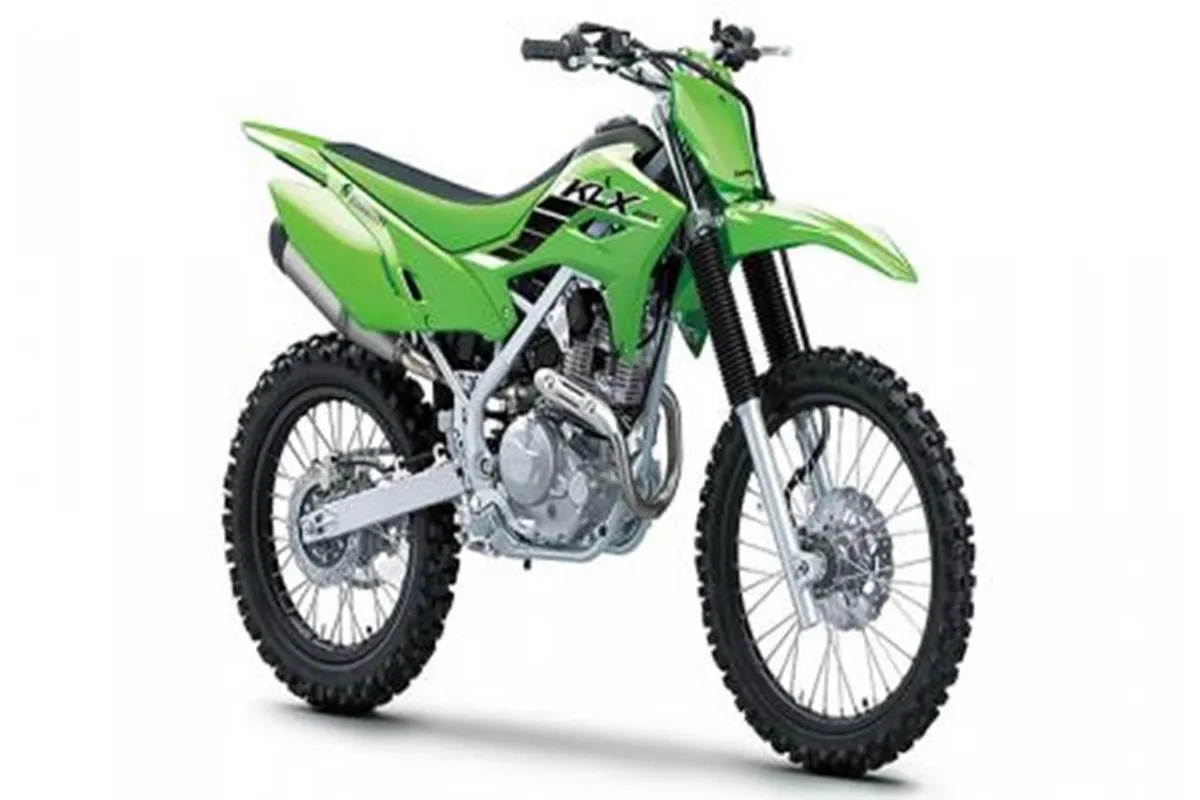
The Kawasaki KLX230 is the cheapest honest way to own a motorcycle that works on pavement and dirt in the same afternoon. It is a 233cc air-cooled single making a published 17 horsepower, in a bike that weighs under 300 pounds and costs about a third of what an adventure bike costs.
The complication is that four different machines on the Power Lodge floor carry KLX230 in the name, and two of them cannot legally be ridden on a road. Getting that right before you sign anything is the whole review.
Who it is for: a rider who wants one bike for surface streets and unpaved ground, or a new rider who wants something forgiving with ABS. Who it is not for: anyone who rides I-75 regularly, and any experienced dirt rider expecting real off-road performance from a 291-pound air-cooled single.
What the Kawasaki KLX230 is, and the four bikes wearing the name
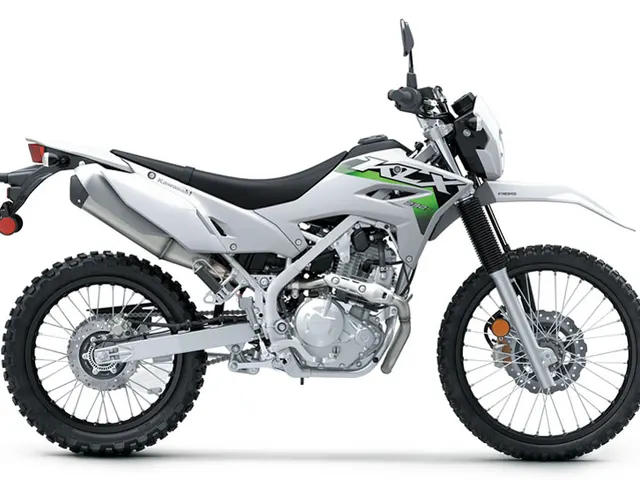
The platform is a 233cc air-cooled SOHC single with digital fuel injection through a 32-millimeter throttle body, a six-speed gearbox, and a steel frame. Kawasaki splits it four ways.
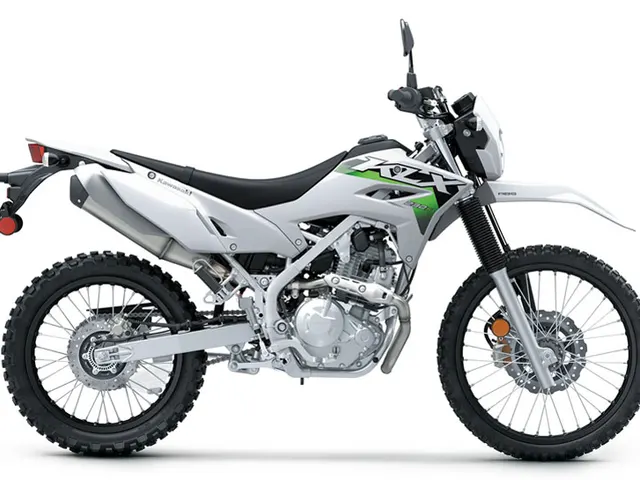
KLX230 S ABS is the street-legal dual-sport in its lowered form: 33.3-inch seat, 291.1 pounds curb, ABS, LED headlight, smartphone connectivity, plate and lights. Two of them are here.
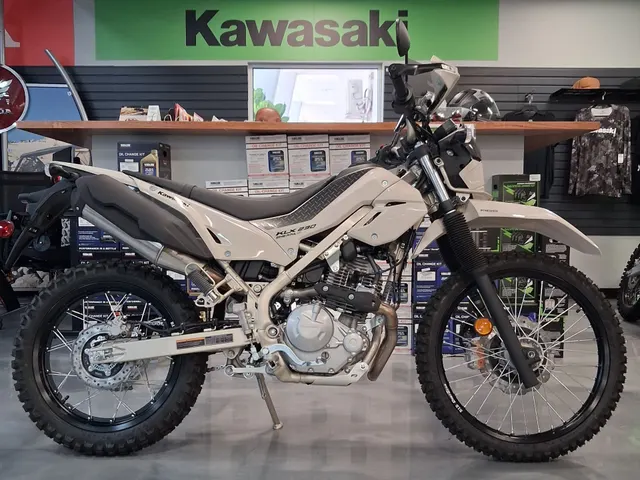
KLX230 Sherpa S ABS is the same street-legal bike with the touring-and-trail package — skid plate, hand guards, tapered bar, dual-LED headlight with a guard bar, spoke wheels with a tubeless rear tire, a bigger 265-millimeter front disc, and ABS you can switch off at the handlebar. It also sits lower still at 32.5 inches. One is here.
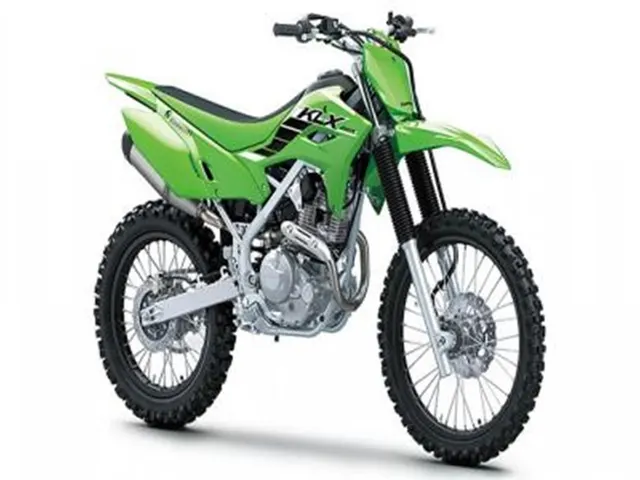
KLX230R S is the off-road-only version, lowered: 34.4-inch seat, 262.4 pounds, no lights, no plate, no ABS, and considerably more suspension for it. One is here.
KLX230R is that same off-road machine in standard, non-lowered form — taller in the seat than the R S. One is here. We have not quoted a seat height for it because we could not read one off Kawasaki’s own page, and it is the number you would want before buying, so ask for the sheet on the unit.
| Spec | KLX230 S ABS | Sherpa S ABS | KLX230R S |
|---|---|---|---|
| Engine | 233cc air-cooled SOHC single, DFI | 233cc air-cooled SOHC single, DFI | 233cc air-cooled SOHC single, DFI |
| Horsepower (Kawasaki published) | 17 hp @ 8,000 rpm | 17 hp @ 8,000 rpm | Not published for the R models |
| Torque (Kawasaki published) | 13.0 lb-ft @ 6,400 rpm | 13.3 lb-ft @ 6,400 rpm | Not published for the R models |
| Transmission | Six-speed | Six-speed, sealed chain | Six-speed, wet multi-disc clutch |
| Road legal | Yes — dual-sport | Yes — dual-sport | No — off-road only |
| Seat height | 33.3 in | 32.5 in | 34.4 in |
| Ground clearance | 9.4 in | 8.5 in | 10.6 in |
| Wheelbase | 53.7 in | 53.3 in | 53.3 in |
| Curb weight | 291.1 lb | 299.9 lb (284.3 lb dry) | 262.4 lb |
| Fuel capacity | 2.0 gal | 2.0 gal | 2.0 gal |
| Wheels | 21 in / 18 in aluminum | 21 in / 18 in spoke, tubeless rear | 21 in / 18 in aluminum |
| Brakes | 240 mm front and 220 mm rear petal discs, ABS | 265 mm front and 220 mm rear petal discs, selectable ABS | 240 mm front and 220 mm rear petal discs, no ABS |
| Listed price, September 2026 | $5,199–$5,499 (MSRP $5,499, MY26) | $5,899 (MSRP $5,899, MY26) | $3,999 (MSRP $4,999, MY25) |
Source: powerlodgefl.com. Specs and pricing are the manufacturer's published figures and can change by model year.
Specifications come from Kawasaki’s own sheets as published on each unit’s Power Lodge listing, read September 3, 2026.
Engine and performance: 17 horsepower, honestly
Seventeen horsepower is not a lot, and Kawasaki has never pretended otherwise. What matters is where the 13 lb-ft lands — at 6,400 rpm, in the middle of a rev range a beginner actually uses.
The practical result is a motorcycle that does exactly what you ask and nothing you did not. Roll the throttle open in second on a sand road and the rear tire finds grip instead of spinning. Grab a handful in third by mistake at a stoplight and nothing dramatic happens. Air cooling and fuel injection between them mean there is very little to go wrong and very little to maintain.
The ceiling is real, though, and worth stating plainly. This is a 45-to-55-mph motorcycle that will hold a posted 55 on Bonita Beach Road without complaint and does not belong on I-75 or Alligator Alley. If your commute includes a limited-access highway, this is the wrong bike and the Kawasaki KLE500 is the conversation to have instead.
Street legal or off-road only: the difference that decides everything
This is where buyers get caught, so here it is directly.
The KLX230 S and Sherpa S are motorcycles in the ordinary Florida sense. They get a highway title, a license plate, an annual registration, and they require a motorcycle endorsement on your license. You can ride one out of the dealership.
The KLX230R and KLX230R S are off-highway vehicles. Florida requires them to be titled under chapter 317 — “must be titled pursuant to this chapter,” per § 317.0006, Fla. Stat. (2026) — and chapter 317 defines an off-highway vehicle as one “not registered and licensed for highway use.” You get a title document and no plate. You cannot ride it on a public road, and there is no conversion kit that changes the legal answer. Our OHV title and registration guide covers the counter work.
The $1,200 to $1,900 that separates an R from an S is, in practical terms, the price of a plate. Whether that is worth it comes down to one question: do you have somewhere to ride that you do not have to drive to?
Where a small dual-sport shines in Southwest Florida
For most people here, the answer to that question is no — and that is the argument for the plated bikes.
Lee and Collier counties have no public OHV trail system. An off-road-only machine means a trailer, a destination, and a plan. A plated KLX230 means you ride out of your garage, take surface streets to whatever unpaved ground you have permission to use, and ride home. On a 291-pound bike with a 21-inch front wheel, the graded shoulders, grove roads, and canal-side tracks that surround Bonita Springs and Estero stop being obstacles and start being the route.
The 2.0-gallon tank is small but the engine is frugal enough that it is not the constraint people expect on a day out. What is a constraint is heat: an air-cooled single has no radiator and no fan, so it depends on airflow. Sitting in stopped traffic on US-41 in August is the one situation this bike genuinely dislikes, and the answer is route choice rather than hardware.
Then there is the wet season. From June through September the storms arrive most afternoons, and ABS on a light bike with knobby-ish tires is worth more here than any other feature on the sheet. The Sherpa’s switchable ABS is the better arrangement of the two — on in the rain, off in deep sand where a locked front wheel is sometimes what you want.
What reviewers and owners say
The KLX230 has a settled reputation and it has not moved much since the platform launched.
The praise is consistent on approachability. RideApart’s coverage of the model has positioned it as a gateway into dirt for riders who do not want a race bike, and that framing matches what owners report: it is easy, cheap to keep, and hard to intimidate yourself on.
The complaints are consistent too, and they are the same complaint twice. Suspension is soft for a fast rider, and the power is modest. Both are what you buy when you buy a $5,500 air-cooled dual-sport, and neither surprises anyone who reads the spec sheet first.
Where owner opinion splits is on the R models. Riders who have somewhere to ride love the 262-pound weight and the extra ground clearance. Riders who bought one and then discovered Southwest Florida’s shortage of legal dirt regret it, which is a geography problem rather than a motorcycle problem.
Living with a KLX230 in Southwest Florida
Three things specific to this machine.
No coolant is a real advantage. There is no radiator to bend, no hose to split, and no water pump seal to weep. On a bike that will get dropped in soft sand at low speed, the absence of a cooling system is one fewer expensive thing to break.
Tubes versus tubeless is the ownership difference between the two street trims. The KLX230 S runs aluminum rims; the Sherpa S runs spoke wheels with a tubeless rear tire. A tubeless rear can be plugged at the roadside in ten minutes. A tube requires the wheel off and the tire broken down. If you ride alone on unpaved ground, that difference is worth more than the skid plate.
Salt reaches further than people expect. A plated bike parked within a few miles of the Gulf ages faster than its mileage says. Rinse after coastal rides, lube the chain ahead of the book interval, and hold to Kawasaki’s service schedule — small does not mean exempt.
Recalls and known issues
For the 2025 and 2026 KLX230 models on our floor, none found in the NHTSA database as of September 2026.
There is one campaign on the record for the model family: a front-brake recall affecting 2022 KLX230 units. It does not reach the model years here, but it is exactly the reason to check a used one. Run the VIN from the steering head at nhtsa.gov/recalls before money changes hands, and note that an off-road-only R model still carries a VIN and can still be searched.
Price and what is on the floor
As of September 2026 the floor holds two 2026 KLX230 S ABS units listed at $5,199 and $5,499 against a $5,499 MSRP, one 2026 KLX230 Sherpa S ABS listed at $5,899 at its MSRP, and two 2025 KLX230R models — the standard R and the R S — each listed at $3,999 against a $4,999 MSRP. Freight, prep, tax, and title work are additional.
The $1,000 off MSRP on the 2025 R models is model-year clearance, not a permanent price. If you have land, that is the cheapest way into a fuel-injected, electric-start, six-speed 233 on this floor.
How the KLX230 compares
Kawasaki KLX300 is the next rung and it is here at $5,649: 292cc, liquid-cooled, and a 35.2-inch seat. More capable and noticeably taller, which for a lot of Florida riders is the deciding factor rather than the power.
Kawasaki KLE500 is the answer if any part of your riding is highway. It is a 451cc twin with a published 51 horsepower and a 34.3-inch seat, listed from $6,599, and it does the road half of dual-sport properly at the cost of the dirt half.
Yamaha TT-R230 at $4,699 is the off-road comparison against the R models: a 223cc air-cooled single with a 34.3-inch seat and 251 pounds wet. Lighter than the KLX230R S, and carbureted where the Kawasaki is fuel-injected.
Honda CRF300L Rally ABS at $6,499 is the touring-flavored alternative among plated small dual-sports, with more bodywork, more seat height, and more money.
Highs
- Air-cooled and fuel-injected — very little to maintain and no cooling system to damage
- Under 300 lb with ABS makes it one of the easiest street-legal bikes to learn on
- Four trims cover 32.5 to 34.4 inches of seat height on one platform
- Sherpa S adds a tubeless rear tire and ABS you can switch off for sand
- The 2025 R models are listed $1,000 under MSRP
Lows
- 17 published horsepower is not enough for I-75 or Alligator Alley
- Soft suspension that fast riders will run out of quickly
- Air cooling dislikes stopped summer traffic
- 2.0-gallon tank limits a long day without planning
- The R models cannot legally use a public road in Florida, ever
Everything on this page comes from Kawasaki’s published specifications, professional coverage, owner reports, and what the crew sees on the floor and in the service bay. Our standard is on how we review. If you are choosing between this and a race-derived enduro, the trade-offs are in two-stroke versus four-stroke dirt bikes.
Bonita Springs — plated and off-road versions side by side, with today's price.
Quick answers
- What is the difference between the Kawasaki KLX230 S and the KLX230R?
- The S is a street-legal dual-sport with lights, mirrors, ABS, and a plate; the R is an off-road-only machine with none of those. In Florida the S gets a highway title, tag, and registration and needs a motorcycle endorsement. The R is titled under chapter 317 as an off-highway vehicle and gets no plate.
- How much horsepower does a Kawasaki KLX230 have?
- Kawasaki publishes 17 horsepower at 8,000 rpm and 13 lb-ft of torque at 6,400 rpm from the 233cc air-cooled single. That is modest by design — this is a beginner-friendly dual-sport, not a detuned race bike, and the low output is why it is so easy to ride slowly.
- What is the seat height of the Kawasaki KLX230 S?
- The 2026 KLX230 S ABS sits at 33.3 inches with 9.4 inches of ground clearance and a 291.1-pound curb weight. The Sherpa S trim is lower at 32.5 inches with 8.5 inches of clearance and 299.9 pounds. The off-road KLX230R S is taller again at 34.4 inches.
- What does the KLX230 Sherpa S add?
- An aluminum skid plate, hand guards, a tapered handlebar, a dual-LED headlight with a guard bar, spoke wheels with a tubeless rear tire, and selectable ABS you can switch off from the handlebar. It sits 0.8 inch lower than the KLX230 S and is listed $400 to $700 above the two S units.
- Is the Kawasaki KLX230 good for beginners?
- Yes, and it is one of the easiest street-legal motorcycles to learn on. Air-cooled simplicity, 17 published horsepower, ABS, a sub-300-pound curb weight, and forgiving suspension add up to a bike that does not punish mistakes. Riders who already ride fast will find it soft.