Review · The Stable
Kawasaki Z7 Hybrid Review: The First Strong-Hybrid Motorcycle, and Who Should Actually Buy It
Nobody else builds one. That is the reason to want it and the reason to think hard before you buy it.
By The Outpost CrewUpdated 7 min read
How this review was built: from Kawasaki's published specs, professional road tests, owner reports, and what the Power Lodge crew sees on the showroom floor and in the service bay — not a first-hand test ride. Prices are MSRP unless the live listing below says otherwise.How we review →
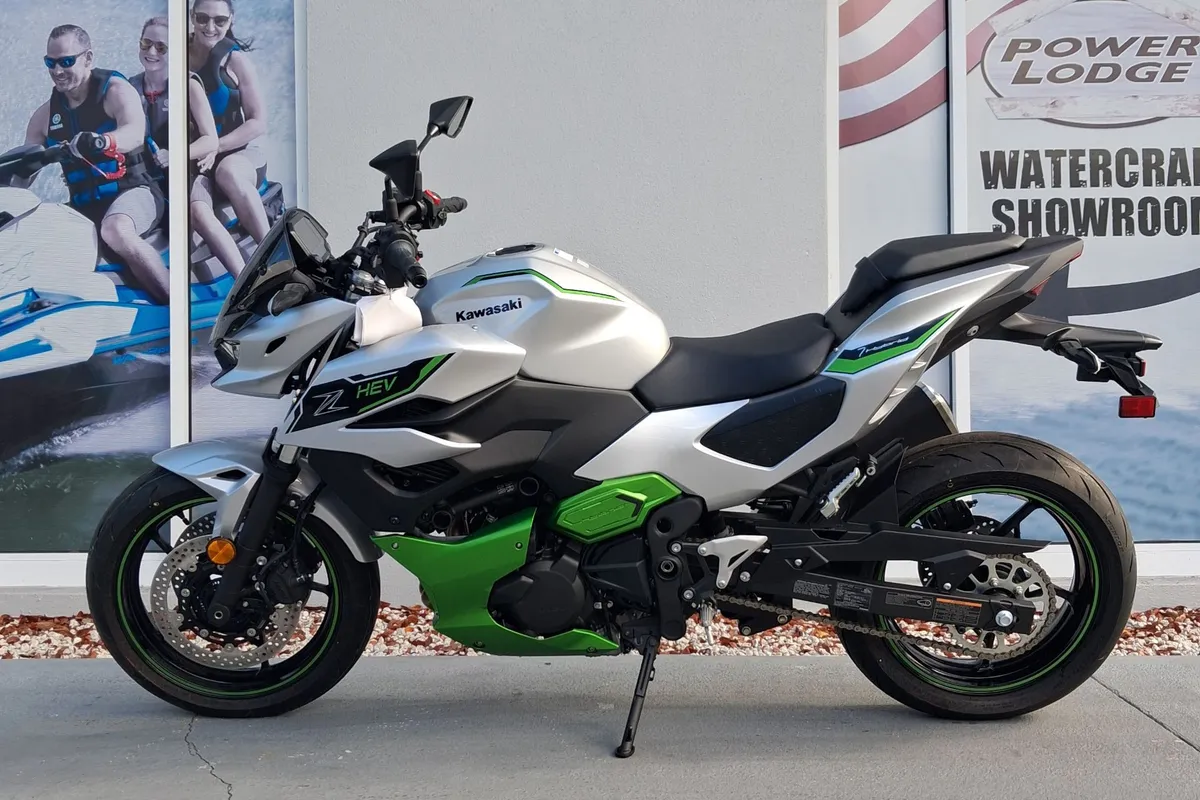
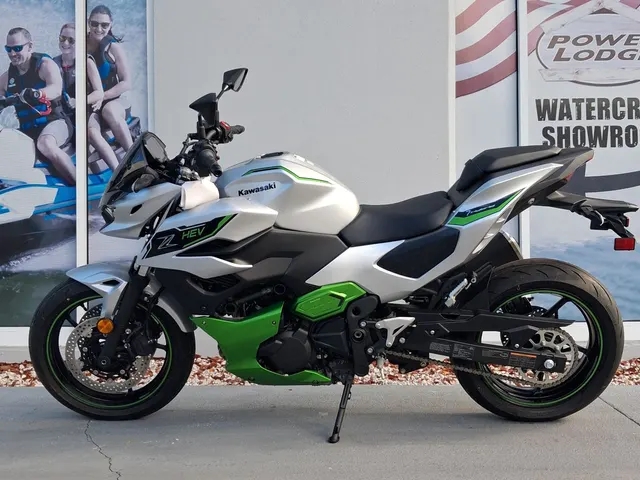
The 2024 Kawasaki Z7 Hybrid is a 451cc parallel twin bolted to an electric traction motor, feeding a six-speed gearbox that shifts itself. It will crawl on battery alone, it will combine both power sources for a short shove when you ask, and it is the only mass-produced strong hybrid motorcycle you can walk in and buy.
Who it is for: an early adopter who commutes, who wants something nobody else in the lot has, and who is genuinely interested in the machine rather than shopping for an automatic. Who it is not for: anyone buying on weight, on value, or on the assumption that a hybrid must be the frugal choice.
The one thing to know before anything else: this model year carries two open NHTSA recall campaigns, and the remedy on one of them is replacement of the motorcycle. That is not a reason to walk away, but it is a reason to make the VIN check the first conversation rather than the last.
What the Kawasaki Z7 Hybrid is
Kawasaki launched the Z7 Hybrid and its faired sibling as a genuine engineering statement rather than a compliance exercise. Hybrid cars are ordinary. Hybrid motorcycles are, for now, this and nothing else.
The layout is a parallel hybrid: the combustion engine and a 48-volt electric motor both drive the transmission. Kawasaki gives you an EV mode for silent low-speed running and two hybrid modes — ECO-HYBRID and SPORT-HYBRID — with an e-boost function on top. The gearbox has no clutch lever — you shift by button, automatically or with paddles, and the bike cannot stall.
It sits in Kawasaki’s Z naked line, sharing its 451cc twin with the Ninja 500 and the Eliminator. What it does not share with them is mass. Where the Ninja 500 is a 377-pound motorcycle, this is a 498.3-pound one, and that difference is the entire ownership story.
| Engine | 451cc liquid-cooled parallel twin, four-stroke |
|---|---|
| Electric drive | 48-volt traction motor, parallel hybrid layout |
| Torque (Kawasaki published) | 44.2 lb-ft @ 2,800 rpm |
| Transmission | Six-speed, automated push-button shifting with manual paddle mode |
| Clutch lever | None |
| Drive modes | SPORT-HYBRID, ECO-HYBRID, and EV; e-boost function |
| Seat height | 31.3 in |
| Curb weight | 498.3 lb, including battery |
| Fuel capacity | 3.7 gal |
| Brakes | Front and rear disc, ABS standard |
| MSRP, 2024 model year | $12,499 |
Source: kawasaki.com. Specs and pricing are the manufacturer's published figures and can change by model year.
Engine and performance: what a hybrid does on a motorcycle
The number Kawasaki publishes for this machine is torque, and it is the interesting one: 44.2 lb-ft at 2,800 rpm. A 451cc twin on its own does not make that, and it certainly does not make it at 2,800 rpm. The electric motor fills the bottom of the rev range where a small twin is normally waiting to catch up.
What that buys in practice is city acceleration out of proportion to the displacement on the side panel. From a light, the motor is already pulling before the engine has anything to contribute, and the automated gearbox is not asking you to do anything about it.
The e-boost function stacks both sources for a short burst — a passing move, a merge onto the Alley. It is a finite resource rather than a mode you live in, which is the honest way to describe it.
We are not going to quote a combined horsepower figure. Numbers in the high sixties circulate in press coverage of this bike, and we could not confirm any of them against a primary Kawasaki page. The torque figure is published; the horsepower figure is not, and a review that pretends otherwise is not worth reading.
Kawasaki has kept working on it since launch. RideApart reported in 2026 that the drive-mode logic was reworked in the ECU, with Sport Mode now available alongside the automatic setting — a meaningful change, because the original pairing of modes was one of the first things testers pushed back on.
On the road
Two things dominate the riding experience, and they pull in opposite directions.
The first is the quiet. Pulling out of a driveway at 6 a.m. under electric power only, with no exhaust noise, is a genuinely novel thing to do on a motorcycle and it does not get old quickly. In a Bonita Springs neighborhood with houses forty feet apart, it is also a courtesy that costs you nothing.
The second is the weight. At 498.3 pounds, the Z7 Hybrid outweighs the 1,099cc Z1100 SE that Kawasaki lists at 487.3 pounds, and it carries that mass in a chassis sized like a middleweight naked. Moving, it disguises it well — the low-rpm torque hides a lot. At walking pace, backing out of a parking space at Coconut Point, it does not. Sit on it, then push it around the lot, then decide.
The 31.3-inch seat is friendly, and the automated gearbox removes both the clutch and the stall from stop-and-go, which is exactly the environment this bike was designed around.
What reviewers and owners say
The press position is less about how it rides than about what it is. RideApart put the significance plainly in its 2026 coverage of the platform:
still stand alone as the only mainstream, mass-produced strong hybrid motorcycles
That is the review, more or less. There is no comparison test to run because there is no rival, and the coverage that exists tends to grade the Z7 Hybrid against the idea of itself rather than against other motorcycles.
The consistent criticisms across that coverage are the weight, the price the machine launched at, and the complexity of a drivetrain that no independent shop in Florida has much experience with. The consistent praise is the low-speed shove, the EV mode, and the fact that Kawasaki has kept updating the software rather than shipping it and moving on.
Owner reporting is thin, because there are not many of these. Treat forum consensus on this model with more caution than you would on a Ninja 650 — the sample size is small enough that one loud owner shapes the whole picture.
Living with a Z7 Hybrid in Southwest Florida
Traffic is where it makes sense. Season on US-41 is a signal-to-signal crawl from November through April, and a bike that shifts itself, cannot stall, and makes its torque at 2,800 rpm is well matched to that. This is the environment the machine was built for.
Heat is the open question. A hybrid drivetrain adds a battery and power electronics to a bike that is already carrying a liquid-cooled twin between your knees in August. Kawasaki’s thermal management is the manufacturer’s problem, not yours, but if you are the kind of owner who wants to understand a machine before committing, ask the service department what they have seen. Our heat and rain playbook covers the rider side.
Service is a real consideration. This is not a bike to buy from three counties away and hope. The dealer network that sold it is the network equipped to diagnose it, and there is one of them at 28470 S Tamiami Trail.
Storms and storage. Hurricane season runs June 1 to November 30. A hybrid has a traction battery in addition to the starter battery, so ask specifically about long-term storage procedure before the first storm watch, not during it.
Recalls and known issues
This section matters more on this page than on any other bike in the building, so here it is in full. Both campaigns below apply to the 2024 model year — the model year of the unit on our floor.
NHTSA 24V680000 — ECU software. NHTSA’s summary states the ECU software may cause an unintended transmission shift to neutral during the first-to-second gear change, and that the resulting loss of drive power increases the risk of a crash. The remedy is a free ECM software reprogramming at a dealer.
NHTSA 24V833000 — steering. NHTSA’s summary states the head pipe-to-frame weld may crack, compromising handling and control. The remedy on this campaign is not a repair: Kawasaki will replace affected motorcycles, free of charge, and the campaign notice advises owners of affected units not to ride them until that happens.
None of that means the specific unit on the floor is affected or unremedied — campaigns cover VIN ranges, and machines get addressed before they ship. It does mean you should ask us to pull the campaign status for that VIN and show it to you, and then run it yourself at nhtsa.gov/recalls. Thirty seconds, and it is the only way to be certain about one machine rather than a model name.
Price and what is on the floor
The 2024 Kawasaki Z7 Hybrid ABS carried a $12,499 MSRP. One 2024 unit is listed at $7,959 on the Power Lodge floor as of September 2026. Freight, prep, tax, and tag are additional — ask for the out-the-door number.
There is exactly one, it is a prior model year, and there is no second one coming. If you want this machine, the timeline is not open-ended.
How it compares
Kawasaki Z e-1 ABS, listed at $6,449 against a $7,599 MSRP for the 2024 model year, is the full-electric answer: around 298 pounds, no gearbox at all, and a surface-street mission. It removes more than the Z7 does and asks you to plan around range.
Kawasaki Ninja 650 is the sane middleweight alternative if what attracted you was easy real-world torque. It is 67 published horsepower, about 425 pounds, and it costs less. Full details in our Ninja 650 review.
Honda’s DCT and E-Clutch bikes are the other route to no clutch lever, and they get there without a battery. The Rebel 1100 DCT is a full automatic; the E-Clutch bikes keep the foot shifter. Both are lighter than this.
There is no cross-brand rival to name, which is the unusual position this motorcycle occupies. The whole landscape is laid out in our automatic motorcycles guide.
Highs
- The only mass-produced strong hybrid motorcycle on sale
- 44.2 lb-ft at 2,800 rpm makes it genuinely quick in town
- Shifts itself, no clutch lever, cannot stall
- EV mode for silent low-speed running
- Kawasaki has kept improving the drive-mode software since launch
Lows
- 498.3 lb at the curb — heavy at walking pace
- Two 2024 recall campaigns, one remedied by vehicle replacement
- Kawasaki publishes torque but no combined horsepower figure
- Thin owner base and no independent service ecosystem
- A 3.7-gallon tank on a heavy machine
Everything here comes from Kawasaki’s published specifications, a direct query of the NHTSA recall database, professional coverage, and what the crew sees on the floor. Our standard is on how we review. Not licensed yet? Start with the Florida motorcycle endorsement guide — an automatic transmission does not change that requirement.
One 2024 unit. Live inventory and today's price.
Quick answers
- How does the Kawasaki Z7 Hybrid work?
- It is a parallel hybrid. A 451cc twin and an electric traction motor drive the same six-speed gearbox, which shifts itself by push-button with paddles for manual control. It will move on electricity alone at low speed, and an e-boost function combines both power sources for short bursts.
- Is the Kawasaki Z7 Hybrid an automatic motorcycle?
- Effectively yes. The six-speed gearbox shifts automatically at the push of a button and there is no clutch lever to work, with paddles available if you want to choose ratios. It is a different approach from Honda DCT, which uses two clutches and no electric motor.
- How much does the Kawasaki Z7 Hybrid weigh?
- Kawasaki publishes 498.3 pounds at the curb, including the battery. That is roughly 120 pounds more than a Ninja 500 built around the same 451cc twin, and it is the single most important number on the spec sheet.
- Does the Kawasaki Z7 Hybrid have any recalls?
- Yes — two campaigns cover the 2024 model year. NHTSA 24V680000 addresses ECU software that can shift the transmission to neutral unexpectedly, remedied by reprogramming. NHTSA 24V833000 covers a head pipe-to-frame weld that may crack; the remedy on that one is motorcycle replacement.
- How much is the Kawasaki Z7 Hybrid?
- The 2024 Z7 Hybrid ABS carried a $12,499 MSRP. One 2024 unit is listed at $7,959 on the Power Lodge floor as of September 2026, before freight, prep, tax, and tag. Ask for an out-the-door figure and for the recall status on that specific VIN.