Buyer's Guide · The Trailhead
Best Youth ATVs in 2026: Raptor 110, Grizzly 110, TRX90X, and KFX90 Compared for Florida Families
The right first quad is the one whose warning label matches your child's age and whose seat matches their legs. Everything else is preference.
By The Outpost CrewUpdated 9 min read
Yamaha at Power Lodge →Honda at Power Lodge →Kawasaki at Power Lodge →
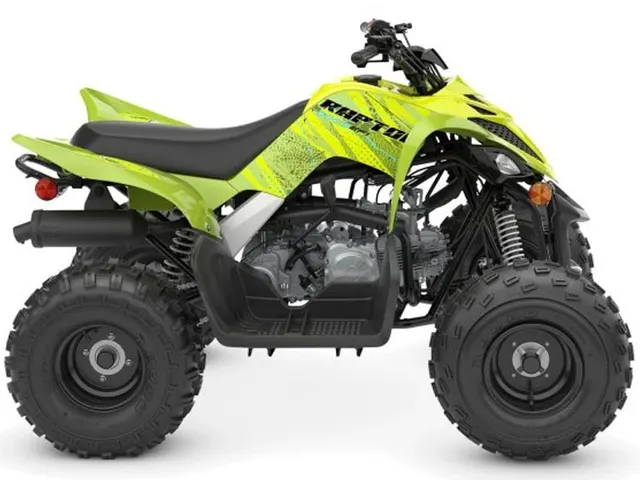
All four of these quads carry the same manufacturer age recommendation — 10 years and older — so the decision is fit, transmission, and parental controls, not power. The Kawasaki KFX90 has the lowest seat and the lowest listed price. The Honda TRX90X is the one that teaches a kid to select gears. The Yamaha Raptor 110 is the sport-styled one with reverse and electric start, and the Grizzly 110 is the same machine wearing utility bodywork for kids who will follow the family to a hunt camp.
That is the short version. The longer version matters more, because the most common mistake in this category is not buying the wrong brand — it is buying too much machine, three years early, for a kid who will grow into it.
Start with the label, not the price
The ATV Safety Institute (accessed September 2026) makes the point cleanly: “Every ATV made by our Members comes with a warning label, clearly stating the minimum age of the rider.” Its instruction to parents is three words long — “Find it. Know it. Enforce it.” Its other two rules are “Ride an ATV that’s right for your age” and “Supervise riders younger than 16; ATVs are not toys.”
The Consumer Product Safety Commission is blunter. Its ATV Safety Information Center (accessed September 2026) states that “riders younger than 16 should drive only age-appropriate youth models — never adult models,” under a heading that reads “Children Should Never Ride Adult ATVs.” In CPSC’s 2018–2020 data, “nearly 300 deaths were among children under the age of 16” in off-highway vehicle incidents.
The ATV Safety Institute publishes five ATV categories with separate youth and adult tiers, but it does not publish engine-size bands for those tiers on its public pages, and we are not going to invent them. The label on the machine is the authority. All four quads below are labeled 10 and up.
The four questions that actually decide it
Does it fit? Sitting on the machine, your child’s feet should reach the footrests with a bend in the knee, their hands should reach the bars and cover the brake lever without stretching, and they should be able to get a foot down flat when stopped. Seat height is the number that decides this, and it varies by nearly four inches across these four.
Automatic or geared? A CVT means throttle and brake and nothing else — one less thing to learn on day one. A semi-automatic gearbox means learning to select gears without a clutch, which is the skill that transfers to a dirt bike later.
Reverse, or not? It sounds trivial until a nine-year-old buries the front end in soft sand and cannot back out. Reverse is the difference between a lesson and a rescue.
How good are the parental controls? Every one of these has a throttle limiter. What differs is whether there is also a key you can take away.
| Spec | Raptor 110 | Grizzly 110 | TRX90X | KFX90 |
|---|---|---|---|---|
| Engine | 112cc air-cooled single, EFI | 112cc single, EFI | 86cc four-stroke OHV | 89.9cc four-stroke single |
| Transmission | Automatic CVT with reverse | Automatic CVT with reverse, gated shifter | Four-speed semi-automatic | Automatic CVT, adjustable speed collar |
| Seat height | 29.5 in | 28.7 in | 26.0 in | 25.6 in |
| Weight | 287.5 lb wet | 315 lb | 262 lb curb | 269 lb curb |
| Suspension travel, front and rear | 5.0 in and 5.7 in | 5.0 in and 5.7 in | 2.6 in and 2.6 in | 2.8 in and 2.9 in |
| Brakes | Drum | Drum | Dual 4.3-in front drums, 5.5-in rear drum | Dual front drums, rear hydraulic disc |
| Parental controls | Throttle limiter | Throttle limiter | Adjustable limiter | Throttle-limit screw plus keyed ignition |
| Minimum age (manufacturer) | 10+ | 10+ | 10+ | 10+ |
| Listed price, September 2026 | $3,599 (MSRP $3,599, MY26) | See today's price | $3,549 | $3,449 |
Figures come from each manufacturer’s published spec sheet: Yamaha’s pages for the Raptor 110 and Grizzly 110 — the Raptor’s reverse gear, which Yamaha’s page omits, is confirmed on its unit listing — and Honda’s and Kawasaki’s sheets on the TRX90X and KFX90 listings. Note the weight figures are not measured identically — Yamaha publishes wet weight for the Raptor 110, Honda and Kawasaki publish curb weight — so read the column as a rough ranking rather than a precise gap.
The four quads, one at a time
Yamaha Raptor 110
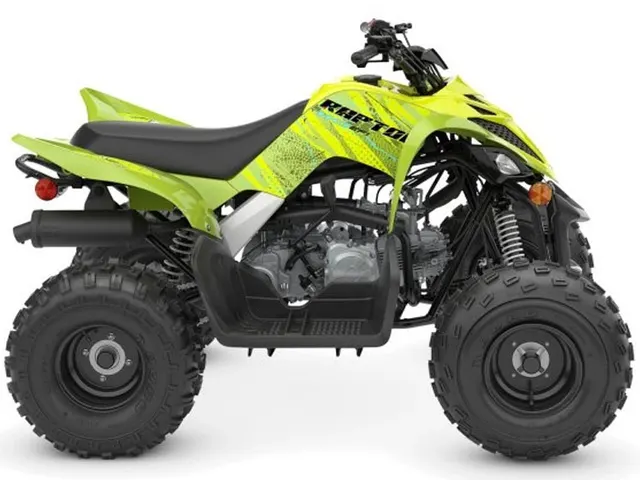
The sport-styled one, and the most machine of the four. A 112cc air-cooled single with fuel injection, an automatic transmission with reverse, electric start, and 5.0 inches of front travel with 5.7 at the rear — roughly double what the Honda and Kawasaki carry. Preload-adjustable shocks mean it can be set up for a light kid rather than merely tolerated by one.
The trade is the seat: at 29.5 inches it is the tallest here by nearly four inches over the KFX90, which puts it out of reach for a smaller ten-year-old and makes it the one an eleven- or twelve-year-old will not outgrow next season. Two of them are on the floor as 2026 units, listed at $3,599 against a $3,599 MSRP for that model year; Yamaha’s 2027 MSRP is $3,749.
Best for the kid who has already ridden something and wants suspension travel. Recalls: none found in the CPSC database as of September 2026 — run the VIN before you buy any used quad.
Yamaha Grizzly 110
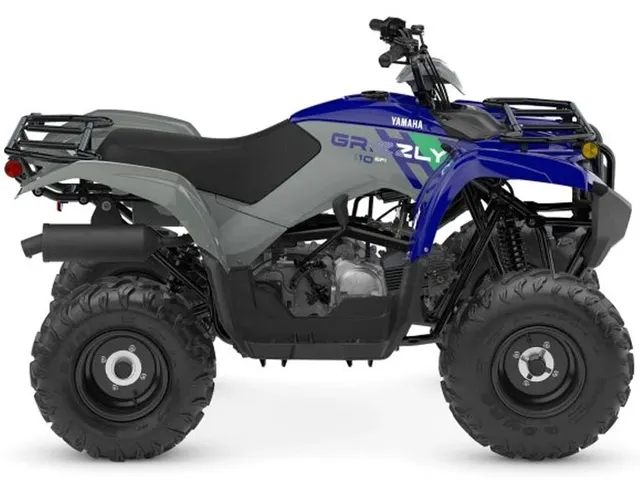
The same 112cc EFI platform and the same automatic CVT with reverse, in utility bodywork with a gated shifter, on a marginally lower 28.7-inch seat. It is heavier at 315 pounds and it looks like the machine the adults in the family are riding, which turns out to matter to some children more than any spec on the sheet.
Choose it over the Raptor if the riding is hunt camp, grove roads, and following a parent’s quad rather than sand-lot laps. Yamaha’s 2027 MSRP is $3,749; the single 2026 unit on the floor has its price suppressed in the dealer feed, so see today’s price at Power Lodge. Recalls: none found in the CPSC database as of September 2026.
Honda TRX90X
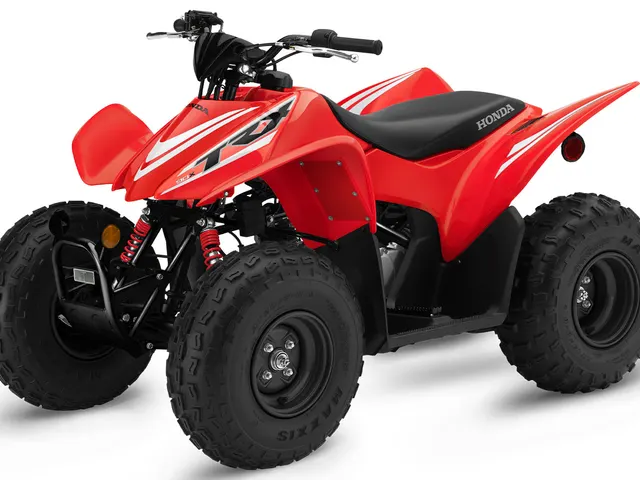
The odd one out, and the reason to consider it is exactly what makes it odd: an 86cc four-stroke with a four-speed semi-automatic gearbox. No clutch lever, but the rider chooses gears. For a family whose ten-year-old is headed for a dirt bike in two years, that is a genuinely useful stepping stone that neither CVT machine here can offer.
Everything else is small and sensible: a 26.0-inch seat, 262 pounds curb, a 38.7-inch wheelbase, and 2.6 inches of travel at both ends — this is a flat-ground machine, not a whoops machine. Honda’s sheet describes an “adjustable limiter, allowing parents to control the speed and power.” One 2026 unit is on the floor, listed at $3,549.
One thing to know if you shop used: American Honda recalled 2022 TRX90X quads for a throttle-cable issue. That campaign does not touch current units, but any used youth quad deserves a CPSC recall check and a VIN lookup before money changes hands.
Kawasaki KFX90
The smallest and the cheapest, and for a lot of ten-year-olds the right answer for both reasons. An 89.9cc four-stroke with electric start and an automatic CVT, a 25.6-inch seat — the lowest here — 269 pounds curb, and 2.8 and 2.9 inches of travel.
Two details set it apart. The rear brake is a hydraulic disc rather than a drum, which is the better brake of the two on a machine a child will grab hard. And the parental controls are the most complete: a throttle-limiting screw plus a keyed ignition that Kawasaki describes as being there “to help address unsupervised use.” A key you can put in your pocket is worth more than any spec on this page. One 2026 unit is on the floor, listed at $3,449.
Florida’s rules for riders under 16
Two practical consequences. First, the safety-course certificate is a real document that has to be on the child, and it is not something to sort out in a parking lot at 7 a.m. Second, the venues layer their own rules on top: Big Cypress requires under-16 riders to wear a DOT helmet and eye protection, and the Ocala National Forest systems require a helmet plus a completed online safety course. Neither one is going to take your word for it.
The machine itself needs paperwork too. Florida titles off-highway vehicles under chapter 317 — a title, not a tag — which our OHV title and registration guide walks through.
Gear, and the training that comes with it
CPSC’s list is short and non-negotiable: wear “a helmet and other protective gear, such as eye protection, boots, gloves, long pants and a long-sleeved shirt.” Add two more of its rules that get broken constantly with children: “Never ride with more passengers than there are seats. Most OHVs/ATVs are designed for one rider,” and “Stay off paved roads. Never ride on public roads, except to cross, where permitted by law.”
Its fourth instruction is the one families skip: “Get hands-on training from a qualified instructor.” The ATV Safety Institute runs the RiderCourse programs that exist for exactly this, and Florida’s public-land rule effectively requires the certificate anyway. Do it in the same month you buy the machine, not the month you get stopped.
Budget $200 to $400 on top of the quad for a properly fitting helmet, goggles, gloves, and boots. A helmet that fits a child now is the only kind worth buying — hand-me-down helmets from an older sibling are how kids end up in something that rotates on impact.
Where can a kid actually ride around here?
This is the part Southwest Florida families underestimate. There is no county trail system in Lee or Collier, no legal beach riding, and no road exception that helps. What exists is private property, one mud park about an hour north, and the Big Cypress trail network east of Naples — which admits ATVs but requires a $100 per-vehicle permit and its own under-16 gear rules. The full map is in where to ride an ATV or UTV in Southwest Florida, and the permit walkthrough is in our Big Cypress ORV permit guide.
If the honest answer is that your family has a back acre and no trailer, that is fine — it is what most of these quads do. Just size the machine for the ground you actually have rather than the ground in the brochure.
Mistakes people make
- Buying up a size “so they grow into it.” A quad a child cannot reach the bars on is a quad they cannot steer out of trouble on. Buy for now, sell in two years; these hold value in a market with four models in it.
- Opening the throttle limiter on day one. Set it low, ride ten hours, then open it a quarter turn. The limiter is the single most useful feature on the machine.
- Skipping the boots. Ankles and footpegs is the injury nobody expects and everybody remembers.
- Letting a second kid ride on the back. These are single-seat machines; a passenger changes the handling of a 262-pound quad completely.
- Assuming private land means no rules. Florida’s helmet and eye-protection requirement for under-16 ATV riders is not limited to trailheads.
What it costs
The four sit within $150 of one another: the KFX90 listed at $3,449, the TRX90X at $3,549, and the Raptor 110 at $3,599 against a $3,599 MSRP for the 2026 model year, with the Grizzly 110’s floor price available on request. Yamaha’s 2027 MSRP on both 110s is $3,749, so the 2026 units on the floor are the current-price machines rather than the incoming ones.
Add gear, add sales tax at 6 percent plus the county surtax on the first $5,000, and add the title work. A realistic all-in number for a first quad, geared and titled, lands close to four thousand dollars.
Where to go next
If the child in question is more interested in two wheels than four, the parallel decision is laid out in our kids’ dirt bike size guide. If the whole family wants to ride together rather than watching one kid do laps, the case for a side-by-side instead is in ATV versus UTV — a four-seat machine with belts changes the calculus entirely for families with two children under twelve.
Laws current as of September 2026; verify with FWC/FLHSMV before you ride or launch. General information, not legal advice.
Bonita Springs — sit your kid on all four before you decide.
Quick answers
- What is the best youth ATV for a 10-year-old?
- All four machines here — the Yamaha Raptor 110, Yamaha Grizzly 110, Honda TRX90X, and Kawasaki KFX90 — carry a manufacturer recommendation of 10 years and older. Pick on fit and transmission: the Yamahas add reverse, the Honda teaches gear selection, and the Kawasaki has the lowest seat.
- What size ATV should a 12-year-old ride?
- Read the warning label on the machine, not a chart. The ATV Safety Institute notes every member-built ATV carries a label "clearly stating the minimum age of the rider," and CPSC is explicit that riders under 16 "should drive only age-appropriate youth models — never adult models."
- Do youth ATVs have a speed limiter?
- Yes, all four here. The Honda TRX90X has an adjustable limiter "allowing parents to control the speed and power." The Kawasaki KFX90 uses a throttle-limiting screw plus a keyed ignition "to help address unsupervised use." Set it low and open it up as skill arrives.
- What are Florida's ATV rules for kids?
- On public lands, § 261.20 requires an under-16 rider to wear a DOT or Snell helmet, eye protection, and over-the-ankle boots, to be supervised by an adult, and to carry an OHV safety-course certificate. Section 316.2074 applies the helmet and eye-protection rule to under-16 ATV riders more broadly.
- How much does a youth ATV cost?
- These four sit in a tight band. The Kawasaki KFX90 is listed at $3,449 and the Honda TRX90X at $3,549 as of September 2026; the Yamaha Raptor 110 is listed at $3,599 against a $3,599 MSRP for the 2026 model year. Gear adds $200 to $400 more.