Review · The Boathouse
Yamaha JetBlaster PRO 3-Up Review: The Playful WaveRunner Built for Tricks and Family Days
The cheapest new WaveRunner on the floor is also the most fun per dollar — as long as you are honest about the 1.5 gallons of storage and the water you plan to ride.
By The Outpost CrewUpdated 7 min read
How this review was built: from Yamaha's published specs, professional road tests, owner reports, and what the Power Lodge crew sees on the showroom floor and in the service bay — not a first-hand test ride. Prices are MSRP unless the live listing below says otherwise.How we review →
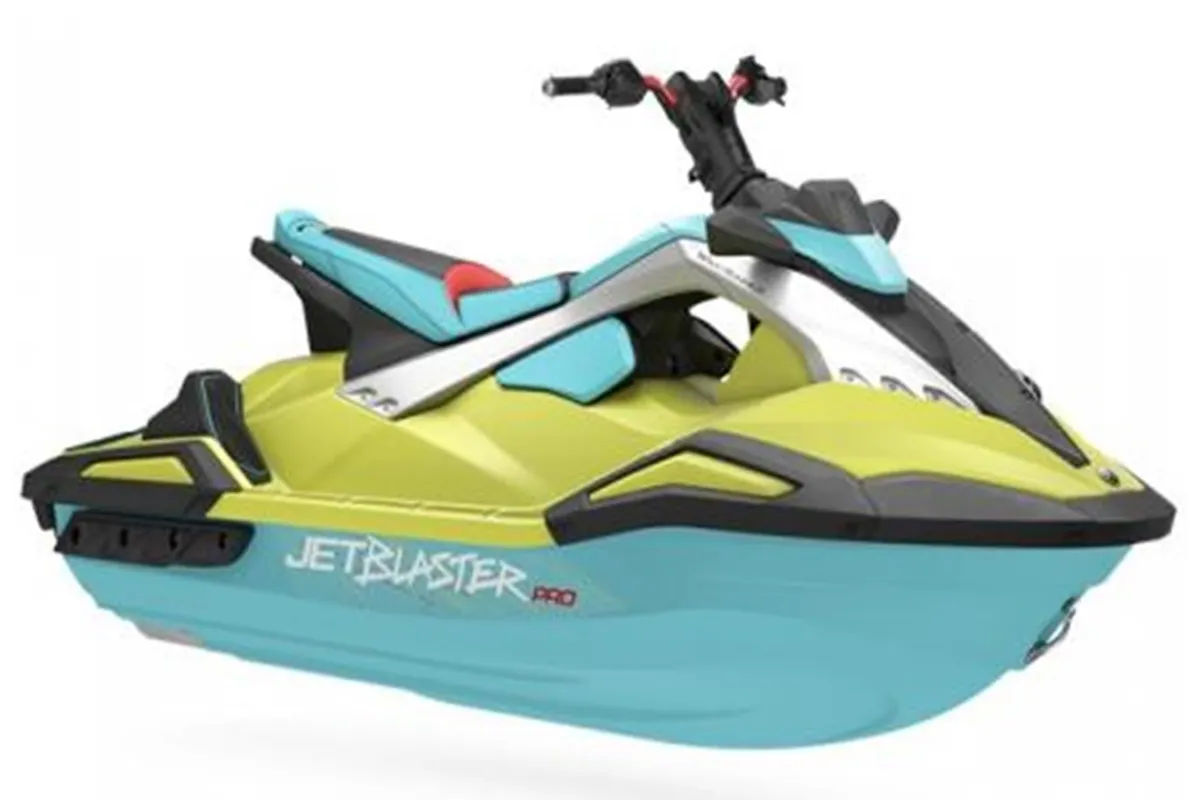
The 2026 Yamaha JetBlaster PRO 3-Up is the cheapest new WaveRunner® on the Power Lodge floor and the one that gets ridden hardest. It is a Rec-Lite machine: 9 feet 8 inches, 545 pounds dry, the naturally aspirated 1,049cc TR-1 HO engine, foot chocks, and electric trim — a personal watercraft (PWC) built around throwing the thing around rather than crossing open water in comfort.
The one thing to know: this is a full-speed machine with almost no storage. About 54 mph, per jetdrift, which is what a full-size recreation machine does, and 1.5 gallons of dry space, which is not what a full-size recreation machine does.
That combination makes it either the smartest buy on the floor or the wrong one, and the deciding factor is not your budget. It is whether you pack for the day.
What the Yamaha JetBlaster PRO 3-Up is
Rec-Lite is the entry class of the personal watercraft world: lighter hulls, smaller tanks, lower prices, and — in exchange — much less of everything you carry. Yamaha’s entry is the JetBlaster, and the PRO 3-Up is the version with three-rider capacity and the fuller equipment package.
What separates it from a plain cheap machine is the freestyle hardware. Foot chocks in the footwells give you something to brace against, so you can weight the tail deliberately rather than hoping. Electric trim moves the nozzle where you want it, which is how the bow comes up. Neither of those is a gimmick — they are the two things that make a light hull do tricks instead of merely being small.
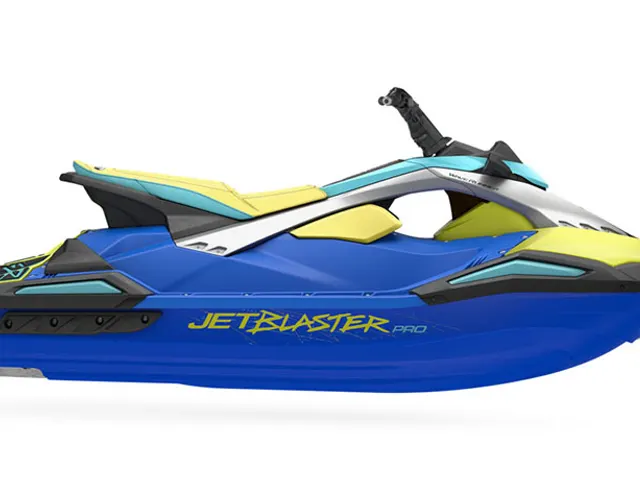
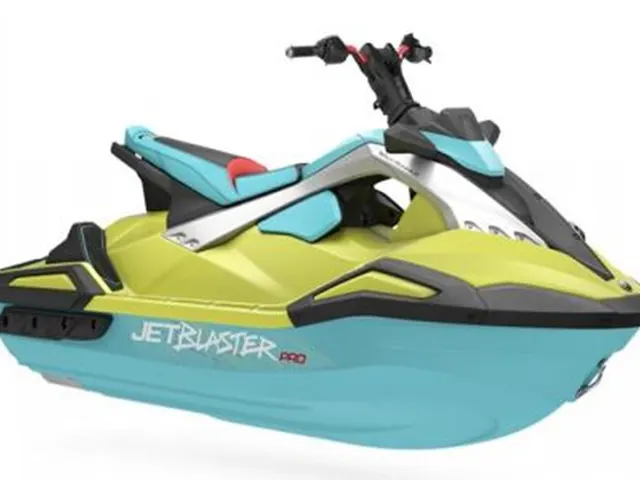
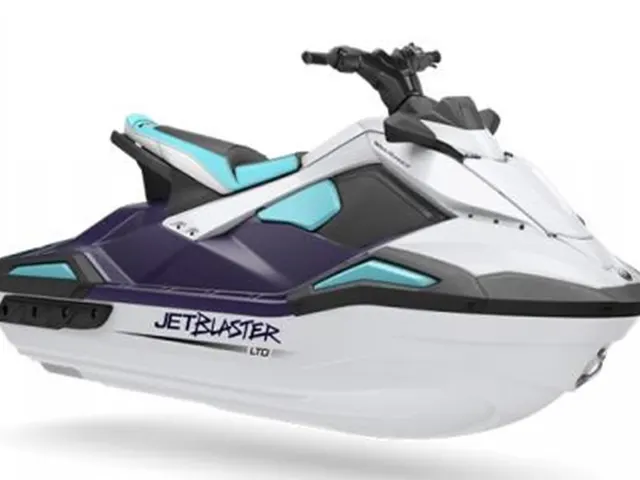
Four sit on the floor as 2025 and 2026 units in Lunar Yellow/Mint and Azure Blue/Lunar Yellow, listed from $11,799 to $12,399 as of September 2026. Beside them is a single 2025 JetBlaster LTD at $11,799 as listed, in Midnight/White.
| Engine | 1,049cc TR-1, three-cylinder, four-stroke, naturally aspirated |
|---|---|
| Horsepower | Not published by Yamaha; about 110 hp estimated by jetdrift |
| Length × width | 9 ft 8 in × 3 ft 7 in |
| Dry weight | 545 lb (about 634 lb curb, per jetdrift) |
| Seating | 3 riders; 496 lb rated load |
| Fuel capacity | 13.2 gal |
| Storage | 1.5 gal |
| Trim | Electric trim |
| Footwells | Foot chocks |
| Display | Connext 4.3-inch touchscreen |
| Tow hook | Standard |
| Top speed | About 54 mph (jetdrift) |
| MSRP, in-stock 2025–26 | $11,799 |
| Listed at Power Lodge, September 2026 | $11,799–12,399 (4 units) |
| MSRP, 2027 model year (Yamaha site, September 2026) | From $12,899 |
Source: yamahawaverunners.com. Specs and pricing are the manufacturer's published figures and can change by model year.
Engine and performance: 110 horsepower in a 545-pound hull
The TR-1 is the same three-cylinder family that powers the VX Deluxe, tuned differently and dropped into a hull that weighs 224 pounds less dry. Yamaha does not publish horsepower; jetdrift estimates about 110 for the JetBlaster PRO against about 125 for the VX Deluxe, and clocks both at within a mile an hour of each other.
Power-to-weight is the whole story. A 545-pound machine with 110 horsepower accelerates in a way a 769-pound machine with 125 does not, and it changes direction the instant you ask. That is what people mean when they say a Rec-Lite machine feels quicker than it is.
The tank is 13.2 gallons rather than the 18.5 that full-size machines carry, which is a real limitation and an easy one to forget. Range is a function of both tank and appetite, and while the naturally aspirated TR-1 is the most frugal engine in the building, a smaller tank still means planning your day around a fuel stop that a VX owner does not have to think about.
On the water: brilliant in the bay, humbled in the Gulf
Light hulls trade in both directions and the JetBlaster is an honest example. Behind Fort Myers Beach, on the Imperial River, in the Cape Coral canals, in the shallow water on the back side of Estero Bay — this is the machine that makes those places entertaining rather than merely scenic. It turns inside anything else on the floor, it launches off its own wake, and it will happily do the same 90 minutes over and over without anyone getting bored.
Now the other direction. jetdrift’s JetBlaster review frames the machine as playful but a long way from the old two-stroke freestyle machines some riders remember, and the same physics that make it quick in a canal make it a handful in a real Gulf chop. A 545-pound hull gets moved around by water that a 948-pound hull ignores. Outside the passes on a windy afternoon is not this machine’s day.
The Connext 4.3-inch touchscreen is the same size unit the full-size recreation machines carry, which is more display than the price usually buys. Whether this trim includes Yamaha’s security and low-rpm settings is worth confirming on the specific hull before you buy — on a machine a teenager is going to ride, that setting is worth more than any number on the spec sheet.
The three-rider rating deserves the same honesty every three-rider rating does, only more so. On a 9-foot-8 hull with a 496-pound load limit, three adults is a rating rather than a plan. Two adults is comfortable. One adult and two kids is the combination that gets used most.
Then there is the storage. 1.5 gallons is a phone, keys, and a wallet in a dry bag. There is a tow hook, so tubes are on the menu, but towels, lunch, and a cooler ride with someone else or not at all. Anyone who has watched a family try to load a Rec-Lite machine for a sandbar day knows how quickly that becomes the whole conversation.
What reviewers and owners say
jetdrift’s coverage is the most useful sourced material here, and it makes two points worth repeating. The first is that the JetBlaster is genuinely playful but should not be confused with a purpose-built freestyle machine. The second comes from its head-to-head with the Sea-Doo Spark TRIXX: the Yamaha is the heavier, more substantial machine — SMC hull, TR-1 power — where the Spark is lighter, cheaper, and built on Polytec. Power Lodge stocks the Yamaha, not the Spark, so that comparison is here for context rather than as a choice you can make on our floor.
Owner discussion of the JetBlaster runs to two themes: the trim-up wheelie is the reason most people bought it, and the storage compartment is a running joke. Both fit the machine. We could not reach the owner forums we would normally cite during this research pass, so take those as commonly reported themes rather than sourced claims — the reasoning is on How we review.
Living with a JetBlaster in Southwest Florida
Flush after every salt or brackish ride, rinse the hull and the trailer, and repeat. The Rec-Lite class gets no discount on the salt contract, and the routine is in our salt-water maintenance guide.
Where this machine pays you back is everywhere except the water. At 545 pounds dry — roughly 634 pounds with fluids, per jetdrift — a JetBlaster fits behind a small trailer, launches without a second person, and can be pushed around a driveway by one adult who is not particularly strong. Families with a garage rather than a boat lift end up appreciating that more than they expected. Our trailering and launching guide has the ramp details.
This is also the machine most often bought for a teenager, which makes Florida’s operator rules the first thing to sort out rather than the last. The age thresholds, the Boating Safety Education ID Card, and the lanyard rule are all laid out in our guide to Florida’s PWC operator requirements.
Recalls and known issues
None found for the Yamaha JetBlaster in the U.S. Coast Guard recall database as of September 2026, based on a spot-check of uscgboating.org’s recall listing. That database’s manufacturer filter is unreliable, so read it as a point-in-time check rather than a guarantee.
A personal watercraft carries a HIN, not a VIN. Have the dealer run the specific hull’s HIN for open campaigns before delivery.
Price and what is on the floor
MSRP for the in-stock 2025–26 model year is $11,799, and Power Lodge lists four JetBlaster PRO 3-Up units between $11,799 and $12,399 as of September 2026 — the spread is color and model year on the same hull. The 2025 JetBlaster LTD is listed at $11,799. Yamaha’s site lists the 2027 JetBlaster PRO 3-Up from $12,899.
Freight, prep, and Florida tax, title, and registration are on top of all of those, as they are everywhere.
How does the JetBlaster PRO compare?
Inside Yamaha, the comparison that matters is against the VX Deluxe, and it is closer than the $1,100 price gap suggests. The VX Deluxe carries an MSRP of $12,899 for the in-stock model year and gives you 30.1 gallons of storage instead of 1.5, an 18.5-gallon tank instead of 13.2, RiDE reverse and deceleration, and a hull that handles chop. The JetBlaster gives you 224 fewer pounds, foot chocks, and a machine that is more entertaining at 25 mph.
For a first and only machine that a family shares, the VX Deluxe is the better answer nearly every time. For a second machine, or a first one bought by someone who wants to play rather than tour, the JetBlaster is the right call and the VX is money spent on capability you will not use.
If this is your first machine and you are weighing the whole field rather than these two, our beginner picks sorts the entry-level options by what actually makes a machine easy to learn on, and the PWC buyer’s guide explains where each segment starts and stops.
Highs
- Cheapest new WaveRunner on the floor
- 545 lb dry — one person can launch, load, and move it
- Foot chocks and electric trim make the tricks accessible
- About 54 mph, the same ballpark as full-size recreation machines
- Tow hook standard for tubes
- Turns inside anything else in the building
Lows
- 1.5 gallons of storage is effectively none
- 13.2-gallon tank shortens the day
- Light hull gets pushed around in real Gulf chop
- Three adults is a rating, not a plan
- Yamaha publishes no horsepower figure
Live inventory, colors, and today's price.
Quick answers
- How fast is a Yamaha JetBlaster PRO?
- About 54 mph, per jetdrift's figures for the PRO 3-Up. That is roughly the same as a full-size recreation machine — the JetBlaster gets there with about 110 estimated horsepower instead of 125 because it weighs 545 pounds dry.
- Can three adults ride a Yamaha JetBlaster PRO 3-Up?
- It is rated for three riders and a 496-pound load, per jetdrift's spec sheet. Three adults is legal and snug on a 9-foot-8 hull. Two adults, or an adult and two kids, is what actually works for an afternoon.
- How much storage does a JetBlaster have?
- 1.5 gallons. That is a phone, a wallet, and a set of keys — not a cooler, not towels, not lunch. It is the single biggest compromise in the Rec-Lite class and the main reason people step up to a VX.
- Yamaha JetBlaster or Sea-Doo Spark TRIXX?
- The JetBlaster is the heavier, more solid-feeling machine with an SMC hull and the TR-1 engine; the Spark TRIXX is lighter, cheaper, and built on Polytec, per jetdrift's comparison. Power Lodge stocks the JetBlaster, not the Spark.
- How much is a Yamaha JetBlaster PRO 3-Up?
- MSRP for the in-stock 2025–26 model year is $11,799, and Power Lodge lists four of them from $11,799 to $12,399 as of September 2026. Yamaha's site lists the 2027 JetBlaster PRO 3-Up from $12,899.