Buyer's Guide · The Boathouse
The Complete Personal Watercraft Buyer's Guide for 2026: Jet Ski, WaveRunner, and Sea-Doo Explained
Six segments, three brands, and about a dozen decisions that actually change your Saturday. Start with the water you ride and the rest of the lineup eliminates itself.
By The Outpost CrewUpdated 9 min read
Yamaha at Power Lodge →Sea-Doo at Power Lodge →Kawasaki at Power Lodge →

Buying a personal watercraft (PWC) in 2026 comes down to five decisions, and the order matters: the water you ride, the number of seats you need, whether you want a supercharger, how you will stop and reverse, and how much storage your day requires. Get those right and the model number sorts itself out.
The vocabulary first, because it trips people up. Jet Ski® is Kawasaki’s trademark, WaveRunner® is Yamaha’s, and Sea-Doo® belongs to BRP. They are three brands making the same kind of machine, and “jet ski” as a generic word is a trademark that escaped. Everything below uses PWC when it means the category.
This guide covers the segments and the hardware. If you want the process — budgeting for the trailer and the registration, new versus used, the showroom visit, the first week — that lives in buying your first jet ski in Southwest Florida, and there is no point in us writing it twice.
How to think about it: five decisions that matter
1. Hull length against your water. This is the one that determines whether you enjoy the machine. Recreation hulls run about 130 to 132 inches. Touring hulls start around 136. That six-inch difference sounds trivial and is not — length and weight are what keep a hull flat and dry when Estero Bay turns to washboard at 2 p.m. or the Gulf builds a two-foot chop outside the pass. Canal and river riders can ignore this entirely. Open-water riders cannot.
2. Naturally aspirated or supercharged. Every PWC engine here is a four-stroke triple or four. The supercharged ones make 230 to 325 horsepower and reach the industry-standard limited top speed of 67 mph. The naturally aspirated ones make roughly 110 to 200 and run 52 to 65 mph. More power past about 230 horsepower never shows up on the speedometer — it shows up as acceleration and the ability to carry load. A supercharger also adds a service item and a fuel bill. Most riders here are better served without one.
3. Seats, honestly counted. Nearly every full-size machine is rated for three riders. That rating is a capacity, not a promise of comfort. Three adults on a recreation hull is a short trip. Two adults and a child is a real day. If three grown people ride together regularly, you are shopping touring hulls whether you planned to or not.
4. Braking and reverse. Yamaha calls its system RiDE, Sea-Doo calls its iBR, and Kawasaki has Smart Reverse. All of them give your left hand a lever that decelerates at speed and reverses at the dock. None is a car brake. The gap that matters is between a machine that has one of these and a machine that does not — for docking, for a busy ramp, and for a new rider’s confidence, this is the most valuable control on the machine.
5. Storage and fuel. Storage ranges from 1.5 gallons on a Rec-Lite machine to 44.5 on a full-size touring hull, and the ranking is not intuitive — Sea-Doo’s recreation GTI line holds 40.3 gallons while its bigger GTX touring hull holds 26.1. Fuel is 18.5 gallons on nearly everything full-size. Match storage to how you pack, not to the price of the machine.
The six segments, with what is actually on the floor
Prices below are as listed at Power Lodge as of September 2026, before freight, prep, and Florida tax, title, and registration.
Rec-Lite: the light, playful, cheapest way in
Short hulls, small tanks, low weight, and a price that starts under twelve thousand. Yamaha’s JetBlaster PRO 3-Up is the example here — 545 pounds dry, 9 feet 8 inches long, a 1,049cc TR-1 engine estimated at 110 horsepower, about 54 mph, with electric trim and foot chocks for riders who want to spin and wheelie rather than cruise. Listed at $11,799 to $12,399, with a JetBlaster LTD alongside at $11,799.
The catch is stated plainly on the spec sheet: 1.5 gallons of storage and a 13.2-gallon tank. This is a play machine and a second machine, not a machine you pack a day into. Full write-up in the JetBlaster PRO review.
Recreation: where most first buyers should land
The volume segment, and the right answer for the majority of Southwest Florida families. Three seats, naturally aspirated engines, hulls in the 130-to-132-inch range, and prices from $12,899 to about $15,199 as listed.
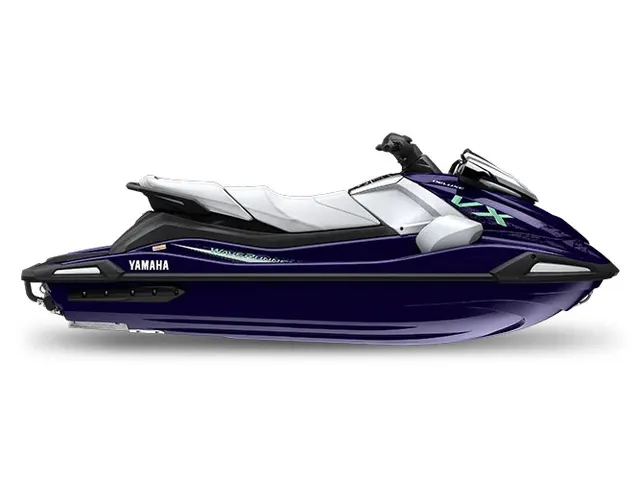
Yamaha’s VX Deluxe is the definitive version — 19 of them on our floor, 30.1 gallons of storage, about 53 mph, from $12,899 as listed. Step up through the VX Cruiser at $13,999 for the tiered seat, the VX Cruiser with Audio at $14,599 for speakers, or the VX Limited at $14,499 to $15,199.
Sea-Doo’s answer is the GTI SE, in 130 and 170 horsepower forms at $14,099 and $14,699 as listed. Both carry 40.3 gallons of storage — the most in the class — plus iBR braking and the iDF debris-clearing pump. Which output to pick is worked out in GTI SE 130 vs 170, and the cross-brand decision is in VX Deluxe vs GTI SE 130.
One machine sits oddly in this segment and deserves a look: the Yamaha VX Cruiser HO puts a 1,898cc naturally aspirated engine — the largest-displacement engine of its kind in any PWC, by Yamaha’s claim — into the recreation hull for $14,899 as listed. About 65 mph without a supercharger, which is a genuinely clever place on the price list.
Touring: longer hulls, worse water, longer days
Three-up riding, real distance, and chop. Hulls from about 136 to 141 inches, weights from about 796 to 950 pounds, and prices from $17,149 to $22,949 as listed.
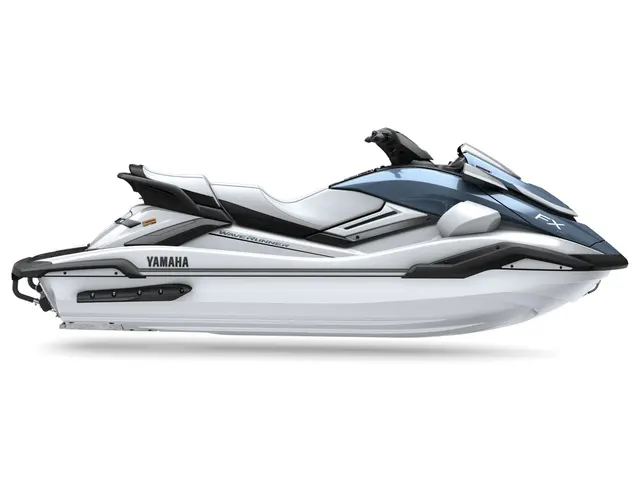
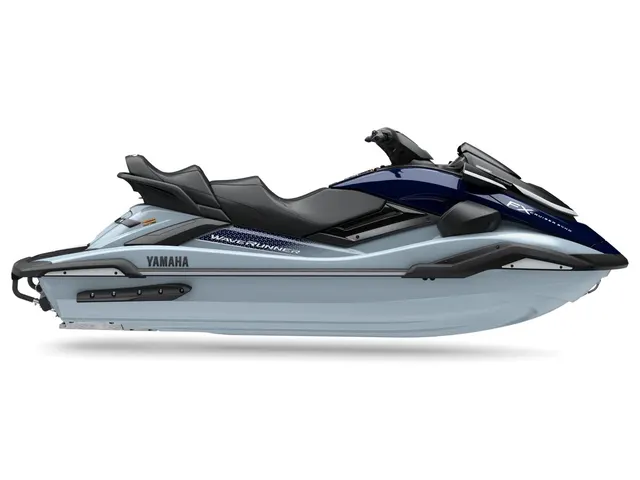
Sea-Doo’s GTX line runs the fiberglass ST3 hull with a 10.25-inch touchscreen: the GTX 170 at $17,149 naturally aspirated, the GTX 230 at $18,149 supercharged, and the GTX Limited 325 at $22,549 to $22,949. Yamaha’s FX line answers with the most storage in the building at 44.5 gallons — the FX HO with Audio at $17,799, the FX Cruiser SVHO at $21,599, and the FX Limited SVHO at $22,199. The head-to-head most people arrive asking about is GTX 230 vs FX Cruiser SVHO.
Performance: acceleration you will feel and rarely need
Lighter hulls, supercharged engines, and a riding position built for cornering rather than cruising. Yamaha’s GP HO with Audio lists at $16,699 and the GP SVHO with Audio at $18,299 — see the GP SVHO review. Sea-Doo’s RXT-X 325 and RXP-X 325 list at $20,999 and $21,099. There is also a used 2021 GP1800R SVHO on the floor with the price withheld online; see today’s price at Power Lodge.
The outlier worth serious attention is Kawasaki’s Jet Ski Ultra 310X: a 1,498cc supercharged inline-four making a published 310 horsepower, a deep-V hull Kawasaki builds for ocean use, the biggest fuel tank here at 21.1 gallons, and 44.5 gallons of storage. Two 2025 units are listed at $14,499 against a $19,199 MSRP — the widest gap between MSRP and listed price in our PWC stock as of September 2026.
Fishing: a PWC that replaces a small skiff
Sea-Doo’s FishPro Trophy 170 is the one, at $21,899 to $22,649 as listed. It is 898 pounds dry with 39.6 gallons of storage, which is where the fishing hardware and the cooler go. It is a specific machine for a specific buyer, and that buyer usually knows exactly who they are. Details in the FishPro Trophy review.
Wake: purpose-built tow machines
Sea-Doo’s Wake 170 starts at $15,649 as listed and the Wake Pro 230 at $18,599. What they add over a standard machine is a ski mode that manages acceleration for a skier and a removable pylon that puts the tow point where it belongs. Any 170-horsepower machine will pull a tube; these are for households where towing is the main event rather than an occasional one.
The dividing line is who is on the rope. Tubing is a load the whole recreation class handles. Getting an adult skier up out of the water repeatedly, at a consistent speed, is a different job — that is what the ski mode and the pylon height are for, and it is worth the premium only if somebody in the house actually skis.
What matters here that does not matter in Michigan
Where you ride shapes the machine as much as any of it: canal and river riders can buy almost anything, Estero Bay riders want length, and anyone running outside the passes should stop looking at recreation hulls. Our guide to where to ride covers the areas, and the manatee zone and no-wake rules cover the parts of the map where speed is not the point.
Mistakes people make
Buying the lightest machine for open water. The Rec-Lite price is tempting and the hull is wrong for the Gulf. This is the most common expensive mistake in the category.
Buying 325 horsepower to idle through no-wake zones. The second most common. If your riding is the Imperial River crawl and a sandbar afternoon, a supercharger is a fuel bill and a service item you bought for nothing.
Assuming the bigger machine holds more. The storage ranking is upside down more than once — Yamaha’s FX holds 44.5 gallons while its VX holds 30.1, and the GTI-versus-GTX inversion above is the same lesson. Check the number, do not infer it.
Counting three seats as three adults. Rated capacity is not a comfortable day. Sit on the machine with the people who will actually ride it.
Forgetting the trailer, the registration, and the gear. A PWC is a vessel in Florida: it gets titled and registered through the county tax collector, per our registration and titling guide, it needs required safety equipment aboard, and the operator rules — including who needs a boating-safety card — are in the Florida jet ski license guide. A single-PWC aluminum trailer runs $1,599 to $1,999 as listed here.
Skipping the flush. It is two minutes, and it is the difference between owning a PWC and slowly dissolving one.
How much does a personal watercraft cost in 2026?
| Segment | Listed range, September 2026 | What you get |
|---|---|---|
| Rec-Lite | $11,799–12,399 | 545 lb, ~54 mph, 1.5 gal storage |
| Recreation | $12,899–15,199 | 3 seats, 52–65 mph, 30.1–40.3 gal storage |
| Touring | $17,149–22,949 | 136–141-in hulls, 26.1–44.5 gal storage, ~56–67 mph |
| Performance | $14,499–21,099 | Supercharged, 67 mph, sport ergonomics |
| Fishing | $21,899–22,649 | 39.6 gal storage plus fishing hardware |
| Wake | From $15,649 | Ski mode and removable tow pylon |
| PWC trailer | $1,599–1,999 | Single-PWC aluminum |
Every figure above is a listed price on our floor as of September 2026, before freight, prep, and Florida tax, title, and registration. Manufacturer MSRPs for the 2027 model year run higher on most of these lines, which is worth knowing when you compare an in-stock machine to a website.
Where to go next
If this is your first machine, read buying your first jet ski in Southwest Florida for the process and the best personal watercraft for beginners for specific picks. If you have narrowed it to a badge rather than a model, Sea-Doo vs Yamaha vs Kawasaki compares the three lines as lines. If you are weighing a PWC against a boat entirely, that argument is in PWC vs boat in Southwest Florida. Everything on the water lives in The Boathouse.
No recall campaigns were found for any of the models above in the U.S. Coast Guard recall database as of September 2026, based on a spot-check of uscgboating.org’s recall listing. A PWC carries a HIN rather than a VIN — have the dealer run the specific hull’s HIN for open campaigns before delivery.
Live inventory, colors, and today's price across all three brands.
Quick answers
- What is the difference between a Jet Ski, a WaveRunner, and a Sea-Doo?
- They are brand names for the same kind of machine. Jet Ski® is Kawasaki's trademark, WaveRunner® is Yamaha's, and Sea-Doo® is BRP's. The generic term is personal watercraft, or PWC. Any of the three will do the same job; the differences are hulls, engines, and control systems.
- How much does a new personal watercraft cost in 2026?
- On the Power Lodge floor as of September 2026, Rec-Lite machines start at $11,799 as listed, recreation models run about $12,899 to $15,199, touring models $17,149 to $22,949, and performance and fishing machines reach roughly $22,650. Freight, prep, tax, and registration are extra.
- Do I need a supercharged personal watercraft?
- Most riders do not. Supercharged machines reach the industry-limited 67 mph and pull hard loaded, but they use more fuel and add a service item. A naturally aspirated machine runs 52 to 65 mph depending on engine, and covers bay riding, tubing, and cruising without complaint.
- What size personal watercraft do I need for the Gulf?
- Length is what buys a dry, composed ride in chop. Recreation hulls run about 130 to 132 inches and get rough outside the passes; touring hulls start around 136 inches and settle down. If most of your riding is open water, buy the longer hull.
- How many people can ride a personal watercraft?
- Most full-size machines are rated for three riders. Three adults is legal but tight on a recreation hull; two adults and a child is what genuinely works for a full day. Rec-Lite machines are rated for three but sized for two.