Head-to-Head · The Trailhead
Honda Pioneer 700 vs Can-Am Defender HD7: Gear Drive or Belt, Which Work UTV Wins?
One has no drive belt. The other has a thousand more pounds of towing and four more seats. Almost every work-UTV shopper in Bonita Springs ends up standing between these two.
By The Outpost CrewUpdated 7 min read
How this review was built: from Honda's published specs, professional road tests, owner reports, and what the Power Lodge crew sees on the showroom floor and in the service bay — not a first-hand test ride. Prices are MSRP unless the live listing below says otherwise.How we review →
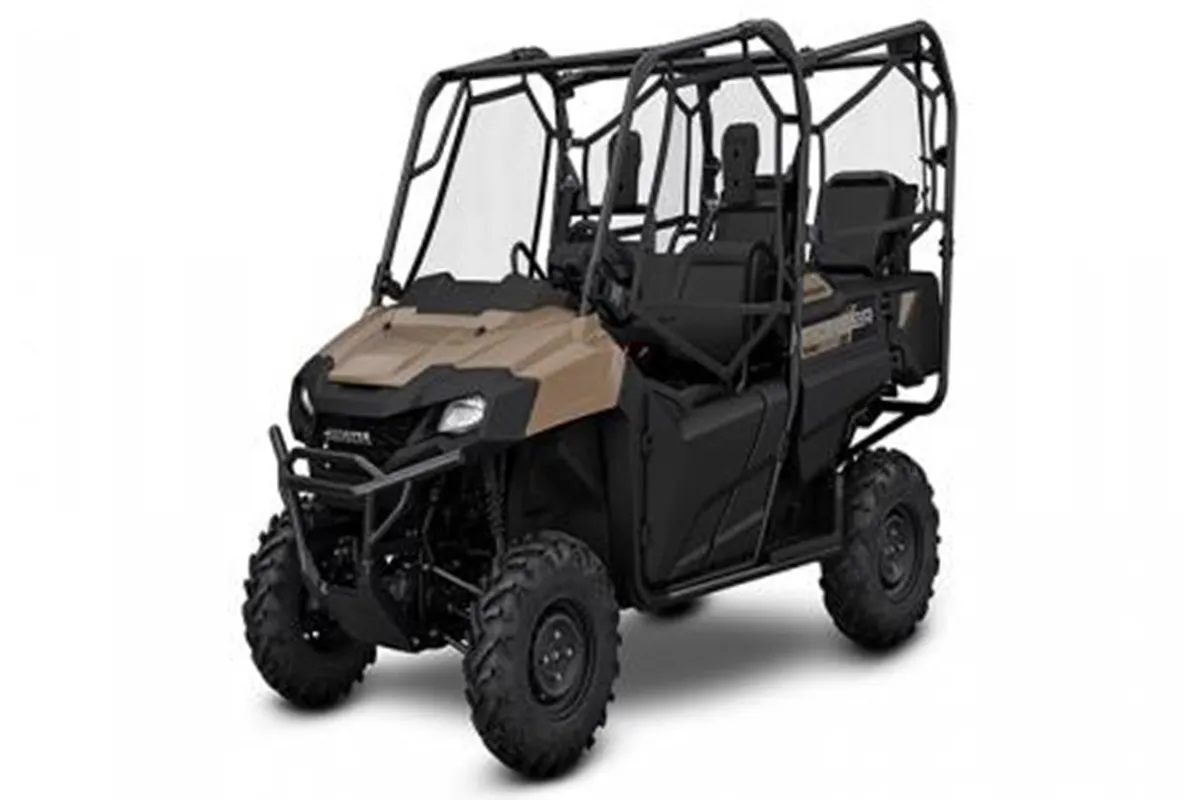
Buy the Can-Am Defender HD7 if you need the capacity, and the Honda Pioneer 700 if you need the machine to still be here in ten years. That is the honest short version, and everything below is why it is not quite as tidy as it sounds.
These two get cross-shopped constantly because they look like the same purchase: a mid-size work side-by-side, a 650-something single-cylinder engine, a thousand-pound bed, a few thousand dollars either side of thirteen. They are not the same purchase. One is a six-seat machine with a 2,500-pound tow rating and a rubber drive belt. The other is a two-seat machine with a torque converter, a driveshaft, and a reputation.
Both are on the floor in Bonita Springs as of September 2026 — three Pioneer 700s and four 700-4s, against two Defender MAX HD7s — so this is a comparison you can go make with your own hands.
The short version
- Towing and seats go to Can-Am. 2,500 pounds and six seats in MAX form, against 1,500 pounds and two (or four in the 700-4).
- The driveline goes to Honda. A hydraulic torque converter feeding an automotive-style automatic through direct driveshafts, with no CVT belt to slip, cook, or replace after a water crossing.
- Published power is not comparable. Can-Am rates the HD7 at 52 hp and 42 lb-ft. Honda publishes no horsepower figure at all for the 675cc Pioneer engine, so anybody handing you a number for it made it up.
- Price is a real gap. $12,899 MSRP for the 2026 Pioneer 700 against $15,799 for the 2026 Defender MAX HD7 — and on the floor, $11,899 against $15,199 as listed.
- The floor is not offering the same shape. Every HD7 we have is a stretched six-seat MAX. Nothing on the Honda side is longer than a four-seater.
| Honda Pioneer 700 | Can-Am Defender MAX HD7 | |
|---|---|---|
| Engine | 675cc single, liquid-cooled | Rotax ACE 650cc single, liquid-cooled |
| Power / torque | Honda publishes neither | 52 hp / 42 lb-ft |
| Transmission | Automotive-style automatic with hydraulic torque converter | pDrive CVT with engine braking |
| Drive | Direct front and rear driveshafts — no belt | 2WD / 4WD with Visco-Lok front differential |
| Suspension travel | 7.9 in front / 9.1 in rear | 10 in front and rear |
| Ground clearance | 10.8 in | 11 in |
| Weight | 1,292 lb curb (700-4: 1,446 lb curb) | 1,757 lb dry |
| Towing | 1,500 lb | 2,500 lb |
| Bed capacity | 1,000 lb tilt bed | 1,000 lb (600 lb in California) |
| Seating | 2 (700-4 seats up to 4 on QuickFlip jump seats) | 6 on the MAX body |
| Power steering | Deluxe trim only | DPS trims only |
| MSRP by model year | $12,899 / $14,499 Deluxe (2026) | $15,799 MAX (2026); 2027 MAX from $15,399 |
| On the floor, as listed | $11,899 to $13,499 (2026) | $15,199 to $17,699 (2025) |
Source: can-am.brp.com. Specs and pricing are the manufacturer's published figures and can change by model year.
Engine and transmission: the only difference that really matters
Six hundred seventy-five cubic centimeters against 650. On paper that is nothing. In the driveline it is everything.
The Defender HD7 runs a Rotax ACE single that Can-Am rates at 52 horsepower and 42 lb-ft, through the pDrive CVT — a belt running between two variable-diameter clutches, with engine braking engineered in. It is a good CVT. It is smooth, it is responsive off idle, and Can-Am has spent a lot of development on belt protection. It is still a belt.
The Pioneer 700 runs a 675cc single through a hydraulic torque converter into an automotive-style automatic gearbox, then out through direct driveshafts. Honda publishes no horsepower figure for it, which is genuinely inconvenient for a comparison page and genuinely honest of them — the number they do not publish is the one every forum argument is about.
A torque converter works through fluid, so nothing in it slips against anything else — a loaded machine holds a grade, and a water crossing is a non-event. That is not a small advantage in a state that spends June through November wet. The full mechanism, and the places a CVT genuinely wins, are on CVT belt versus gear drive, explained.
The counter-argument is honest too. The CVT gives the Can-Am a livelier, more immediate throttle, and 52 published horsepower moving a machine rated to pull 2,500 pounds is a real working advantage over 1,500. A torque converter is smoother and slightly muted; the pDrive is quicker.
Ride and handling
Ten inches of travel front and rear on the Can-Am against 7.9 and 9.1 on the Honda, with 11 inches of ground clearance against 10.8. On a graded grove road neither of those gaps matters. On a rutted lease road in October the Can-Am is the more comfortable machine, and the two extra inches of rear travel are where you feel it.
The Honda answers with size. A 14.8-foot turning radius on a 59.9-inch-wide two-seater is a genuinely maneuverable vehicle, and it fits places a stretched six-seat MAX simply does not — narrow gates, tight tree lines, the back half of a grove where the rows were laid out before side-by-sides existed. If you are hauling a machine on a truck bed or threading it between citrus, the shorter vehicle wins every time.
Both are rated for a thousand pounds in the bed. Honda’s tilts, which is more useful than it sounds the first time you have half a yard of shell in it.
Seats, cab, and what each one is shaped like
This is where the floor forces the comparison to be honest, because we are not stocking the same body style on both sides.
Every Defender HD7 in the building is a MAX — the stretched six-seat version, with flip-up rear benches. Can-Am does build a shorter three-seat HD7; we do not have one right now. So the machine you can actually walk up to is a six-seater, and six seats cost you length, weight, and parking.
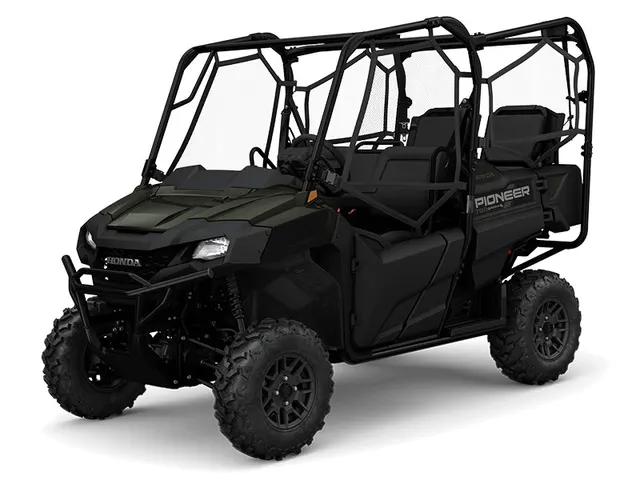
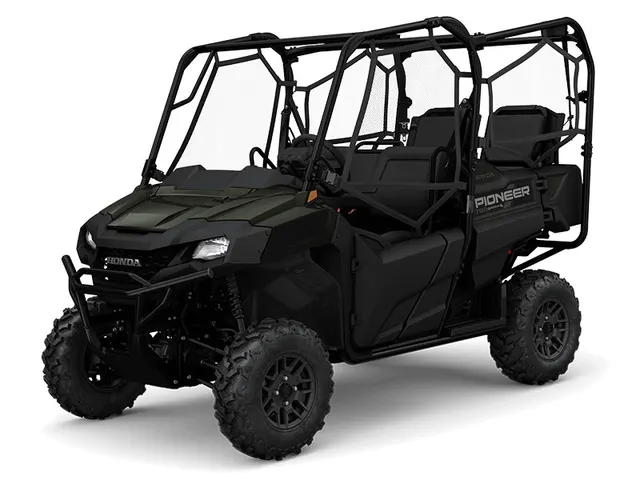
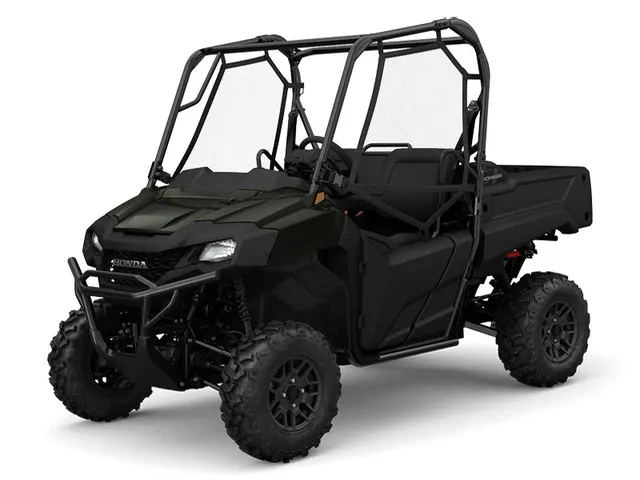
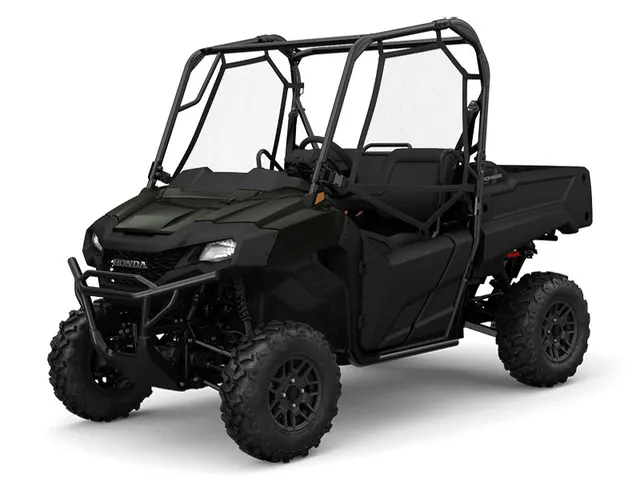
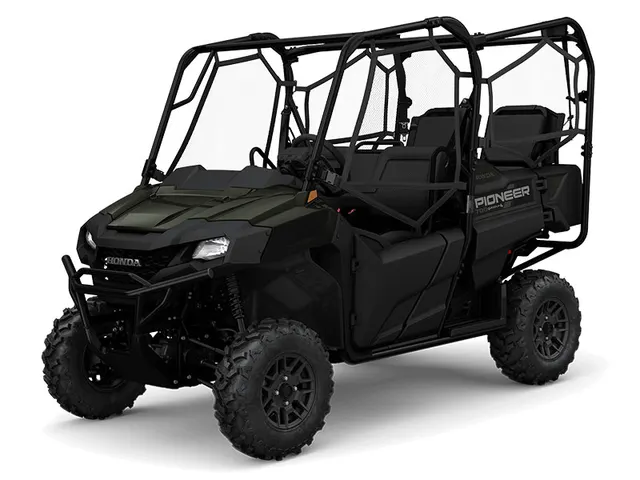
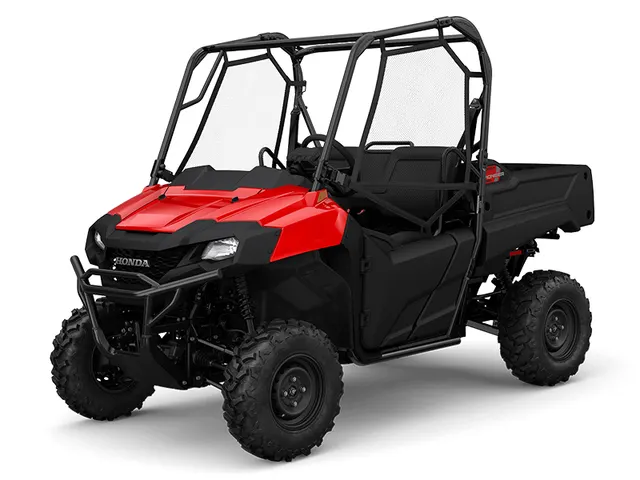
On the Honda side, the two-seat Pioneer 700 gives you a bench and a full bed, and the Pioneer 700-4 adds QuickFlip jump seats that fold up out of the bed floor for two more people and fold flat again to restore the cargo space. UTV Guide credits exactly that flexibility — seats when you need them, bed the rest of the time — and it is a real advantage over a fixed six-seat bench for anyone who carries people occasionally and cargo constantly.
Equipment splits cleanly. Power steering is Deluxe-only on the Honda and DPS-only on the Can-Am — on both machines, that is the trim step worth paying for if you spend four-hour days in the seat. The 2026 Pioneer refresh brought better tires, USB-C, and sealed underbed storage — small things you notice every ride. Can-Am’s answer at the HD7 level is a longer accessory catalog and a much bigger cab-and-roof ecosystem.
What reviewers and owners say
UTV Guide’s verdict on the Pioneer 700 — a versatile, reliable workhorse — rests on the proven single, the real bed, and the tow rating; no independent instrumented test of the current model surfaced in this research pass, because the enthusiast press treats the platform as settled.
UTV Driver puts the Defender MAX line at the top of the class for torque, cargo, and towing per dollar, with cheap-feeling plastics the standing gripe on the legacy generation.
Owner traffic runs along predictable lines. The Honda side-by-side forums skew heavily toward work reporting, with two recurring complaints: cab heat, which Florida is the worst state in which to be relaxed about, and a thread on gear selectors that will not drop into Drive. On the Can-Am side, the recurring owner theme across the brand is drive-belt life — the standing knock Outdoor Troop’s brand comparison lays against Can-Am.
Price and ownership
MSRP, by model year: the 2026 Pioneer 700 is $12,899 and the Deluxe $14,499; the 2026 Defender MAX HD7 is $15,799 per UTV Driver’s coverage, and Can-Am’s 2027 MAX line opens at $15,399.
On the Bonita Springs floor as of September 2026, as listed: one 2026 Pioneer 700 at $11,899, two 2026 Deluxes at $13,499, three 2026 Pioneer 700-4 Deluxes at $14,999, a 2025 700-4 at $12,499, a 2025 Defender MAX HD7 at $15,199, and a 2025 MAX DPS HD7 at $17,699. Freight, prep, and Florida sales tax are separate — the math is on our sales tax guide.
The running costs diverge in one predictable place. The Can-Am has a drive belt, which is a consumable; the Honda does not, which removes the most common wet-season service item in this class without emptying the list — bearings, brakes, and CV boots do not care what transmission you bought.
On recalls: none found for the 2026 Pioneer 700 or the 2025 Defender MAX HD7 in the CPSC recall database as of September 2026. Two campaigns are worth knowing about on used units. Honda’s #25-207 covers accessory heaters fitted to 2022–2025 Pioneer and Talon machines for a fire and burn hazard — an accessory recall, not a vehicle one. Can-Am’s previous-generation HD7 carried a clutch-maintenance campaign covering 2022–23 model years (#24-735) and a 2023 fuel-hose campaign (#23-723). Off-highway vehicles are recalled through the Consumer Product Safety Commission rather than NHTSA, so search cpsc.gov and saferproducts.gov and register the VIN.
Both are recreational off-highway vehicles under Florida’s definitions rather than ATVs, which keeps both of them off public roads — the rules are on are UTVs street legal in Florida.
Which one for which rider
Buy the Defender MAX HD7 if you move people. Six seats, 2,500 pounds of towing, and 10 inches of travel at both ends is the right machine for a lease with a crew, a property where the trailer is regularly loaded, or a family that all wants to go at once. The trade is a belt, a longer vehicle, and roughly $3,300 more as listed.
Buy the Pioneer 700 if you move things. Two seats, a tilting 1,000-pound bed, a tight turning circle, and a driveline with nothing in it to burn is the right machine for groves, fence lines, and any property where the water crossings are a normal part of the day rather than an event.
Buy the Pioneer 700-4 if the answer is “both, sometimes.” It is the compromise that costs the least, because the jump seats fold away and give the bed back.
Step past both if the towing number is the whole problem. The Defender HD9 and HD11 bring more engine to the same 2,500-pound rating, Kawasaki’s MULE range is the fleet-and-ranch answer, and if the budget is the real constraint, start with best UTVs under $15,000.
Both families on the floor in Bonita Springs, with live pricing.
Quick answers
- Is the Honda Pioneer 700 or the Can-Am Defender HD7 better?
- Different machines. The Defender HD7 tows 2,500 pounds and seats six in MAX form; the Pioneer 700 tows 1,500, seats two, and has no CVT belt in the driveline. Buy the Can-Am for capacity and seats, the Honda for a driveline that does not care about water.
- Does the Can-Am Defender HD7 have a belt?
- Yes. The HD7 drives through Can-Am's pDrive CVT, which uses a rubber drive belt, with engine braking built in. The Honda Pioneer 700 uses a hydraulic torque converter and direct driveshafts instead, with no belt anywhere in the driveline.
- How much does a Can-Am Defender HD7 tow compared with a Honda Pioneer 700?
- 2,500 pounds against 1,500. Both carry 1,000 pounds in the bed, though Can-Am rates the Defender bed at 600 pounds in California. If your trailer is regularly loaded past three-quarters of a ton, that gap decides the purchase on its own.
- How many seats does each one have?
- The Pioneer 700 seats two, and the Pioneer 700-4 seats up to four using Honda's fold-away QuickFlip jump seats. Every Defender HD7 on the Bonita Springs floor is a MAX, which is the stretched six-seat body. Can-Am also builds a shorter three-seat HD7 that we do not currently stock.
- Which is cheaper, the Pioneer 700 or the Defender HD7?
- The Honda, clearly. MSRP on the 2026 Pioneer 700 is $12,899 against $15,799 for the 2026 Defender MAX HD7. On the Bonita Springs floor as of September 2026 the Pioneers list from $11,899 and the Defender MAX HD7s from $15,199.