Head-to-Head · The Trailhead
Can-Am Defender HD7 vs HD9 vs HD11: Which Engine Do You Actually Need?
Three engines, nine trims, and a twenty-two-thousand-dollar spread. The badge on the fender decides more than horsepower does.
By The Outpost CrewUpdated 8 min read
How this review was built: from Can-Am's published specs, professional road tests, owner reports, and what the Power Lodge crew sees on the showroom floor and in the service bay — not a first-hand test ride. Prices are MSRP unless the live listing below says otherwise.How we review →
Most people shopping a Can-Am Defender need the HD7, want the HD9, and are looking at the HD11. That is the whole comparison in one sentence, and the rest of this page is the honest version of why.
The three badges are three engines: a 650cc Rotax single, a 976cc V-twin, and a 999cc inline-triple. All three tow 2,500 pounds. All three seat six in MAX form. What separates them is how hard they work to do it, and — the part the spec sheets bury — the fact that the HD11 does not just bring a bigger engine, it brings a different chassis.
On the Bonita Springs floor as of September 2026 there are sixteen Defenders across nine trims, spanning $15,199 to $37,899 as listed. That is a $22,000 range under one nameplate, which is why this question gets asked in the showroom more than any other in the Trailhead.
The short version
- HD7 (650cc single, 52 hp / 42 lb-ft) — the right answer for most property work. Full 2,500-pound tow rating, 1,000-pound bed, lowest price of entry. Listed from $15,199 for a 2025 MAX HD7.
- HD9 (976cc V-twin, 65 hp / 59 lb-ft) — the torque upgrade. UTV Driver calls the HD9 the sweet spot of the legacy MAX line, and the PRO-TORQ CVT is the work-duty transmission. Listed from $19,499.
- HD11 (999cc triple, 95 hp / 70 lb-ft) — a new engine on a new chassis: 12 inches of travel against 10, and 14 inches of clearance against 11. Listed from $26,299.
- The HD10 question — the HD10 badge gave way to the HD11 at the top of the redesigned line; Can-Am still lists an HD10 tier below it at 80 horsepower, and the legacy 82-horsepower V-twin is still under some trims, including the Defender PRO Limited on our floor at $33,499 as listed.
- Towing is not the tiebreaker. All three are rated 2,500 pounds. Chassis, cab, and bed capacity are what actually differ.
| HD7 | HD9 | HD11 | |
|---|---|---|---|
| Engine | Rotax ACE 650cc single | Rotax 976cc V-twin | Rotax HD11 999cc inline-triple |
| Power / torque | 52 hp / 42 lb-ft | 65 hp / 59 lb-ft | 95 hp / 70 lb-ft |
| Transmission | pDrive CVT with engine braking | PRO-TORQ CVT with Quick Response System | pDrive with QRS-X CVT |
| Front differential | Visco-Lok | Visco-Lok QE | Smart-Lok electronic locking |
| Suspension travel | 10 in front and rear | 10 in front and rear | 12 in front and rear |
| Ground clearance | 11 in | 11 in | 14 in |
| Towing | 2,500 lb | 2,500 lb | 2,500 lb |
| Cargo bed | 1,000 lb (600 lb in California) | 1,000 lb (600 lb in California) | 1,000 lb on XT and X MR; 600 lb box with 1,000-lb payload on Limited |
| Dry weight (MAX) | 1,757 lb | 1,789 lb | 2,400 lb X MR / 2,645 lb Limited |
| Seating (MAX) | 6 | 6 | 6 |
| MSRP by model year | $15,799 MAX (2026) | $16,399 MAX (2026); $19,799 MAX XT (2027) | $24,799 MAX XT (2026); $37,999 MAX Limited (2026) |
Source: can-am.brp.com. Specs and pricing are the manufacturer's published figures and can change by model year.
Engine: what the three actually feel like
The HD7 is a single. Fifty-two horsepower and 42 lb-ft is not a lot of paper, and the machine is not slow — 1,757 pounds dry is light for a six-seater, and Can-Am’s pDrive CVT gets it moving briskly. What a single gives up is refinement under load: hitch 2,000 pounds to it and climb, and you hear it working in a way the twins do not.
The HD9 is where the character changes. Fifty-nine lb-ft from a 976cc V-twin is a 40 percent torque increase over the HD7 for roughly $4,000 as listed, and it arrives with the PRO-TORQ CVT and its Quick Response System — a work-duty transmission rather than a general-purpose one. UTV Driver’s Defender MAX coverage credits the line generally with class-leading torque, cargo, and towing for the money, and singles out the HD9 as the sweet spot of the legacy range. Their standing gripe about that generation is cheap-feeling plastics, which is fair and is exactly what the redesign addressed.
The HD11 is a different machine wearing the same nameplate. Ninety-five horsepower and 70 lb-ft from a 999cc inline-triple, and three cylinders idle and pull more smoothly than two. If you have only ever driven the older Defenders, the HD11 is the one that makes the twenty-minute demo feel like a different price bracket, because it is.
All three drive through a belt. That is the standing asterisk on the whole family, and the counter-argument on the other side of our floor is the geared Honda driveline — we laid the trade-off out on CVT belt versus gear drive, explained and in Pioneer 700 versus Defender HD7.
Ride and handling: the chassis is the real upgrade
This is the part that gets lost in a horsepower argument. The HD7 and HD9 share a chassis: 10 inches of travel at each end, 11 inches of ground clearance, and Visco-Lok viscous front differentials that wait to feel slip before they engage.
The HD11 sits on the redesigned platform: 12 inches of travel, 14 inches of ground clearance, and Smart-Lok — an electronically controlled locking front differential that commits to a lock rather than reacting to wheelspin. UTV Driver’s assessment of the XT HD11 is that the new platform addresses just about every complaint people had about the legacy Defender, with the caveat that the result does not come cheap.
On a Southwest Florida grove road in August, three extra inches of clearance and two extra inches of travel change more about the day than thirty horsepower does. Ruts get deeper here between June and November, and the machine that stops scraping is the machine you keep using.
The mud specialist is the MAX X MR HD11, which takes the new chassis to 15 inches of clearance on 30-inch Swamp King tires, with elevated CVT intakes and exhaust, arched A-arms, steel rock sliders, and a high-mounted 4,500-pound winch. UTV Driver describes it as the legacy mud Defender given all the blessings of the new chassis, and calls it spendy. Both halves are true. Two of them sit on the floor at $29,199 as listed.
Comfort, storage, and tech
Every MAX seats six. What climbs with the price is what surrounds those six.
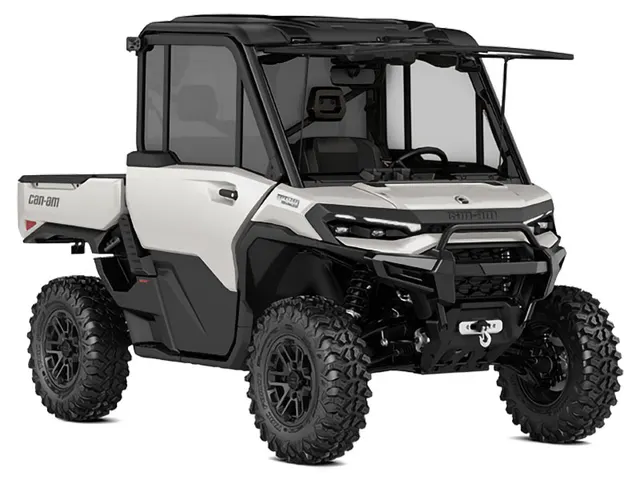
Body length is a separate decision from engine, and it is worth making deliberately. MAX is the stretched six-seat body; Can-Am also builds each engine in a shorter three-seat Defender, and our floor has one of those in Limited HD11 trim at $34,699 as listed. Six seats are useful roughly four days a year and in the way of a full bed the rest of the time, so be honest about which problem you are solving before the engine question even comes up.
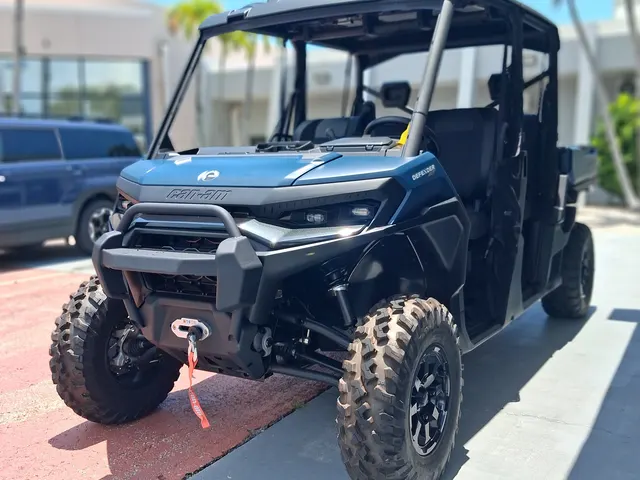
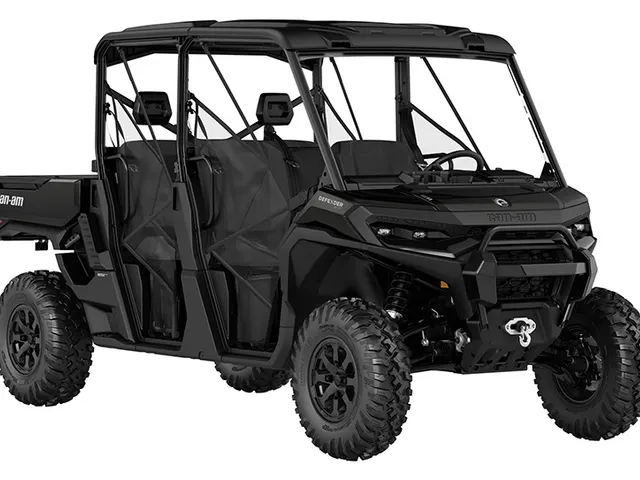
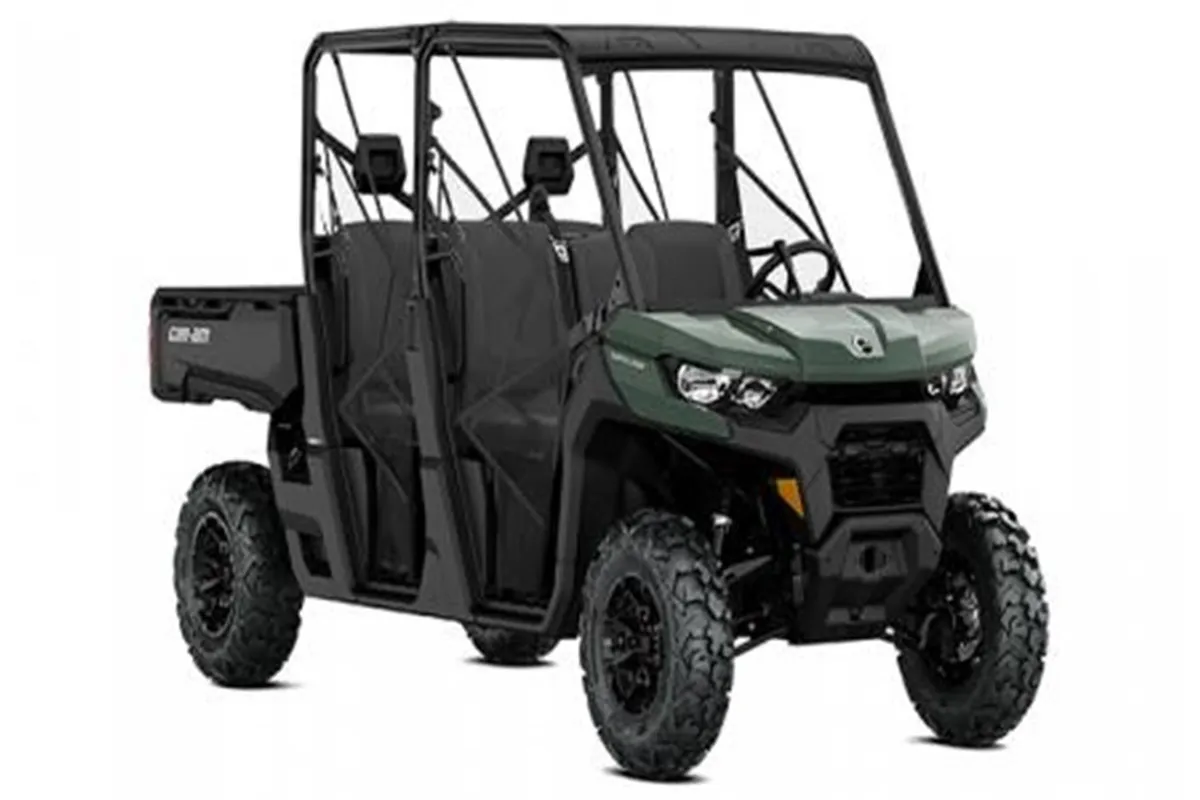
At the HD7 and HD9 end, DPS means dynamic power steering and XT adds cast wheels, a winch-ready bumper, and better tires. These are open-cab machines with a roof if you order one, and in this climate that is a real choice rather than a downgrade: airflow beats glass most of the year.
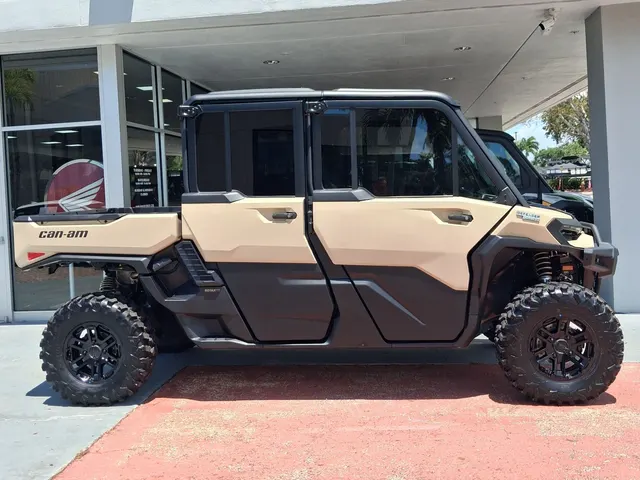
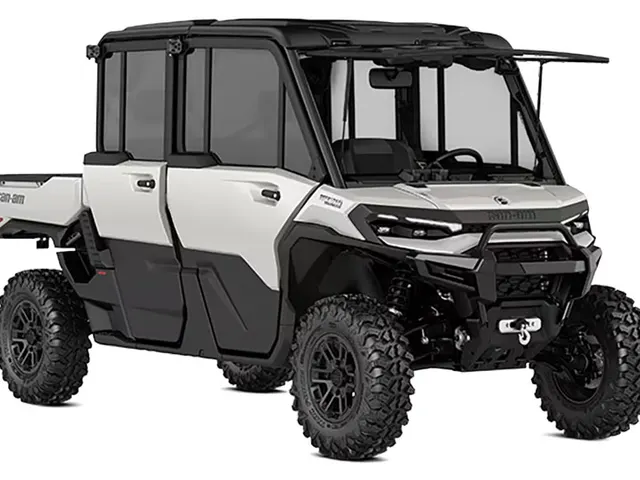
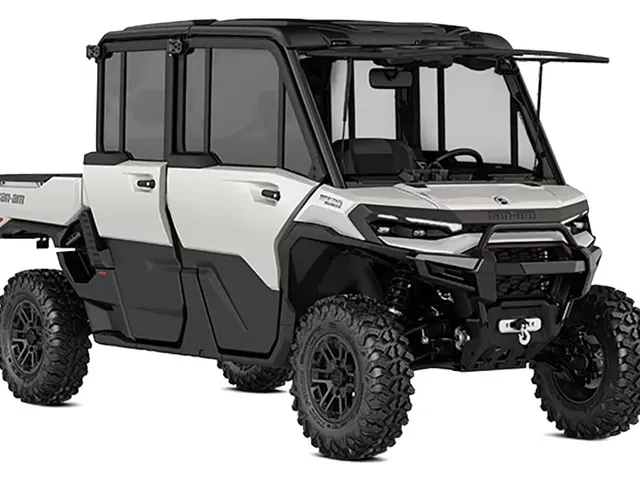
At the HD11 end, the trims fan out fast. The MAX XT HD11 is the open-cab version of the new chassis, with the optional 10.25-inch touchscreen fitted on the two units we have. The MAX Limited HD11 is the sealed, air-conditioned one, with a full HVAC system, locking doors, electric tinted windows, a 10.25-inch touchscreen carrying navigation and a rearview camera, a separate 4.5-inch digital display, and a standard 4,500-pound winch. We reviewed that machine on its own at Defender MAX Limited HD11, and compared it against Kawasaki’s air-conditioned crew cab at UTVs with air conditioning.
One capacity trap worth naming, because it is counterintuitive: the Limited’s cargo box carries 600 pounds against a 1,000-pound payload, where the XT versions of the same chassis carry a full 1,000-pound box. Paying $11,500 more for the cab costs you 400 pounds of box. If your day is material rather than people, that is a real consideration.
Price and ownership
Here is the ladder as it sits in Bonita Springs as of September 2026, listed prices, model years labelled.
| Trim | Engine | On the floor, as listed |
|---|---|---|
| Defender MAX HD7 (2025) | 650 single | $15,199 |
| Defender MAX DPS HD7 (2025) | 650 single | $17,699 |
| Defender MAX DPS HD9 (2025) | 976 V-twin | $19,499 |
| Defender MAX XT HD9 (2026) | 976 V-twin | $20,299 |
| Defender MAX XT HD11, 10.25-in touchscreen (2026) | 999 triple | $26,299 ×2 |
| Defender MAX X MR HD11, half-doors (2026) | 999 triple | $29,199 ×2 |
| Defender PRO Limited (2026) | legacy 82-hp V-twin | $33,499 |
| Defender Limited HD11, three-seat (2026) | 999 triple | $34,699 |
| Defender MAX Limited HD11 (2026) | 999 triple | $37,799–37,899 ×6 |
MSRP for reference and by model year: the 2026 MAX HD7 is $15,799 and the 2026 MAX HD9 is $16,399 per UTV Driver’s coverage; the 2026 MAX XT HD11 is $24,799 before the optional touchscreen; the 2026 MAX Limited HD11 is $37,999, and Can-Am’s 2027 page starts the same machine at $39,399. Freight, prep, and Florida sales tax are separate — the math is on our sales tax guide.
Ownership costs run in the same order as the prices. Belts are the shared consumable across all three. The HD11’s electronics package is in its first full model year, which is worth a moment of buyer skepticism on any new platform. And the Limited’s sealed cab adds door seals, cabin filters, and an air-conditioning system to the service list.
On recalls: none current for the HD9 or HD11 in the CPSC recall database as of September 2026. The previous-generation HD7 carried a clutch-maintenance campaign covering 2022–23 model years (#24-735) and a 2023 fuel-hose campaign (#23-723), neither of which reaches the current units. Off-highway vehicles are recalled through the Consumer Product Safety Commission rather than NHTSA, so check cpsc.gov and saferproducts.gov and register the VIN with Can-Am.
Which one for which rider
Buy the HD7 if you run a property, tow occasionally rather than constantly, and want six seats and a 1,000-pound bed for the least money. It is not the compromise choice; it is the volume choice for a reason.
Buy the HD9 if you tow near the rating regularly, carry six people up grades, or simply want the torque. Roughly $4,000 as listed over the HD7 buys a genuinely different working character and the PRO-TORQ transmission that goes with it.
Buy the HD11 if you want the chassis. The engine is the headline and the suspension is the reason — 12 inches of travel, 14 inches of clearance, and Smart-Lok change what rough ground feels like. Within the HD11 range, take the XT if you work in the open air and want the full 1,000-pound box, the X MR if your ground is genuinely wet, and the Limited if August heat is what actually ends your working day.
Cross-shopping outside the family, the honest alternatives are the geared Honda Pioneer 700 at a third of the money, Kawasaki’s MULE PRO line for fleet and ranch buyers, and — for anyone weighing the whole segment on price — our best UTVs under $15,000. Shoppers arriving from a Polaris Ranger are usually asking the belt question this page raises above.
Sixteen on the floor in Bonita Springs across all three engines, with live pricing.
Quick answers
- What is the difference between the Can-Am Defender HD7, HD9 and HD11?
- Three different engines. HD7 is a 650cc Rotax single rated 52 hp and 42 lb-ft. HD9 is a 976cc V-twin rated 65 hp and 59 lb-ft. HD11 is a 999cc inline-triple rated 95 hp and 70 lb-ft, and it comes with a redesigned chassis with more travel and clearance.
- What happened to the Can-Am Defender HD10?
- The HD10 badge gave way to the HD11 at the top of the redesigned Defender line, and Can-Am still lists an HD10 tier below it at 80 horsepower. The badge persists in searches because it topped the previous generation, and the legacy 82-horsepower V-twin is still under some trims.
- Do all three Defender engines tow the same?
- Yes. Can-Am rates the HD7, HD9 and HD11 Defenders at 2,500 pounds of towing. What changes with displacement is how hard the machine works to do it, and how much chassis is underneath you when it does.
- Is the Can-Am Defender HD7 enough engine?
- For most property work, yes. Fifty-two horsepower and 42 lb-ft moves a 1,757-pound six-seater and pulls the full 2,500-pound rating. Step up if you regularly tow at capacity, carry six people up grades, or want the HD11 chassis rather than the engine.
- How much does a Can-Am Defender cost?
- On the Bonita Springs floor as of September 2026, MAX models run from $15,199 as listed for a 2025 MAX HD7 to $37,799 for a 2026 MAX Limited HD11. MSRP on the 2026 MAX HD7 is $15,799; the 2026 MAX Limited HD11 is $37,999. Freight, prep and tax are separate.