Head-to-Head · The Trailhead
UTVs With Air Conditioning: Kawasaki RIDGE CREW HVAC vs Can-Am Defender MAX Limited HD11
Two sealed cabs, two climate systems, and six thousand dollars between them. In a county where August ends the working day at noon, this is a serious purchase decision.
By The Outpost CrewUpdated 8 min read
How this review was built: from Kawasaki's published specs, professional road tests, owner reports, and what the Power Lodge crew sees on the showroom floor and in the service bay — not a first-hand test ride. Prices are MSRP unless the live listing below says otherwise.How we review →
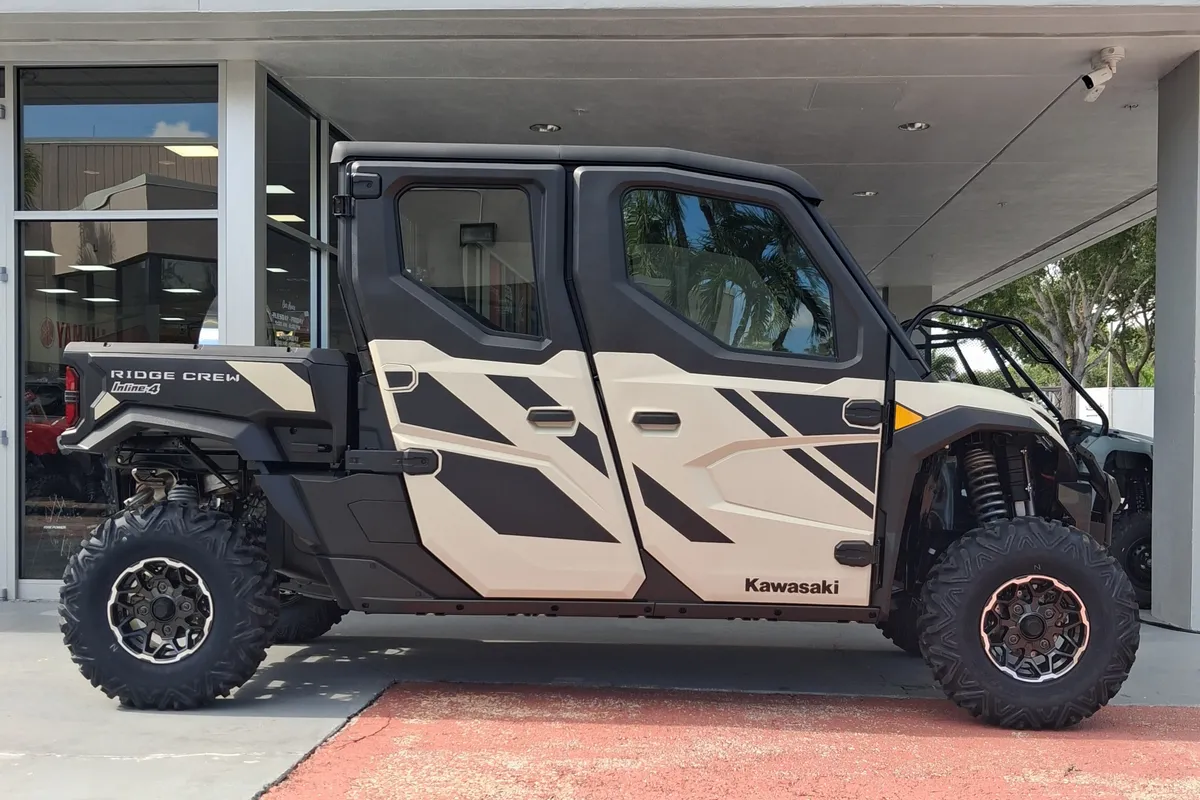
Buy the Kawasaki RIDGE CREW HVAC if the machine has to carry material, and the Can-Am Defender MAX Limited HD11 if it has to carry people and screens. Six thousand dollars separates them as listed, and the specification that actually decides it is not horsepower — it is the cargo box.
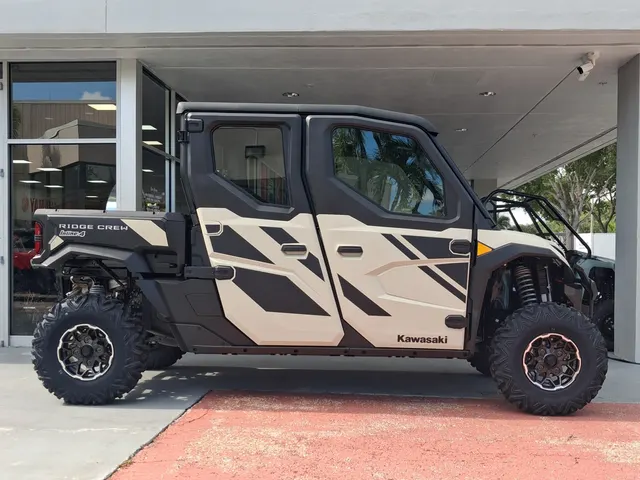
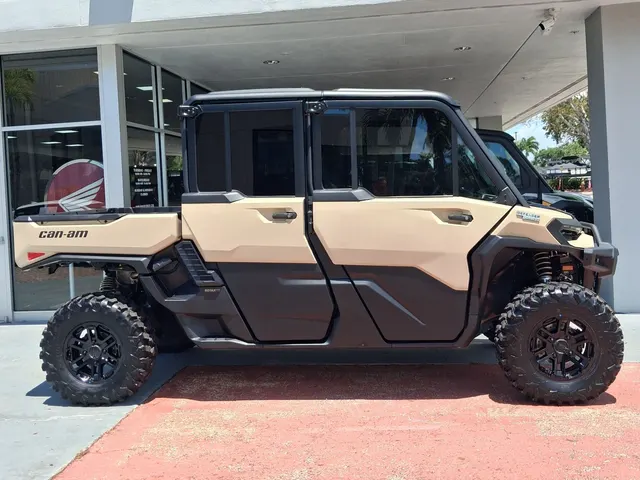
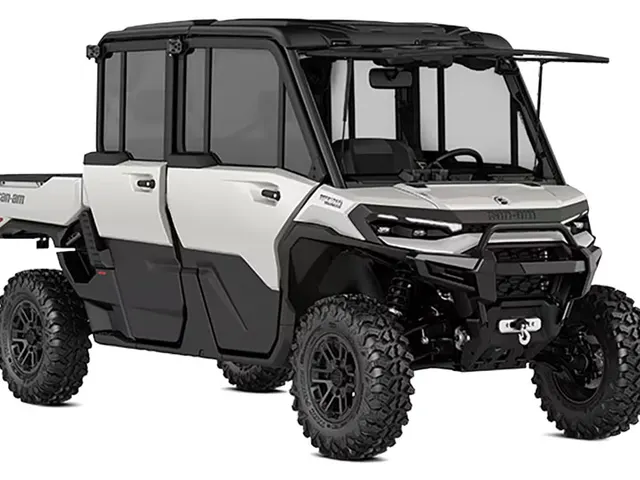
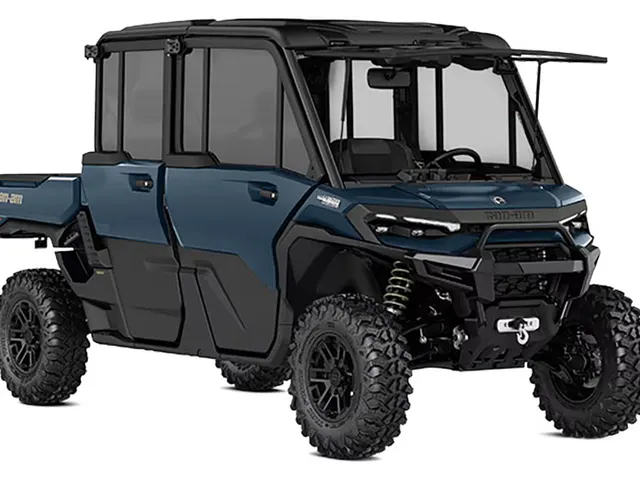
These are the only two factory air-conditioned side-by-sides on the Bonita Springs floor as of September 2026: one 2026 RIDGE CREW HVAC listed at $31,799, and six 2026 Defender MAX Limited HD11s listed at $37,799 to $37,899. Both seat six behind sealed glass with real climate control, and both are the most expensive machines in their respective ranges by a wide margin.
Air conditioning on an off-road vehicle sounds like an indulgence until you have tried to run a grove crew through a Lee County August. Then it stops sounding like one and starts sounding like a labor calculation.
The short version
- Power goes to Kawasaki. 116 horsepower and 73.8 lb-ft from a 999cc inline-four, against 95 horsepower and 70 lb-ft from Can-Am’s 999cc inline-triple.
- Cargo goes to Kawasaki, decisively. A 1,000-pound bed against a 600-pound cargo box. Both tow 2,500 pounds.
- Tech goes to Can-Am. A 10.25-inch touchscreen carrying navigation and a rearview camera, plus a separate 4.5-inch digital display, against Kawasaki’s 8-inch TFT.
- Price goes to Kawasaki by about $6,000 as listed, and the model-year gap widens it: Can-Am’s 2027 page starts the same machine at $39,399.
- Neither escapes the belt. Both run a CVT, so the standing consumable in this category survives all the way to the top of the price list.
| Kawasaki RIDGE CREW HVAC | Can-Am Defender MAX Limited HD11 | |
|---|---|---|
| Engine | 999cc DOHC inline-four, liquid-cooled | Rotax HD11 999cc inline-triple, liquid-cooled |
| Power / torque | 116 hp @ 8,500 rpm / 73.8 lb-ft | 95 hp / 70 lb-ft |
| Transmission | CVT, H / L / N / R | pDrive primary with QRS-X CVT |
| Drive | Selectable 4WD, locking front and rear differentials, shaft | Selectable 4WD with Smart-Lok front differential |
| Suspension travel | 12.7 in front and rear | 12 in front and rear |
| Ground clearance | Up to 15.2 in at maximum preload | 14 in |
| Weight | 2,564 lb curb | 2,645 lb dry (estimated) |
| Towing | 2,500 lb | 2,500 lb |
| Cargo | 1,000 lb bed | 600 lb cargo box; 1,000 lb total payload |
| Seating | 6 in two rows | 6, on a 162.4-in body with a 117.5-in wheelbase |
| Cab | Sealed cab with full HVAC | Sealed cab with HVAC, locking doors, electric tinted windows, rear vents, fast defrost |
| Display | 8-in TFT | 4.5-in digital display plus 10.25-in touchscreen with navigation and rearview camera |
| Winch | 4,500 lb, standard | 4,500 lb with synthetic cable and autostop, standard |
| Tires | SUNF 30 x 10-14 | XPS Trac Force 30 in on 15-in cast aluminum |
| Price | $31,799 as listed (2026); $32,999 MSRP on the 2027 page | $37,799–37,899 as listed (2026); $37,999 MSRP (2026), $39,399 (2027) |
Source: kawasaki.com. Specs and pricing are the manufacturer's published figures and can change by model year.
Engine: four cylinders against three
Both are 999cc. That is where the similarity ends.
Kawasaki’s is an inline-four, rated at 116 horsepower at 8,500 rpm and 73.8 lb-ft. Four small cylinders spinning to 8,500 is a motorcycle-shaped solution to a utility problem, and it gives the RIDGE a top end nothing else in the utility class has. Can-Am’s HD11 is an inline-triple rated at 95 horsepower and 70 lb-ft — the engine introduced with the redesigned 2026 Defender to replace the old 82-horsepower V-twin at the top of the range. Three cylinders idle and pull more smoothly than two, and the torque arrives lower.
Both tow the same 2,500 pounds, so the horsepower difference does not buy a bigger number on the hitch. It buys margin: how hard each machine works to move a full load up a grade with six people in it, and how much is left over when the air conditioning is running.
Both drive through a CVT. Kawasaki’s is a conventional high/low/neutral/reverse unit; Can-Am’s is a pDrive primary feeding the QRS-X. Neither manufacturer has put a gearbox in an air-conditioned utility machine, so the belt question follows you all the way up the price list — the argument in both directions is on CVT belt versus gear drive, explained.
Traction hardware differs in kind rather than degree. Kawasaki gives you locking differentials at both ends. Can-Am gives you Smart-Lok at the front — an electronically controlled lock that commits rather than waiting to feel slip. On wet St. Augustine grass, on a loaded grove road, both work; the Kawasaki’s rear lock is the one that matters when a diagonal wheel comes off the ground.
The cab: what factory HVAC actually means
Both machines give you a genuinely sealed enclosure with a heat, vent, and air-conditioning system fitted at the factory rather than bolted on by a dealer. That distinction matters more than the brochures make it sound — a factory system is engineered around the machine’s electrical capacity and its cooling, and it is covered by the machine’s warranty.
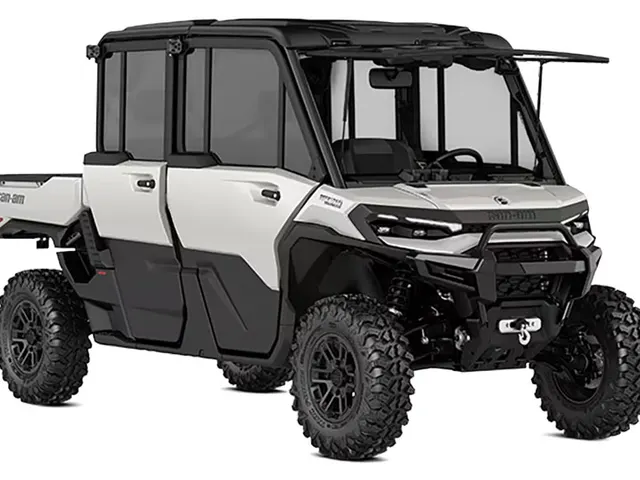
Can-Am’s cab is the more elaborate one. Locking doors, electric tinted windows, rear vents so the second row is not an oven while the first row is comfortable, and fast defrost — which earns its keep here the moment an afternoon storm hits chilled glass. Kawasaki’s is a two-row six-seat cab, simpler in specification and with the more conventional single 8-inch screen.
What neither brochure tells you is that a sealed cab is only sealed as long as you maintain it as one. Door seals and window channels are wear items on a vehicle that spends its life vibrating over ruts, and a cab that has started to leak makes the air-conditioning system fight humid outside air all day. On a truck, that system lives a sheltered life; here the condenser sits where mud lands and the whole assembly gets shaken for eight hours at a time. That is a different duty cycle, and it belongs in the ownership budget.
The other cab reality is glass. A rock chip in a windshield you cannot fold down is a windshield you replace, not one you live with, and both of these have real glass to break.
Work capacity, and the 600-pound catch
Here is the specification that should decide this comparison for a working buyer, and it is buried in both spec sheets.
The RIDGE CREW HVAC carries 1,000 pounds in the bed. The Defender MAX Limited HD11 carries 600 pounds in its cargo box, against a 1,000-pound total payload for the whole machine. That is not a rounding difference — it is 400 pounds of material, and the open-cab Defender MAX XT HD11 on the same chassis carries the full 1,000-pound box. Paying up for the Can-Am cab costs you box capacity in a way paying up for the Kawasaki cab does not.
Towing is a tie at 2,500 pounds each. Ground clearance goes narrowly to Kawasaki at up to 15.2 inches at maximum preload against Can-Am’s 14, and suspension travel is effectively level at 12.7 inches against 12. Both wear 30-inch tires. Both include a 4,500-pound winch as standard, which at this price they should.
If your day is moving material — feed, posts, sand, tools — the Kawasaki is simply the more useful vehicle. If your day is moving six people and a laptop between sites, the Can-Am’s box is not the constraint.
What reviewers and owners say
UTV Driver ran the RIDGE against the utility field and made it their comparison winner, describing it as seamless utility, and their separate pros-and-cons write-up concludes there are few better machines out there if you have got the scratch. That is a strong verdict from an outlet that tests the whole class.
Their coverage of the Defender Limited HD11 is enthusiastic about the redesign and blunt about the price: stiffer chassis, more power and torque, loaded with kit, and the con is bring money. Their write-up of the XT version credits the new platform with addressing nearly every complaint people had about the legacy Defender.
Owner data on both is thin for the same reason: these are new lines. Open forum traffic on the RIDGE is limited and much of the owner conversation lives in closed groups we cannot verify. The one documented complaint we could source is a take-off clutch squeal on a 2024 RIDGE XR, resolved with a warranty clutch replacement — a single report rather than a pattern, and worth listening for on a test sit. On the Can-Am side the HD11 is in its first full model year, so anyone claiming to know how these hold up at 3,000 hours is speculating, and the brand-wide belt-life conversation carries over.
Price and ownership
As listed on the Bonita Springs floor in September 2026: the 2026 RIDGE CREW HVAC at $31,799, and six 2026 Defender MAX Limited HD11s at $37,799 to $37,899. Against MSRP, by model year: Kawasaki’s 2027 page lists the RIDGE CREW HVAC at $32,999; UTV Driver puts the 2026 Defender MAX Limited HD11 at $37,999, and Can-Am’s 2027 page starts the same machine at $39,399.
So the gap on the floor is roughly $6,000, and it widens to about $6,400 on model-year MSRP. Freight, prep, and Florida sales tax are separate on both — the math is on our sales tax guide, and if this is a financed purchase, powersports financing 101 covers what actually drives the payment on a machine at this price.
On recalls: none found for the Kawasaki RIDGE or the Can-Am Defender MAX Limited HD11 in the CPSC recall database as of September 2026. For platform context, the previous-generation Defender HD7 carried a clutch-maintenance campaign covering 2022–23 model years (#24-735) and a 2023 fuel-hose campaign (#23-723), neither of which reaches the HD11. Off-highway vehicles are recalled through the Consumer Product Safety Commission rather than NHTSA, so search cpsc.gov and saferproducts.gov and register the VIN.
Both are recreational off-highway vehicles rather than ATVs under Florida’s definitions, so neither goes on a public road — the rules are on are UTVs street legal in Florida.
Who actually buys a $35,000 side-by-side in Florida
The arithmetic is simpler than the price suggests, and it is about hours rather than horsepower.
If heat reliably ends your working day at noon from June through September, an air-conditioned cab buys back afternoons. Four months of recovered afternoons on a property crew is a labor number, not a comfort number, and that is the case these machines make. The buyers the specification fits are large-acreage operations, grove and ranch properties, hunting leases with a long road in, and lodge, resort, and HOA properties that shuttle people in uniform in July.
The buyers it does not fit are just as clear. If the machine works mornings and evenings, or lives on five acres, or spends most of its hours parked, thirty-two to thirty-eight thousand dollars buys an enormous amount of open-cab machine instead — and the open-cab Defender MAX XT HD11 with the same 95-horsepower triple is roughly $11,500 less as listed than the Limited.
Which one for which buyer
Buy the RIDGE CREW HVAC if the machine works. A 1,000-pound bed, 116 horsepower, locking differentials at both ends, up to 15.2 inches of clearance, and roughly $6,000 left over is a straightforward argument for a property that moves material. Kawasaki’s whole utility range sits below it, and the ladder is on our MULE lineup guide.
Buy the Defender MAX Limited HD11 if the machine carries people, or if the cab specification itself is the point. Locking doors, electric tinted windows, rear vents, and a 10.25-inch touchscreen with navigation and a rearview camera are a meaningfully more finished environment, and Smart-Lok is a better front differential than a viscous coupling. The full write-up is our Defender MAX Limited HD11 review.
Buy neither if the honest answer is that you work early and late. The open-cab machines in the Defender HD7, HD9 and HD11 ladder do the same work for a great deal less, and for anyone whose constraint is budget rather than heat, best UTVs under $15,000 is a more useful page than this one.
Both cabs on the floor in Bonita Springs, with live pricing.
Quick answers
- Which UTVs come with factory air conditioning?
- Two on the Bonita Springs floor as of September 2026: the Kawasaki RIDGE CREW HVAC, listed at $31,799 for a 2026 unit, and the Can-Am Defender MAX Limited HD11, listed at $37,799 to $37,899 for 2026 units. Both are six-seaters with sealed cabs and full heat, vent and air-conditioning systems.
- Is the Kawasaki RIDGE CREW HVAC more powerful than the Can-Am Defender Limited HD11?
- Yes, on published figures. Kawasaki rates the RIDGE at 116 horsepower and 73.8 lb-ft from a 999cc inline-four. Can-Am rates the HD11 at 95 horsepower and 70 lb-ft from a 999cc inline-triple. Both tow 2,500 pounds, so the extra power shows up in how hard each works to do it.
- Which air-conditioned UTV carries more?
- The Kawasaki. The RIDGE CREW HVAC carries 1,000 pounds in the bed. The Defender MAX Limited HD11 carries 600 pounds in its cargo box against a 1,000-pound total payload — 400 pounds less box than the open-cab Defender XT on the same chassis.
- How much is a UTV with air conditioning?
- Roughly $32,000 to $38,000 as listed in September 2026. The 2026 RIDGE CREW HVAC is listed at $31,799 against a $32,999 MSRP on Kawasaki's 2027 page; the 2026 Defender MAX Limited HD11 is listed from $37,799 against a $37,999 MSRP, with Can-Am's 2027 page starting at $39,399.
- Do air-conditioned side-by-sides still use a drive belt?
- Both of these do. The RIDGE and the Defender Limited each run a CVT with a rubber drive belt, so the standing maintenance item in this category does not go away at the top of the price range.