Review · The Trailhead
Can-Am Defender MAX Limited HD11 Review: Six Seats, a Cab, and Air Conditioning in the Florida Heat
Most side-by-sides ask you to endure August. This one air-conditions it, seats five friends while it does, and charges accordingly.
By The Outpost CrewUpdated 7 min read
How this review was built: from Can-Am's published specs, professional road tests, owner reports, and what the Power Lodge crew sees on the showroom floor and in the service bay — not a first-hand test ride. Prices are MSRP unless the live listing below says otherwise.How we review →
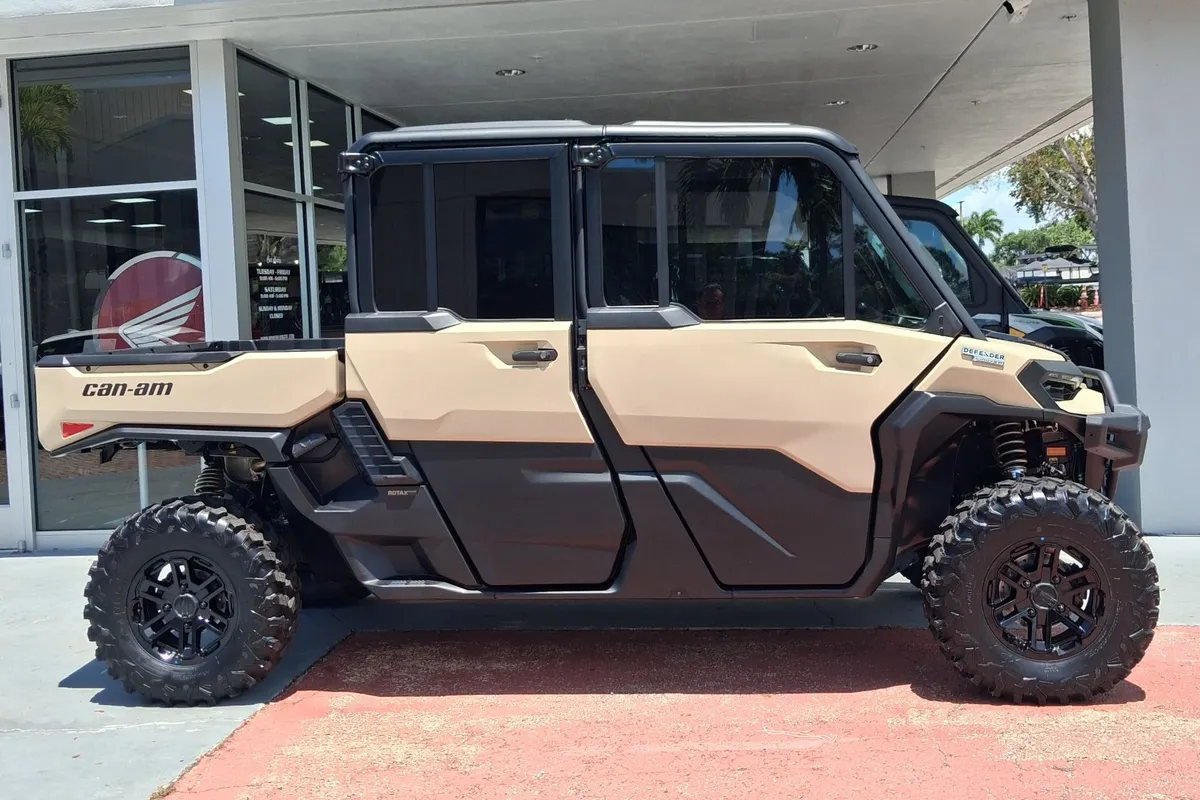
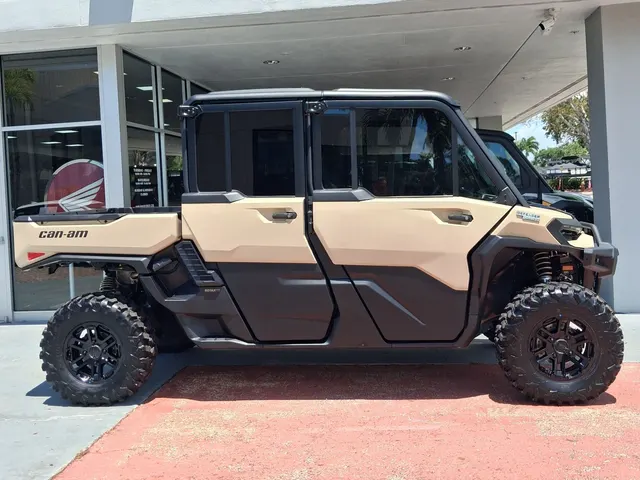
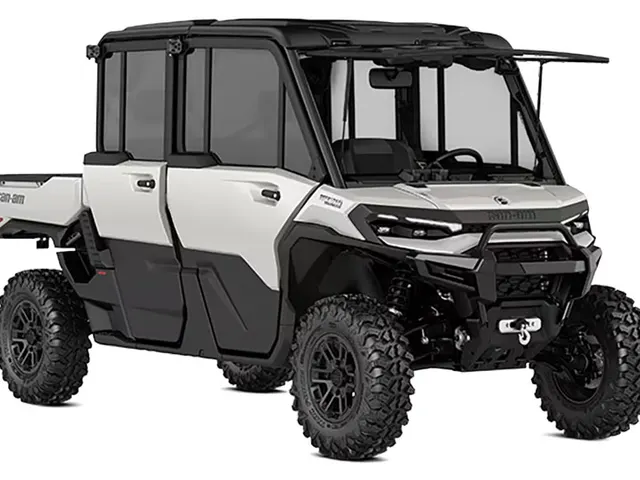
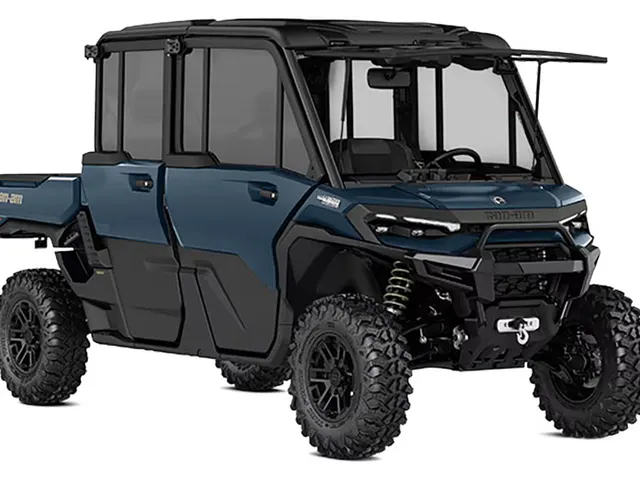
This is the machine you buy when the reason you stop working at noon in August is the heat, not the job. The 2026 Can-Am Defender MAX Limited HD11 is a six-seat utility side-by-side with a sealed cab, locking doors, electric tinted windows, and a factory HVAC system that actually makes cold air. Behind it: a 999cc Rotax triple rated 95 horsepower and 70 lb-ft, 2,500 pounds of towing, and 14 inches of ground clearance.
It is also the most expensive utility machine in the building, listed at $37,799 as of September 2026, and there are six of them on the floor — the deepest Can-Am position we carry. In Southwest Florida that is not a coincidence. Air conditioning is the single most persuasive feature a side-by-side can have between May and October, and grove managers, ranch operations, and lodge properties around Bonita Springs have voted with deposits.
The question worth answering honestly is not whether it is good. It is whether the cab is worth roughly $11,500 over the same chassis with an open one.
What the Defender MAX Limited HD11 is
The Limited is the top of Can-Am’s utility Defender line, and MAX means the stretched six-seat body. For 2026 Can-Am redesigned the platform and renamed the big engine: the HD10 badge people still search for gives way to the HD11, a 999cc inline-triple that Can-Am rates at 95 horsepower and 70 lb-ft. Can-Am still lists an HD10 tier below it at 80 horsepower. From here on this page says HD11, because that is what is on the fender.
Below the Limited sit the MAX XT HD11 (open cab, same engine, roughly $11,500 less as listed), the MAX X MR HD11 mud build, and the older-displacement HD7 and HD9 MAX models. The trim ladder is genuinely confusing and we untangled it at Defender HD7 versus HD9 versus HD11.
| Engine | Rotax ACE HD11, 999cc inline-triple, liquid-cooled |
|---|---|
| Power / torque | 95 hp / 70 lb-ft |
| Transmission | pDrive primary with Quick Response System X (QRS-X) CVT |
| Drive | Selectable Turf Mode / 2WD / 4WD with Smart-Lok front differential |
| Steering | High-torque Tri-Mode Dynamic Power Steering |
| Suspension | Arched double A-arm front with sway bar; arched double A-arm rear; twin-tube gas shocks |
| Suspension travel | 12 in front and rear |
| Ground clearance | 14 in |
| Cab | Sealed cab, Smart HVAC climate system, locking doors, electric tinted windows, rear vents, fast defrost |
| Seating | 6 |
| Towing / payload | 2,500 lb towing; 1,000 lb payload; 600 lb cargo box |
| Dry weight | 2,645 lb (estimated) |
| Dimensions | 162.4 in long × 65 in wide × 81.4 in high; 117.5-in wheelbase |
| Tires / wheels | XPS Trac Force 30 x 9 / 10 x 15 in. on 15-in cast aluminum |
| Winch | 4,500 lb with synthetic cable and autostop |
| Displays | 4.5-in digital display with keypad plus 10.25-in touchscreen |
| Fuel capacity | 11.9 gal |
Source: powerlodgefl.com. Specs and pricing are the manufacturer's published figures and can change by model year.
Engine and performance
Ninety-five horsepower and 70 lb-ft is a lot of engine for a utility machine, and the triple is why. Three cylinders idle smoother than the big V-twins Can-Am used to put here, and they spread torque across a wider band, which is what you want when the load behind you is 2,500 pounds and the surface under you is wet St. Augustine grass.
The driveline is a pDrive primary feeding a QRS-X CVT — a belt, in other words, with Can-Am’s electronic drive-belt protection watching over it. That is the standing asterisk on every Can-Am in this class: belts are a consumable, heat and water are what kill them, and a 2,645-pound machine working hard in Florida summer asks a lot of one. It is the honest counterpoint to the Honda argument on the other side of the floor, which we laid out in CVT belt versus gear drive, explained.
Smart-Lok is the other differentiator worth understanding. It is an electronically controlled locking front differential rather than a viscous coupling, so it commits to a lock when traction disappears instead of waiting to feel slip. Add Turf Mode for not tearing up a client’s lawn and the drive-mode selector earns its place.
On the property, and in the heat
Fourteen inches of clearance and 12 inches of travel at both ends put it at the top of the utility class alongside Kawasaki’s RIDGE CREW, and that changes what a rutted grove road feels like at 20 mph with six people aboard. The 117.5-inch wheelbase makes it stable and makes it long — 162.4 inches of machine does not thread a tight trail, and it is not trying to.
The cab is the product. A sealed enclosure with a proper HVAC system, locking doors, and electric tinted windows means the machine is usable at 2 p.m. in July, which is precisely when every open side-by-side in Lee County is parked in the shade. Fast defrost matters more here than you would think — not for frost, but for the instant fog that arrives when a 3:40 storm hits a cold cab. Rear vents mean row three is not an oven while row one is comfortable.
The 10.25-inch touchscreen carries navigation and a rearview camera as standard equipment per UTV Driver’s coverage of the Limited, with a separate 4.5-inch digital display and keypad for the driving essentials. That is a first-model-year electronics package on a redesigned platform, which is worth a moment of buyer skepticism — big screens are the part of a modern machine most likely to need a software update.
One spec to look at twice: the cargo box carries 600 pounds on this trim, against a 1,000-pound payload. The XT versions of the same chassis carry a full 1,000-pound box. If your day is mostly moving material rather than moving people, that difference is worth more than the air conditioning.
What reviewers and owners say
UTV Driver’s coverage of the Limited HD11 is enthusiastic about the redesign and blunt about the price — the strengths listed are a stiffer chassis, more power and torque, and how much equipment is included; the con is, roughly, bring money. Their separate write-up of the XT version credits the new platform with addressing just about every complaint people had about the legacy Defender, with the same caveat that the result does not come cheap.
Owner data is where the honesty has to come in: the HD11 is early. This is the first full year of the redesigned platform, so long-term durability reporting is thin, and anyone claiming to know how these hold up at 3,000 hours is speculating. What is not thin is demand — enclosed, air-conditioned cabs are the fastest-moving thing in Florida utility side-by-sides, and the belt-life conversation that follows every Can-Am carries over to this one.
Living with it in Southwest Florida
The cab changes the ownership routine in both directions. Good: your electronics, your paperwork, and your back stay dry, and salt spray never lands on the seats. Less good: a sealed cab means door seals, window mechanisms, cabin filters, and an A/C system — more parts, more service items, and a compressor that will eventually need attention. Budget for cabin-filter changes the way you would in a truck, and rinse the condenser area when you rinse the machine.
The rest is standard Florida practice: rinse after brackish or muddy work, keep the radiator clear, watch the belt after any deep-water crossing, and store it out of the UV. Titling is a title with no plate — see Florida OHV title and registration — and at 65 inches wide this is a recreational off-highway vehicle, so it stays off public roads under the rules we cover in are UTVs street legal in Florida.
Recalls and known issues
None found for the Defender MAX Limited HD11 in the CPSC recall database as of September 2026. For context on the platform’s history, the previous-generation HD7 carried a clutch-maintenance campaign covering 2022–23 model years (#24-735) and a 2023 fuel-hose campaign (#23-723) — neither reaches the HD11.
Off-highway vehicles are recalled through the Consumer Product Safety Commission rather than NHTSA, so check cpsc.gov and saferproducts.gov before you buy used, and register the VIN with Can-Am so a notice reaches you rather than the previous owner.
Price and what is on the floor
Six 2026 Defender MAX Limited HD11 units are listed at $37,799 to $37,899 as of September 2026, our deepest Can-Am stock. Can-Am’s 2027 model page starts the same machine at $39,399 MSRP, so the model-year gap is real money. Freight, prep, and Florida sales tax are separate — the tax math is on our sales tax guide.
For scale against the rest of the range as listed here: the open-cab MAX XT HD11 is $26,299, the MAX X MR HD11 mud build is $29,199, and the three-seat Defender Limited HD11 is $34,699.
How it compares
Inside the Defender line, the honest comparison is the MAX XT HD11 at $26,299 as listed: identical 95-hp triple, identical towing, 1,000-pound box instead of 600, open cab. That is roughly $11,500 for climate control and glass. If you work mornings and evenings, take the XT and buy a lot of ice. If your crew is out there at 2 p.m. in July, the Limited pays for itself in hours worked.
The other machine in this conversation is the Kawasaki RIDGE CREW HVAC, the only other factory-air-conditioned crew cab we stock — one on the floor, listed at $31,799 as of September 2026 (2026 model), with an inline-four and a bigger cargo box. Kawasaki counters with more claimed power and a lower price; Can-Am answers with the 10.25-inch touchscreen carrying navigation and a rearview camera standard, and the Smart-Lok front end. That is a whole page of its own: UTVs with air conditioning, RIDGE versus Defender Limited.
Buyers who reject the price bracket entirely usually end up at the Honda Pioneer 700 or the Defender HD7 — a third of the money, a third of the machine, no glass, and a driveline argument worth having.
Highs
- Genuine factory HVAC in a sealed six-seat cab
- 95-hp Rotax triple with 2,500-lb towing and 14 in of clearance
- 12 in of suspension travel at both ends
- 4,500-lb winch, 30-in tires and a 10.25-in touchscreen included
Lows
- The most expensive utility machine on the floor by a wide margin
- 600-lb cargo box, against 1,000 lb on the open-cab XT
- CVT belt and a first-year electronics package to keep an eye on
- A cab means seals, filters and an A/C system to maintain
Six on the floor in Bonita Springs, with live pricing.
Quick answers
- What is the difference between the Can-Am Defender HD10 and HD11?
- The HD11 is the 999cc inline-triple that tops the redesigned Defender line, rated 95 hp and 70 lb-ft on Can-Am's own page. HD10 is the tier below it, listed at 80 hp. Searchers still type HD10 because that badge topped the previous-generation Defender.
- Does the Can-Am Defender MAX Limited HD11 have real air conditioning?
- Yes. Can-Am fits a full HVAC climate system to a sealed cab with locking doors and electric tinted windows — heat, vent, air conditioning, fast defrost, and rear vents. It is factory equipment, not a dealer-installed kit.
- How much can a Defender MAX Limited HD11 tow?
- 2,500 pounds, with a 1,000-pound payload and a 600-pound cargo box, per the OEM specification sheet on the unit. Dry weight is listed as an estimated 2,645 pounds.
- How much is a Can-Am Defender MAX Limited HD11?
- Six 2026 units are listed at $37,799 to $37,899 on the Bonita Springs floor as of September 2026. Can-Am's 2027 model page starts the same machine at $39,399. Freight, prep, and tax are separate.
- How many people does the Defender MAX Limited HD11 seat?
- Six, in a fully enclosed climate-controlled cab, across a 162.4-inch-long body on a 117.5-inch wheelbase. The three-seat Defender Limited HD11 is the shorter version of the same idea.