Review · The Stable
Kawasaki Ninja ZX-4RR Review (and ZX-4R): The 400cc Four-Cylinder That Should Not Exist
Everyone else builds small bikes with two cylinders because four is expensive and hard. Kawasaki built four anyway, and the noise it makes is most of the argument.
By The Outpost CrewUpdated 7 min read
How this review was built: from Kawasaki's published specs, professional road tests, owner reports, and what the Power Lodge crew sees on the showroom floor and in the service bay — not a first-hand test ride. Prices are MSRP unless the live listing below says otherwise.How we review →
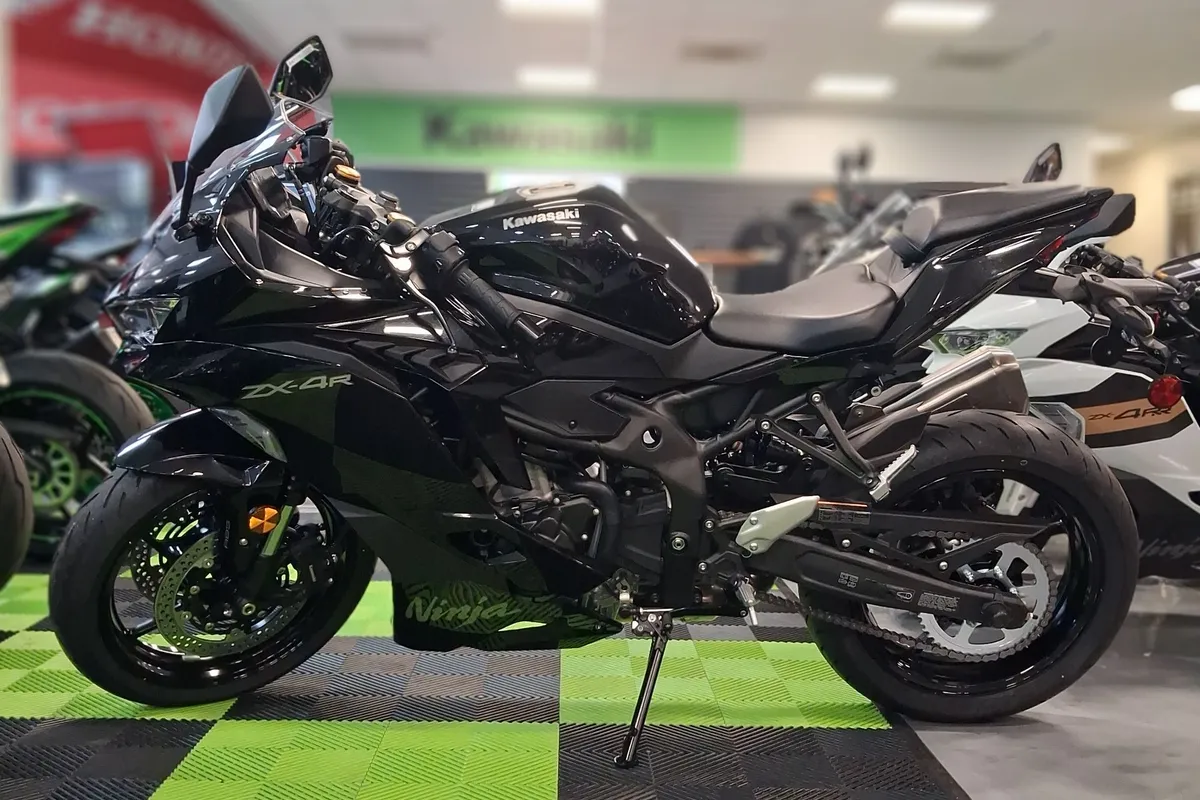
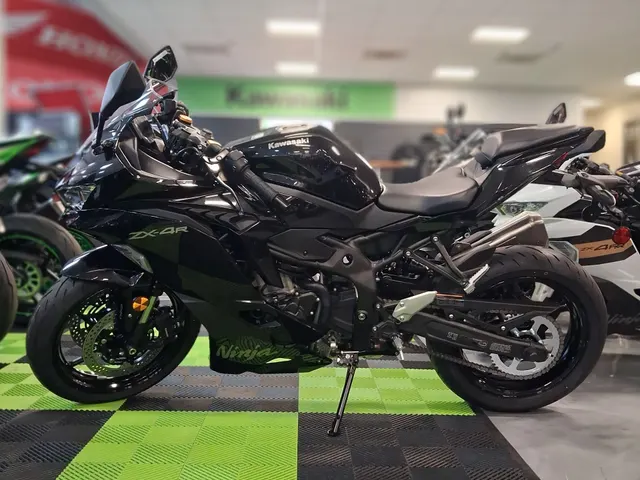
The 2026 Kawasaki Ninja ZX-4RR is a 399cc inline-four sportbike that revs past 15,000 rpm and makes almost none of its power below 9,000. It is the only new small-displacement four-cylinder motorcycle anyone sells, and it exists because Kawasaki decided to build a thing the market had stopped asking for.
Who it is for: an experienced rider who wants a track-day bike that is legal and cheap to run, or anyone who has heard a 400 four at full throttle and cannot let it go. Who it is not for: new riders, despite the number on the side panel, and anyone whose riding happens below 6,000 rpm.
The one thing to know before you shop it is the horsepower argument, because you will run into two different numbers and neither side is lying.
The 56 horsepower question
Kawasaki USA publishes 56.0 hp at 11,500 rpm and 26.5 lb-ft at 11,000 rpm for the Ninja ZX-4R and ZX-4RR. That is the figure on the American spec page for the bike sold here.
Kawasaki’s claims in other markets, and the figures that appear in international press tests, run closer to 77 to 80 horsepower. Those higher numbers travel with a ram-air qualifier — they describe the engine with airflow forced into the intake at speed, which is a different measurement of a different condition.
We quote the 56.0 figure throughout this review because it is the number Kawasaki publishes for the motorcycle Power Lodge sells. We are telling you about the other one because you will find it in five minutes of searching and deserve to know why it does not match. Anyone who cites the 80 without the ram-air context is selling you something.
What is not in dispute is where the power lives. Whatever the peak reads, it happens above 11,000 rpm, and that fact shapes everything about how this bike rides.
What the Kawasaki Ninja ZX-4RR is
A modern revival of the 400cc four-cylinder sportbikes that Japan built in the late eighties and nineties for its home market and then stopped building everywhere. Four cylinders in 399cc means tiny pistons, short strokes, and a rev ceiling that a twin cannot approach.
It sits in Kawasaki’s supersport line — below the ZX-6R in displacement, above nothing at all in that line, and entirely separate from the Ninja 500 despite the two bikes looking related in a catalogue.
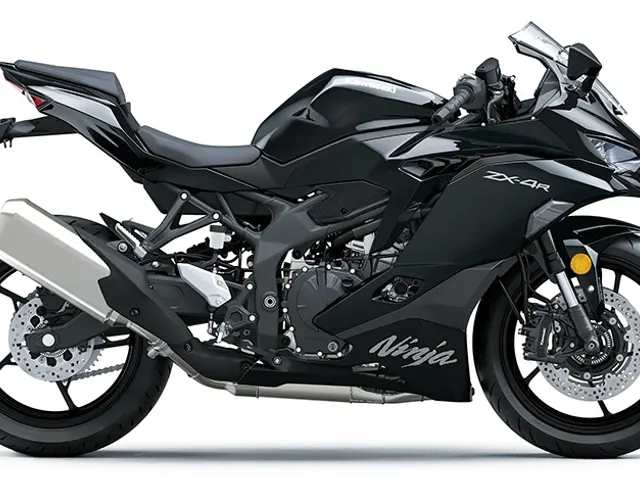
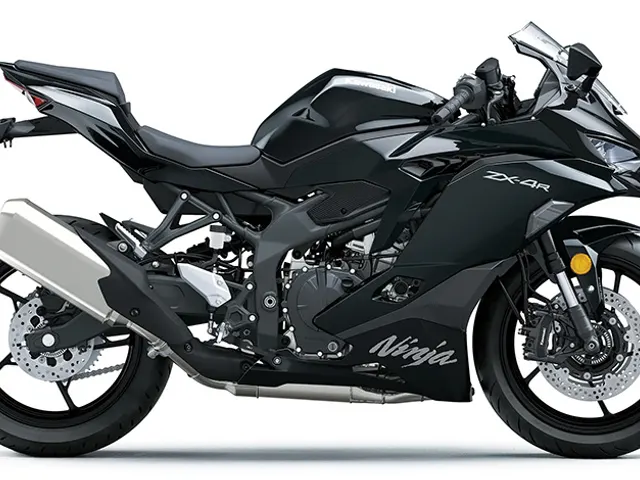
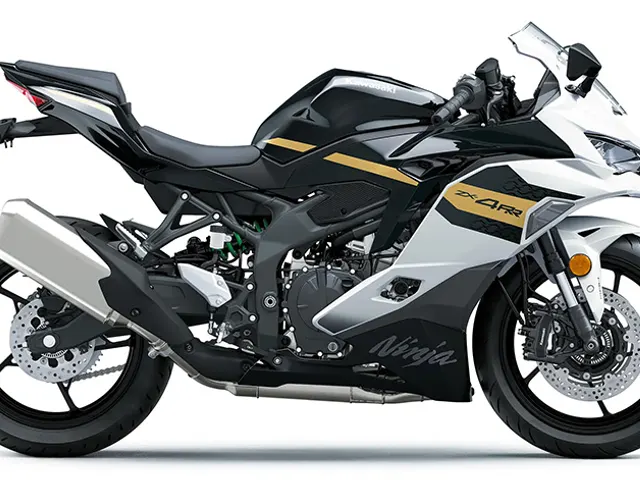
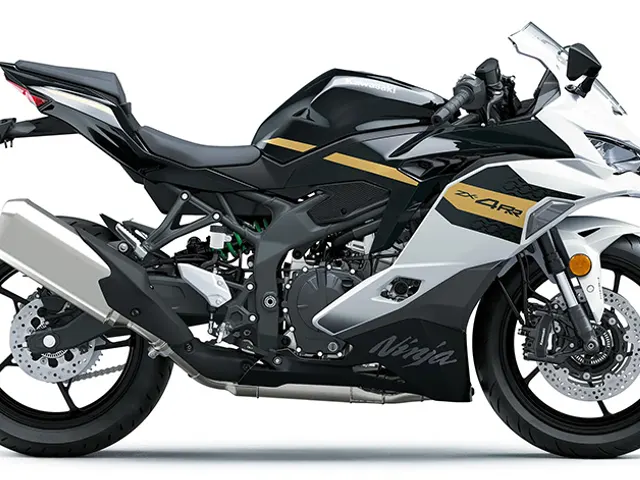
Two trims are on the floor. Ninja ZX-4R ABS is the standard bike, three units from the 2025 and 2026 model years listed between $8,999 and $9,299. Ninja ZX-4RR ABS is the higher-specification trim, two 2026 units listed at $9,999, matching MSRP.
What actually separates them, per Kawasaki’s 2026 trim pages: both run a 37mm inverted Showa fork with SFF-BP internals, but the RR adds spring-preload adjustability to it, swaps the standard back-link rear shock for Showa’s BFRC lite unit, and fits Kawasaki’s dual-direction quickshifter (KQS). The engine, the chassis, and the published output figures are identical. Whether firmer suspension control and clutchless shifts are worth the gap is a track-day question more than a street one — both trims are in the building, so sit on both.
| Engine | 399cc liquid-cooled DOHC inline-four, four-stroke |
|---|---|
| Horsepower (Kawasaki USA published) | 56.0 hp @ 11,500 rpm |
| Torque (Kawasaki USA published) | 26.5 lb-ft @ 11,000 rpm |
| Other-market claims | Approximately 77–80 hp, quoted with ram air |
| Transmission | Six-speed; Kawasaki Quick Shifter (KQS), dual-direction |
| Front suspension | 37mm inverted Showa fork, SFF-BP internals, spring preload adjustability |
| Rear suspension | Showa BFRC lite shock |
| Seat height | 31.5 in |
| Curb weight | 414.5 lb |
| Fuel capacity | 4.0 gal |
| Rider aids | Traction control, ride modes, ABS |
| Display | TFT |
| MSRP, 2026 ZX-4RR ABS | $9,999 |
| Listed on our floor, ZX-4R ABS (2025–26) | $8,999–$9,299 |
Source: kawasaki.com. Specs and pricing are the manufacturer's published figures and can change by model year.
Engine and performance: living above 11,000 rpm
Ride a ZX-4RR the way you ride a normal motorcycle and you will conclude it is slow. Roll on in fifth at 45 mph and very little happens, because at 4,000 rpm a 399cc four is a 399cc four.
Ride it the way it was designed and it becomes something else entirely. Keep it above 10,000, use the gearbox constantly, and the last third of the tachometer delivers a rush and a shriek that no parallel twin at any displacement produces. RideApart’s first ride of the ZX-4RR, by Adam Child, characterized it as a race-bred chassis with a screaming top end, and that is the machine.
The consequence is that this is a demanding motorcycle. Not dangerous — 56 published horsepower is not going to loop you — but demanding of attention and gear selection in a way a Ninja 500 never is. A rider who has not learned to keep a small engine on the boil will find the ZX-4RR frustrating and will not understand why everyone else is excited.
The 414.5-pound curb weight is worth staring at. That is heavier than a Ninja 500 and only about 22 pounds under a ZX-6R, which has 636cc and a published 127 horsepower. The four-cylinder architecture costs weight, and on a small bike you feel it.
On the road, and on a track day
The ergonomics are supersport: clip-ons, a 31.5-inch seat, a forward lean that is committed rather than punishing. It is a comfortable bike for two hours and a tiring one for six.
Track days are where the ZX-4RR makes total sense, and the appeal is economic as much as emotional. It is fast enough to be genuinely engaging, slow enough that a mistake happens at a survivable speed, and cheap enough to run that a set of tires does not end the season. It is one of the few new bikes bought specifically to be ridden hard on a closed course.
On the street, in Southwest Florida, the honest assessment is more mixed. The bike works well on Corkscrew Road and the Immokalee back roads, where you can actually use the revs — the routes are in the best rides in Southwest Florida. It works less well on US-41 in season, and there is a specific reason for that below.
What reviewers and owners say
The sound is the product. Owners on Kawasaki forums are close to unanimous, and they mostly bought the bike after hearing one. That is an unusual purchase driver and it is a real one.
Heat in traffic. The most consistent owner complaint, and the one that matters most here. Four cylinders packed into a small frame produce heat, and there is nowhere for it to go at a standstill. In August, on the Trail, at a light, this is not a comfortable motorcycle. Our heat and rain playbook helps at the margins; it does not change the engine.
Fuel consumption when you use it. Ridden the way it wants to be ridden, the ZX-4RR gets through fuel quickly. A 4.0-gallon tank makes that manageable rather than invisible.
Insurance. Owners consistently report premium quotes above what the displacement suggests, because insurers price supersport bodywork and a four-cylinder engine, not cubic centimeters. Get a quote before you commit — it is a real line item and it surprises people.
The press position. Coverage since launch has been consistent: the most exciting small sportbike on sale, and expensive and heavy compared with the twins it sits beside on a showroom floor. Both halves of that are true and neither cancels the other.
Is the Ninja ZX-4RR a beginner bike?
No, and the honest reasoning is worth spelling out because the displacement fools people every week.
Beginner-friendliness is about how power arrives, how much a bike weighs, and how much it forgives. The ZX-4RR delivers power in a narrow band near the top of the range, which means constant downshifting. It weighs 414.5 pounds. It has committed ergonomics. And it costs $9,999 at MSRP against $5,799 for the Ninja 500 ABS, which is a $4,200 gap that buys a beginner nothing they can use.
Buy it as a second or third bike, or as a first bike if you already ride and are coming from a decade off. Florida requires a motorcycle endorsement and a Basic RiderCourse before any of this is theoretical — the path is in our endorsement guide, and the sensible first bikes are in our beginner shortlist.
Recalls and known issues
For the Kawasaki Ninja ZX-4R and ZX-4RR, none found in the NHTSA database as of September 2026.
That covers the model, not the machine. Run the VIN of the specific bike at nhtsa.gov/recalls before you sign — thirty seconds, and it is the only way to be certain about one motorcycle.
Price and what is on the floor
As of September 2026, the Power Lodge floor holds two 2026 Ninja ZX-4RR ABS units listed at $9,999, matching the 2026 MSRP, and three Ninja ZX-4R ABS units from the 2025 and 2026 model years listed between $8,999 and $9,299. Freight, prep, tax, and tag are additional — ask for the out-the-door figure.
Five 400cc four-cylinder sportbikes in one building is not a normal thing for a dealership to have, and it will not be a permanent one.
How it compares
Kawasaki Ninja 500 ABS, from $5,799 at MSRP, is the opposite philosophy at two-thirds the price: a 451cc twin with 51 published horsepower and torque you can use at any rpm. It is the better street bike for almost everyone and the worse track bike for almost anyone. Full details in the Ninja 500 review.
Kawasaki Ninja 650 ABS, listed at $7,699 against an $8,199 MSRP for the 2026 ABS model, is the practical middleweight — 649cc, 67 published horsepower, real midrange, and a bike you can commute on without planning around heat. See the Ninja 650 review.
Kawasaki Ninja ZX-6R, listed from $11,399 on our floor, is the next rung of the same ladder: 636cc, a published 127 horsepower, and roughly 22 more pounds. If what you want is the supersport experience rather than the small-four novelty, the ZX-6R is more motorcycle for about $1,400 more.
There is no direct rival to name, which is the strange position this bike occupies. Yamaha’s R3 and the 400-class twins compete with it on price and on nothing else.
Highs
- The only new 400cc inline-four on sale, and it sounds like it
- Revs past 15,000 rpm with a genuine top-end rush
- Race-bred chassis that flatters a competent rider
- Traction control, ride modes, and a TFT dash as standard
- Cheap to run hard compared with a litre bike
Lows
- Almost nothing below 9,000 rpm — demands constant shifting
- 414.5 lb, heavier than a Ninja 500 and near a ZX-6R
- Runs hot in stop-and-go, which is most of season on US-41
- Insurance quotes above what the displacement suggests
- Kawasaki USA's 56 hp and the ram-air numbers do not agree
Everything on this page comes from Kawasaki’s published specifications, professional road tests, owner reports, and what the crew sees on the floor and in the service bay. Our standard is on how we review. The rest of the street coverage lives in The Stable.
Five units across both trims. Live inventory and today's price.
Quick answers
- How much horsepower does the Kawasaki Ninja ZX-4RR have?
- Kawasaki USA publishes 56.0 horsepower at 11,500 rpm and 26.5 lb-ft at 11,000 rpm. Kawasaki's claims in other markets and figures quoted in international press tests run closer to 77 to 80 horsepower with ram air. Both numbers are real; they are not measuring the same thing.
- Is the Kawasaki Ninja ZX-4RR a good beginner bike?
- No. The displacement misleads people — a 399cc four that makes its power above 11,000 rpm demands constant gear selection, weighs 414.5 pounds, and costs more to insure than bikes with twice the engine. The Ninja 500 is the beginner bike in this showroom.
- What is the difference between the Ninja ZX-4R and the ZX-4RR?
- Per Kawasaki's 2026 trim pages, the RR adds spring-preload adjustability to the Showa SFF-BP fork, upgrades the rear shock to Showa's BFRC lite unit, and fits Kawasaki's dual-direction quickshifter (KQS). Engine, chassis, and published output are identical, and the RR lists about $700 to $1,000 above the R on our floor.
- How fast does the Kawasaki Ninja ZX-4RR rev?
- Past 15,000 rpm. That is the entire point of the motorcycle and the reason a 399cc four exists at all — the power arrives in the last third of the tachometer, accompanied by a noise no parallel twin can make.
- How much is the Kawasaki Ninja ZX-4RR?
- Two 2026 ZX-4RR ABS units are listed at $9,999 each on the Power Lodge floor as of September 2026, matching the MSRP in our feed. Three ZX-4R ABS units from the 2025 and 2026 model years are listed between $8,999 and $9,299.