Review · The Trailhead
Kawasaki Teryx KRX4 1000 eS Review: The Four-Seat Sport UTV With Real Suspension Tech
Twenty-one inches of rear wheel travel, shocks that re-valve themselves several times a second, and four seats. The KRX4 is not the quickest thing in its class and it does not need to be.
By The Outpost CrewUpdated 7 min read
How this review was built: from Kawasaki's published specs, professional road tests, owner reports, and what the Power Lodge crew sees on the showroom floor and in the service bay — not a first-hand test ride. Prices are MSRP unless the live listing below says otherwise.How we review →
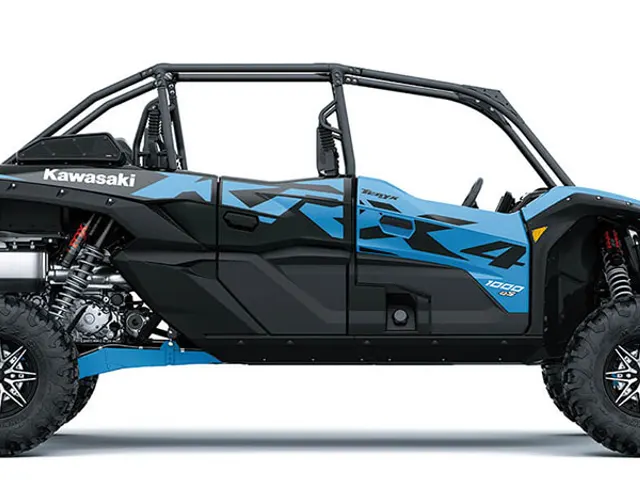
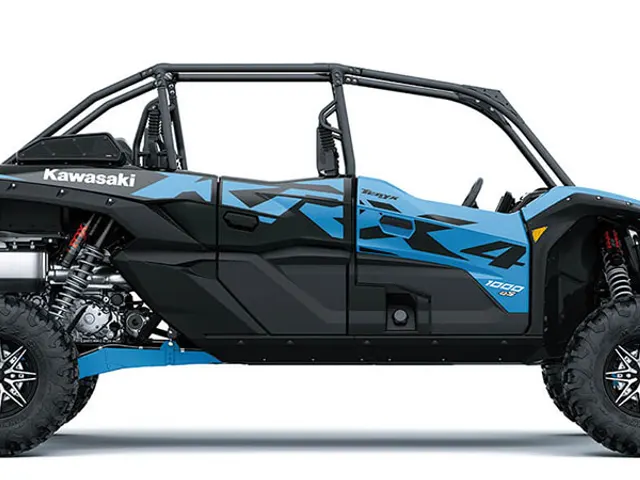
The KRX4 is the four-seat sport machine you buy for the suspension, not for the stopwatch. Eighteen and a half inches of front travel, 21.1 inches at the rear, and FOX 2.5 Live Valve shocks that re-valve themselves as you drive — on a 2026 Kawasaki Teryx KRX4 1000 eS listed at $23,999 on the Bonita Springs floor as of September 2026, against a $26,999 MSRP on Kawasaki’s 2027 page.
The engine is a 999cc parallel twin making 110 horsepower and 75.2 lb-ft, which is a lot in absolute terms and mid-pack in a class where turbocharged rivals make two hundred. Kawasaki did not build this to win a drag race down a fire road. They built it to be the machine still comfortable at hour six, with four people in it, on ground that would have shaken a lesser chassis apart.
If you have been cross-shopping four-seaters and cannot work out why this one costs what it does while making less power than the alternatives, the answer is the shocks and the structure underneath them.
What the Kawasaki Teryx KRX4 1000 eS is
A four-seat, full-size sport side-by-side — the recreation tier, not the work tier. In Kawasaki’s range it sits above the two-seat KRX 1000, alongside the supercharged Teryx4 H2 that tops the line, and entirely apart from the MULE utility family, which is where Kawasaki puts bed and tow ratings.
The eS is the trim that matters, and the letters are not marketing. Per the OEM specification sheet on the unit, eS means FOX 2.5 Live Valve Internal Bypass shocks managed by Kawasaki Electronic Control Suspension (KECS), with selectable three-mode semi-active damping. That is a genuinely current suspension technology on a machine at this price, and it is the single strongest reason to choose this over a conventionally sprung four-seater.
| Engine | 999cc DOHC eight-valve parallel twin, four-stroke, liquid-cooled |
|---|---|
| Power / torque | 110.0 hp @ 8,500 rpm / 75.2 lb-ft @ 7,000 rpm |
| Transmission | Automatic CVT with centrifugal clutch, H / L / N / R |
| Drive | 2WD / 4WD with locking front differential |
| Suspension | FOX 2.5 Live Valve Internal Bypass shocks with KECS three-mode semi-active damping |
| Suspension travel | 18.6 in front / 21.1 in rear |
| Ground clearance | 14.2 in standard, up to 15.2 in at maximum preload |
| Curb weight | 2,108 lb |
| Dimensions | 157.3 in long × 68.1 in wide × 76.2 in high; 125.8-in wheelbase |
| Seating | 4 |
| Cargo bed | 351 lb |
| Towing | Not rated by Kawasaki |
| Tires | Maxxis Carnivore 31 x 10.00R15, 8-ply |
| Display | 7-in high-grade full-color TFT with smartphone connectivity |
| Fuel capacity | 10.6 gal |
| Warranty | Six months, limited |
| MSRP | $26,999 (2027 model) |
Source: powerlodgefl.com. Specs and pricing are the manufacturer's published figures and can change by model year.
Engine and performance
One hundred ten horsepower from a naturally aspirated 999cc parallel twin is honest, usable power, and the 75.2 lb-ft peak arriving at 7,000 rpm tells you what kind of engine it is: one that wants revs. It pulls cleanly from the middle and keeps going, and the CVT with its centrifugal clutch engages smoothly enough at walking pace to make rock work and tight trail transitions manageable.
What it is not is fast for the class. Dirt Wheels’ testing of the four-seat KRX put acceleration as modest against its competition, and that is a fair characterization — a 2,108-pound machine with 110 horsepower is not going to trade blows with a turbocharged sport rig. Kawasaki’s own answer to that criticism is the supercharged Teryx4 H2, which sits on this floor at $43,199 as listed for the 2026 model and is a different conversation entirely.
The more interesting number is what the four-seat body cost. Dirt Wheels’ assessment is that the KRX4 added only around 310 pounds over the two-seater and kept the comfort and what they call crazy technical trail capability. Adding two seats and a foot of wheelbase for that little penalty is the engineering achievement here, and it is why the KRX4 does not feel like a stretched compromise the way some four-seaters do.
On the trail
Twenty-one inches of rear wheel travel is the headline and the semi-active damping is what makes it usable. A conventional long-travel shock is a compromise you set in the parking lot: firm enough for speed means harsh at a crawl, and plush at a crawl means wallowing at speed. KECS re-evaluates damping continuously and lets you pick a base mode on top of that, which means the machine can be soft over roots at 10 mph and controlled over whoops at 45 without you touching a clicker.
UTV Guide’s 60-mile first ride on the eS came back praising exactly those two things: the suspension and the low-speed control. Low-speed control is the underrated half. Most sport machines are unpleasant below 15 mph, and a four-seat family machine spends a lot of its life there.
Ground clearance is 14.2 inches standard and up to 15.2 at maximum preload, which is the number that matters most in Southwest Florida. Wet-season ruts here get deep enough between June and November to bottom out machines with a foot of clearance, and the KRX4 clears them. The 31-inch Maxxis Carnivores are a genuine eight-ply tire rather than a soft OEM compromise, which matters when the ground under Florida sand turns out to be limerock.
Size is the honest cost. At 68.1 inches wide and 157.3 inches long on a 125.8-inch wheelbase, this is a large vehicle — check the posted width limit at any trail system before you tow it there, and plan on a full-size trailer and a tow vehicle rated for the 2,108-pound curb weight plus the trailer. It is also, at 65-plus inches, firmly on the recreational-off-highway-vehicle side of Florida’s definitions rather than the ATV side, which settles the road question; that is covered on are UTVs street legal in Florida.
What reviewers and owners say
The reviewer consensus is consistent: the chassis and suspension are the product, the engine is adequate, and the four-seat conversion cost less than it should have. Dirt Wheels’ test of the KRX4 platform makes both points. UTV Guide’s eS first ride adds the specific praise for the electronic damping and low-speed manners.
Owner reporting on the KRX forums runs in two directions and both are useful. On the positive side, there is a long-running thread culture around suspension tuning, and the recurring finding is that the FOX adjusters genuinely reward time spent on them — this is a machine that gets better if you learn it, which is not true of every side-by-side. On the negative side, there are documented owner threads about power and idle gremlins where the dealer visit did not resolve the complaint. That is a real theme worth raising with a service department before you buy — and a reason to buy where one exists.
One more number to weigh honestly: the specification sheet on this unit lists six months of limited warranty. Kawasaki’s own MULE utility sheets list three years. Six months on a $24,000 sport machine is short, and it should factor into the decision.
Living with it in Southwest Florida
Salt air, sugar sand, and UV set the maintenance rhythm. Rinse after brackish, beach-adjacent, or muddy work; keep the radiator face clear, because a packed radiator on a 110-horsepower engine in August is how you find out about heat soak; and store it out of the sun.
Three things specific to this machine. The CVT belt is the wet-season service item, and 2,108 pounds pushed through deep water gives a belt the worst day of its life — our mud and sand setup guide is the post-ride list. The Live Valve shocks are sealed electronic components living behind the wheels, so rinse them thoughtfully rather than blasting the connectors with a pressure washer. And there is no winch fitted, which on a machine this heavy is the first accessory to budget for.
Florida titles it as an off-highway vehicle with no plate — see OHV title and registration — and for where to actually use it, our Southwest Florida riding guide has the permits, hours, and drive times.
Recalls and known issues
None found for the Kawasaki Teryx KRX4 1000 in the CPSC recall database as of September 2026. Off-highway vehicles are recalled through the Consumer Product Safety Commission rather than NHTSA, so search cpsc.gov and saferproducts.gov, and register the VIN with Kawasaki.
One current Kawasaki campaign gets confused with this machine and should be bounded precisely: recall #26550, issued June 2026, covers 2026 model-year Teryx4 H2 and Teryx5 H2 recreational off-road vehicles for impact and injury hazards. Those are the supercharged models. The KRX4 is not in scope.
The known-issues list from owner reports rather than formal recalls is the power and idle reporting noted above, plus the universal belt caution.
Price and what is on the floor
MSRP is $26,999 on Kawasaki’s 2027 model page. On the Bonita Springs floor as of September 2026 there are two 2026 Teryx KRX4 1000 eS units listed at $23,999. Freight, prep, and Florida sales tax are separate; the math is on our sales tax guide.
How it compares
Inside Kawasaki’s own range, the choices are seats and boost. The two-seat KRX 1000 is the same idea, shorter and lighter. The supercharged Teryx4 H2 Deluxe eS at $43,199 as listed is where the power complaint gets answered, at a very different price. And if what you actually need is a bed and a tow rating, you are shopping the wrong family — that is the MULE lineup.
Across the floor, the two real cross-shops are Honda’s Talon 1000X-4, a four-seat sport machine with Honda’s six-speed DCT gearbox and no drive belt — the three Talons in the building list from $22,799 — and Can-Am’s sport range, where the Maverick X3 MAX and the 240-horsepower Maverick R are quicker and considerably more expensive. Honda’s FOX Live Valve Talons are the closest suspension-tech rivals here, and the four-seat Talon X-4 FLV lists at $34,995 on our floor; the KRX4 answers with 21.1 inches of rear travel, KECS damping, and an as-listed price roughly $11,000 under it.
For anyone whose four seats are really about work rather than play, the utility answer is the Can-Am Defender comparison — same money buys six seats, 2,500 pounds of towing and a 1,000-pound bed, with far less suspension.
Highs
- FOX 2.5 Live Valve shocks with KECS semi-active damping
- 18.6 in front and 21.1 in rear travel with 14.2 in of clearance
- Four seats for roughly 310 lb over the two-seater
- 31-in eight-ply tires and a 7-in TFT as standard equipment
Lows
- Six-month factory warranty on a $24,000 machine
- 110 hp is mid-pack against turbocharged rivals
- 68.1 in wide and 2,108 lb — a full-size trailer proposition
- No winch, and Kawasaki publishes no tow rating
Two on the floor in Bonita Springs, with live pricing.
Quick answers
- What does eS mean on the Kawasaki Teryx KRX4 1000?
- Electronic suspension. The eS trim fits FOX 2.5 Live Valve Internal Bypass shocks controlled by Kawasaki Electronic Control Suspension, with selectable three-mode semi-active damping. The shocks adjust their damping continuously as you drive rather than waiting for you to turn a clicker.
- How much horsepower does the Kawasaki Teryx KRX4 1000 have?
- 110 horsepower at 8,500 rpm and 75.2 lb-ft of torque at 7,000 rpm from a 999cc DOHC eight-valve parallel twin, per the OEM specification sheet. It drives through a CVT with a centrifugal clutch and high, low, neutral and reverse.
- How wide is the Kawasaki Teryx KRX4 1000?
- 68.1 inches wide and 157.3 inches long on a 125.8-inch wheelbase, with a curb weight of 2,108 pounds. That is a full-size sport machine — check the width limit posted at any trail system you plan to ride, and plan on a full-size trailer.
- How much suspension travel does the KRX4 have?
- 18.6 inches in front and 21.1 inches at the rear, with 14.2 inches of ground clearance standard and up to 15.2 inches at maximum preload. That is among the most travel of any four-seat machine at this price.
- Can the Kawasaki Teryx KRX4 1000 tow?
- Kawasaki does not publish a towing rating for the KRX4. The cargo bed is rated at 351 pounds. This is a sport machine, not a utility one — for towing and hauling, the MULE line is where Kawasaki puts those numbers.