Review · The Boathouse
Crownline 200 FS Review: A Do-It-All 20-Foot Bowrider for Southwest Florida Bays
The only fiberglass boat under fifty thousand dollars on our floor, and the one machine here that fishes on Saturday and pulls a tube on Sunday.
By The Outpost CrewUpdated 8 min read
How this review was built: from Crownline's published specs, professional road tests, owner reports, and what the Power Lodge crew sees on the showroom floor and in the service bay — not a first-hand test ride. Prices are MSRP unless the live listing below says otherwise.How we review →
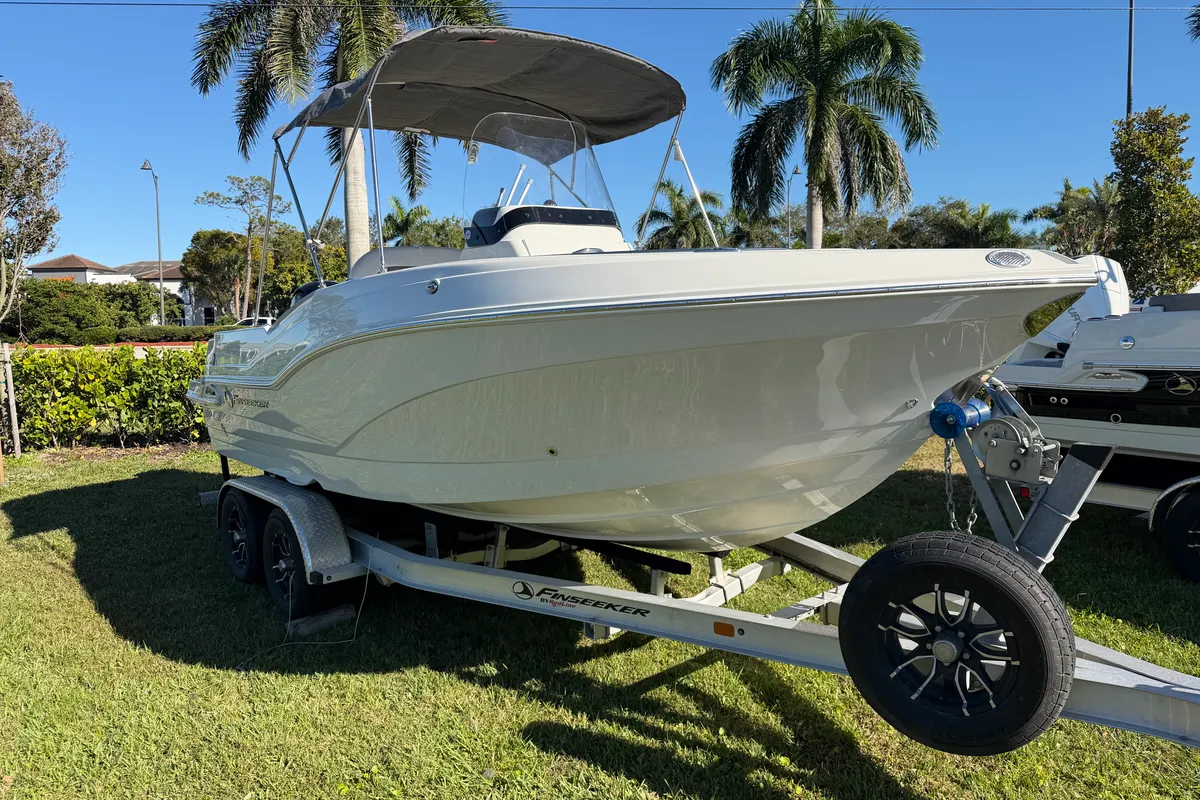
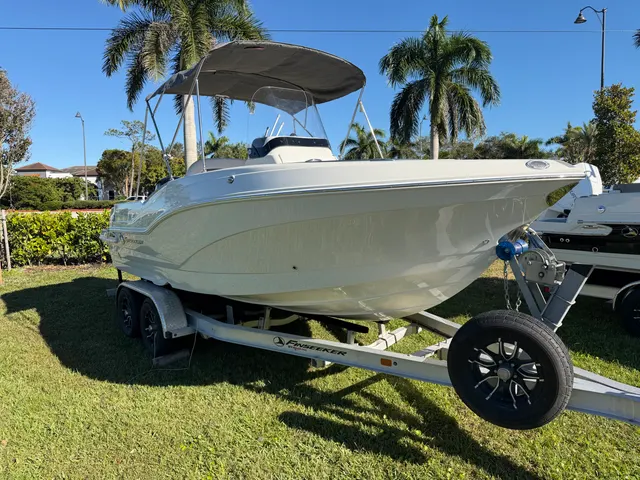
The 2024 Crownline 200 FS is the only fiberglass boat on the Power Lodge floor under $50,000, and it is the machine for the buyer whose weekend splits: nearshore fishing when the wind cooperates, a tube behind the boat when it does not. It is listed at $49,990 as of September 2026 against a feed MSRP of $59,990.
It measures 20 feet 6 inches of hull — 22 feet 6 inches with the outboard — on an 8-foot-6-inch beam, with a 19-degree deadrise, 71 gallons of fuel, six built-in rod holders, twin 9-inch Garmin touchscreens, and Wet Sounds speakers. Crownline’s own line for it is “fishable from bow to stern.”
One thing to sort out before anything else. The dealer badges this boat a 200 FS; FS is the Finseeker series, and the specifications on the listing match the boat Crownline publishes on its Finseeker 200 page exactly — same length, same beam, same deadrise, same dry weight, same tank. Crownline’s current series page lists that boat as the 200 CC. We could not check the badge against a 2024 Crownline catalog, so read the identification as a well-supported inference and have the dealer confirm the exact model designation on the hull.
What the Crownline 200 FS is
Crownline built its name on fiberglass sport boats and bowriders, and Finseeker is what happened when that fit-and-finish went fishing. The company describes the line as “outboard fishing boats” that are “fully customizable for the most discerning sportsmen,” and it runs from this 200 up through 210, 220, and 230 center consoles to dual-console and walkaround hulls in the 240 to 280 range.
The 200 is the entry point, and in Southwest Florida it is the size that makes the most sense for a first boat. Twenty feet fits a driveway and a normal-sized truck. It handles Estero Bay, San Carlos Bay, and Pine Island Sound comfortably, reaches the passes, and can run nearshore on a calm morning. It is not the boat for a 30-mile offshore day, and it does not pretend to be.
| Length overall | 20 ft 6 in (6.25 m) |
|---|---|
| Length with engine | 22 ft 6 in (6.86 m) |
| Beam | 8 ft 6 in (2.59 m) |
| Deadrise | 19 degrees |
| Dry weight (Crownline figure) | 4,205 lb (1,907 kg) |
| Fuel capacity | 71 gal (268 L) |
| Hull | Fiberglass |
| Power | Single outboard; make and horsepower not itemized on this listing |
| Rod holders | Six, built in |
| Electronics | Twin 9-inch Garmin touchscreens |
| Audio | Wet Sounds speakers |
| Maximum horsepower | Not published by Crownline |
| Person capacity | Not published by Crownline — read the capacity plate on the boat |
| Listed at Power Lodge, September 2026 | $49,990 (1 unit, 2024 model year) |
| Feed MSRP, 2024 model year | $59,990 |
Source: Crownline Finseeker 200 spec page, plus the Power Lodge unit listing (2026-09-03). Specs and pricing are the manufacturer's published figures and can change by model year.
Two of those rows are worth pausing on. Crownline does not publish a maximum horsepower or a person capacity for this model, which means the capacity plate on the boat itself is the only number that governs — and it is best read before the boat fills with guests. And the 4,205-pound dry weight is a substantial figure for 20 feet 6 inches of boat; confirm the actual trailered weight with fuel, engine, and gear before you match it to a tow vehicle.
Engine and performance: the number that is not on the listing
The floor unit is rigged with a single outboard that the listing does not name, and on a boat this size that is the specification that decides its character. Which engine, how many hours, and how much factory warranty remains — settle those three before anything else.
For a sense of what the line does with real power, Boating tested the larger Finseeker 220 center console with a Mercury 225 four-stroke V-6 and recorded a 45.1-mph top speed. That is a different, longer boat, so treat the figure as a line reference rather than a number for this hull — a 20-footer with less engine will not match it, and one rigged to the top of its rating may not be far off.
Fuel is where this boat is genuinely well specified. Seventy-one gallons on a 20-footer is a lot of range for bay work, which is what turns a nearshore run into a comfortable decision rather than a calculation. It also means filling it is a real bill in season.
On the water: 19 degrees and a high bow
The hull number that matters here is the 19-degree deadrise. That is a moderate-V — sharp enough to cut a bay chop without beating everybody aboard, flat enough to stay stable at rest when you are casting or somebody is climbing back aboard. For water that is flat at seven in the morning and unpleasant by two in the afternoon, moderate-V is the right compromise, and it is why so many boats of this size on this coast are built the same way.
Boating’s assessment of the larger Finseeker was that the designers had built a hull with “the strength of a sumo wrestler and the agility of a martial-arts champion,” and credited the high bow with getting it safely through rough inlets. That family resemblance is the useful part for a 200 shopper: this is a hull line drawn for salt water and pass conditions, not a freshwater bowrider with rod holders bolted on.
What 20 feet 6 inches will not do is make the Gulf small. On a day when the sea breeze has been at it since noon, this is a boat you take home rather than push through, and the honest planning habit on this coast is to be back inside the pass before the afternoon builds.
What reviewers and owners say
The most useful sourced assessment of a Finseeker is Boating’s test of the 220 center console. Alongside the speed figure, the reviewer’s complaints were specific and worth knowing: the centered 12.5-gallon livewell was smaller than the tester wanted, with the note that enlarging it would have cost storage underneath, and the trim-tab switches were awkwardly placed on a vertical face of the console — a detail Crownline subsequently relocated.
Finseeker’s first entrée into the saltwater fishing market is a strong one that won’t disappoint anglers and will certainly appeal to family cruisers.
Owner discussion is a gap we would rather name than paper over. The forums where center-console owners compare notes on long-term ownership were unreachable during this research pass, so there is no owner-sentiment section on this page. On a 2024 boat with one example in the building, the substitute is the boat itself: look at the hardware, the hatch gaskets, the wiring behind the console, and the transom.
Fishing and family, on the same hull
“Fishable from bow to stern” is a layout claim, and on a center console it means what it says: you can walk the boat and cast in any direction without a windshield or a bow seat in the way. Six built-in rod holders and twin 9-inch Garmin screens are a genuinely equipped starting point rather than a token gesture.
The family side works because a center console with a 19-degree hull and 8 feet 6 inches of beam is a stable platform to swim off, and because Crownline came to fishing boats from sport boats. Wet Sounds audio on a fishing hull is a tell about who the company thinks is buying it.
Where this boat asks you to choose is comfort. There is no shade unless it has a top, no head, and nowhere for a grandparent to sit out of the sun for four hours. That is the trade a center console makes, and it is why the pontoon annex exists a few spaces away on the same floor — the tube-by-tube version of that decision is in our pontoon buyer’s guide.
Living with a Crownline 200 FS in Southwest Florida
This is the rare boat on our floor that trailers as naturally as it lifts. At 8 feet 6 inches of beam it is a wide but ordinary tow, and a 20-footer fits in more driveways than a tritoon does — which matters, because in Lee and Collier counties the storage bill outruns every other cost of keeping a boat. If it lives on a trailer, budget for a truck that is comfortable with the loaded weight rather than merely capable of it.
Salt care on an outboard boat is engine-first. Flush the outboard after every salt trip per the engine manufacturer’s procedure, rinse the boat and the trailer, and pay attention to the two systems a fishing boat has that a bowrider does not: the livewell plumbing and the transducer. Both are additional paths for salt water to sit somewhere and work on metal.
The electronics deserve the same attention. Twin 9-inch screens, a stereo, and a battery living under a console in August humidity are the things that fail first on a boat used hard here, and they are worth checking on a 2024 hull that has already spent a season in the heat.
The paperwork is simple by comparison. At 20 feet 6 inches this boat registers as a Class 1 vessel — 16 feet to under 26 feet — under § 328.72, Fla. Stat. (2026), the cheapest bracket that any real boat lands in, and the whole errand is in our registration and titling guide. Whoever runs it needs the boating safety card if born on or after January 1, 1988, which has its own clock. And a trailerable boat is a genuine advantage from June to November — being able to tow it inland is the simplest hurricane plan there is, and the rest of that plan is in our hurricane-season prep guide.
Recalls and known issues
None found for the Crownline Finseeker 200 in the U.S. Coast Guard recall database as of September 2026, based on a spot-check of uscgboating.org’s recall listing. The database’s manufacturer filter is unreliable, so treat that as a point-in-time check rather than a clean bill.
A boat carries a hull identification number rather than a VIN. Have the dealer run this hull’s HIN before delivery, and run the outboard’s serial number separately — on an outboard boat the engine carries its own recall and warranty history, and it is the more expensive half of the machine.
Price and what is on the floor
One 2024 Crownline 200 FS, listed at $49,990 as of September 2026 against a feed MSRP of $59,990 for that model year, in black, red, and white. Freight, prep, and Florida tax, title, and registration are additional.
That is the entire fiberglass-boat inventory in the building, which is the honest context for the price: this is a carryover model year, one hull, and no second unit to compare it against. What that means practically is that the negotiation is about this boat’s rigging and condition rather than about a model line.
How does the Crownline 200 FS compare?
Under this roof, the comparison is a category question rather than a spec question. The Premier 250 Solaris REV at $167,869 as listed carries three times the people in far more comfort and cannot fish the way this hull can. The ALERA and Balise pontoons sit in the same premium bracket. Nothing else here is a fiberglass fishing boat.
The genuinely interesting cross-shop is smaller and cheaper. A Sea-Doo FishPro Trophy at $21,899 to $22,649 as listed is a purpose-built fishing personal watercraft with a livewell that gets into water this hull cannot reach, for less than half the money — and gives up the deck space, the range, and the ability to take four people. That fork is worked through in PWC or boat.
Outside our brands, shoppers at this size and price routinely cross-shop Robalo and Sea Hunt center consoles, and they should. What Crownline brings to that fight is sport-boat finish, a 71-gallon tank, and a price on a carryover hull. What it gives up is the published max-horsepower and capacity data those builders put on their own spec pages.
Highs
- Only fiberglass boat under $50,000 on the floor
- 71 gallons of fuel is generous range for a 20-footer
- 19-degree deadrise handles bay chop without punishing anyone
- Six rod holders and twin 9-inch Garmin screens as delivered
- Fishes and family-cruises on the same hull
- Trailerable, which simplifies both storage and storm season
Lows
- Engine make and horsepower are not itemized on the listing
- Crownline publishes no maximum horsepower or person capacity
- 4,205 lb dry is heavy for the length — confirm the tow weight
- No shade, no head, no soft seating for a long day
- One 2024 hull on the floor, no second unit to compare
- Boating wanted a bigger livewell on the larger Finseeker
One 2024 hull in Bonita Springs — live listing, photos, and today's price.
Quick answers
- How big is a Crownline 200 FS?
- 20 feet 6 inches of hull, or 22 feet 6 inches with the outboard hanging off the back, on an 8-foot-6-inch beam. Crownline publishes a 19-degree deadrise and a 4,205-pound dry weight for the boat, and a 71-gallon fuel capacity.
- Is the Crownline 200 FS a fishing boat?
- Yes. Finseeker is Crownline's outboard fishing line, and the 200 is built with six rod holders, twin 9-inch Garmin touchscreens, and a layout the company calls "fishable from bow to stern." It is a fishing boat that a family can also use, rather than a family boat with rod holders.
- How much is a Crownline 200 FS?
- The 2024 unit at Power Lodge is listed at $49,990 as of September 2026, against a feed MSRP of $59,990 for that model year. It is the least expensive boat in the building by a wide margin. Freight, prep, and Florida tax, title, and registration are additional.
- How fast is a Crownline Finseeker?
- Boating recorded a 45 mph top speed testing the larger Finseeker 220 with a Mercury 225 four-stroke. The engine on the 200 in Bonita Springs is not itemized on the listing, so ask before you assume a number — outboard choice moves top speed more than hull length does.
- Can you take a 20-foot center console offshore in Southwest Florida?
- On a calm morning, nearshore, with fuel discipline and a weather plan — yes, people do it constantly here. Twenty feet is a bay-and-nearshore boat, not an offshore boat, and the Gulf gets a chop on faster than most new owners expect.
- Crownline 200 FS or a pontoon?
- Fishing decides it. A tritoon carries more people in more comfort and costs far more; the Finseeker hull goes further, in worse water, with a rod in your hand. If your Saturday is entertaining 12 people, buy the pontoon.