Buyer's Guide · The Boathouse
Pontoon vs Tritoon in Southwest Florida: The Buyer's Guide (Premier, ALERA, Balise)
On this coast the tube count is usually settled by the weather. The harder questions are what the boat is rigged for, where it sleeps, and which builder will actually show you a spec sheet.
By The Outpost CrewUpdated 10 min read
On Southwest Florida water, buy the tritoon. Three tubes rather than two, because the water you are actually going to use is open bay that gets a chop on it by early afternoon, and because the third tube is what lets a boat this size carry enough engine to be pleasant rather than merely adequate.
That is the easy half of the decision, and it is the half most buyer’s guides spend all their time on. The harder questions are the ones the brochures answer badly: what the boat is rigged for in salt water, which layout matches the way you will actually use it, where the thing is going to sleep, and — on two of the three lines Power Lodge stocks — whether the builder publishes any specifications at all.
This guide works through those in order, using the boats currently on the floor in Bonita Springs as the worked examples. Where the documentation is thin, it says so rather than filling the gap with adjectives.
How to think about it: five decisions
- Two tubes or three. Settled by your water more than your budget. Open bay and passes want three.
- Salt rigging. Not a given, not always published, and the difference between a boat that ages well here and one that does not.
- Layout and capacity. What the boat is for on a normal Saturday, not on the one day a year you have 16 people.
- Where it sleeps. Lift, slip, rack, or trailer. This predicts how often you use it better than any spec.
- Power. On a tritoon the engine is a large fraction of the price and most of the personality.
Pontoon or tritoon?
Two tubes work fine on protected water. Canals, rivers, the back of a bay on a calm morning — a twin-tube boat is lighter, cheaper, and perfectly pleasant. If your water never gets rough and you never need to be anywhere quickly, you can stop reading and save money.
Three tubes buy three things: buoyancy, planing surface, and the ability to hang a bigger outboard on the transom without the boat squatting. That combination is what makes a 26-foot boat ride flat with 12 people aboard when the sea breeze has been working since noon.
Premier’s version of the third tube is its PTX chassis, and the company is specific about what it claims for it: “the best cruising comfort with 17% lower planing speed,” “5% tighter turning radius and faster cornering speed,” “up to 15% more top-end speed,” “up to 17% improved efficiency,” and “up to 218% more center-locker volume.” Those are manufacturer figures with no published baseline — presumably measured against Premier’s own conventional boats — so read them as a statement of design intent rather than as independent test results. The direction is right even where the percentages are unverifiable.
Are pontoons good in salt water?
Yes, with a caveat that matters more than the answer. Aluminum tubes and salt water coexist all over this coast; what determines how well is how the boat was built and rigged, and that is a per-boat question rather than a brand question.
Here is the honest state of the documentation for the three lines on this floor. Premier’s Solaris page does not publish a saltwater package. ALERA publishes no specifications at all. Balise’s own website is under construction. So there is no spec sheet anywhere that tells you what a given hull is protected with — which makes the build sheet the single most important document in the transaction.
Ask for it, and ask specifically about anodes, fastener and hardware materials, and whether the boat was ordered for salt-water service. If it will live in the water on a lift rather than out of it, settle the bottom-paint question before delivery instead of six months later when something is growing on the tubes.
The rest of salt-water ownership is the same discipline every machine on this coast needs: rinse the boat after use, flush the outboard per the engine manufacturer’s own procedure, and treat electrical connections as the things that fail first. The PWC version of that routine, which translates almost directly, is in our salt-water maintenance guide.
Layouts: what the boat is actually for
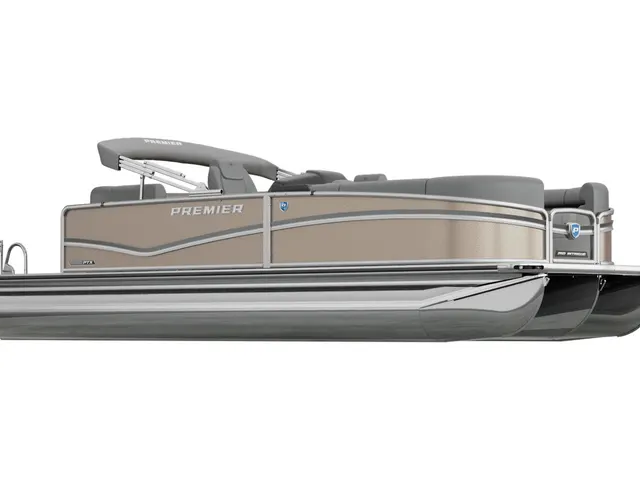
Pontoon floorplans are the real product, and Premier’s Solaris line is a useful way to see the menu because the plans are named for what they do: RF faces seating rear and bow, RL converts its rear lounge into a bed, and RS opens up a rear social area with water panels. The 250 Solaris Upper Deck — 12 feet of second story and a water slide — is its own species of Saturday.
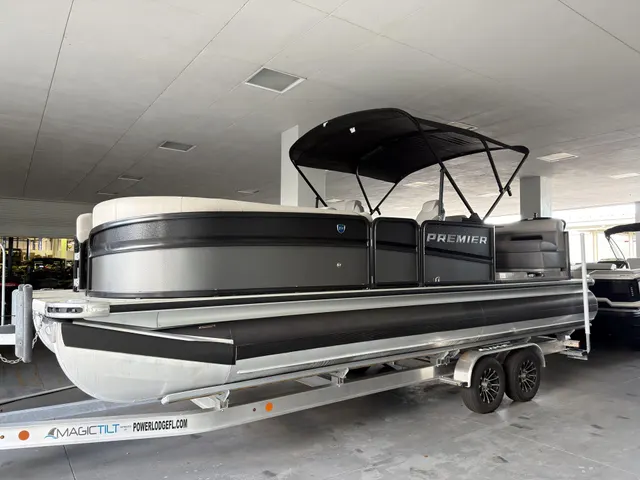
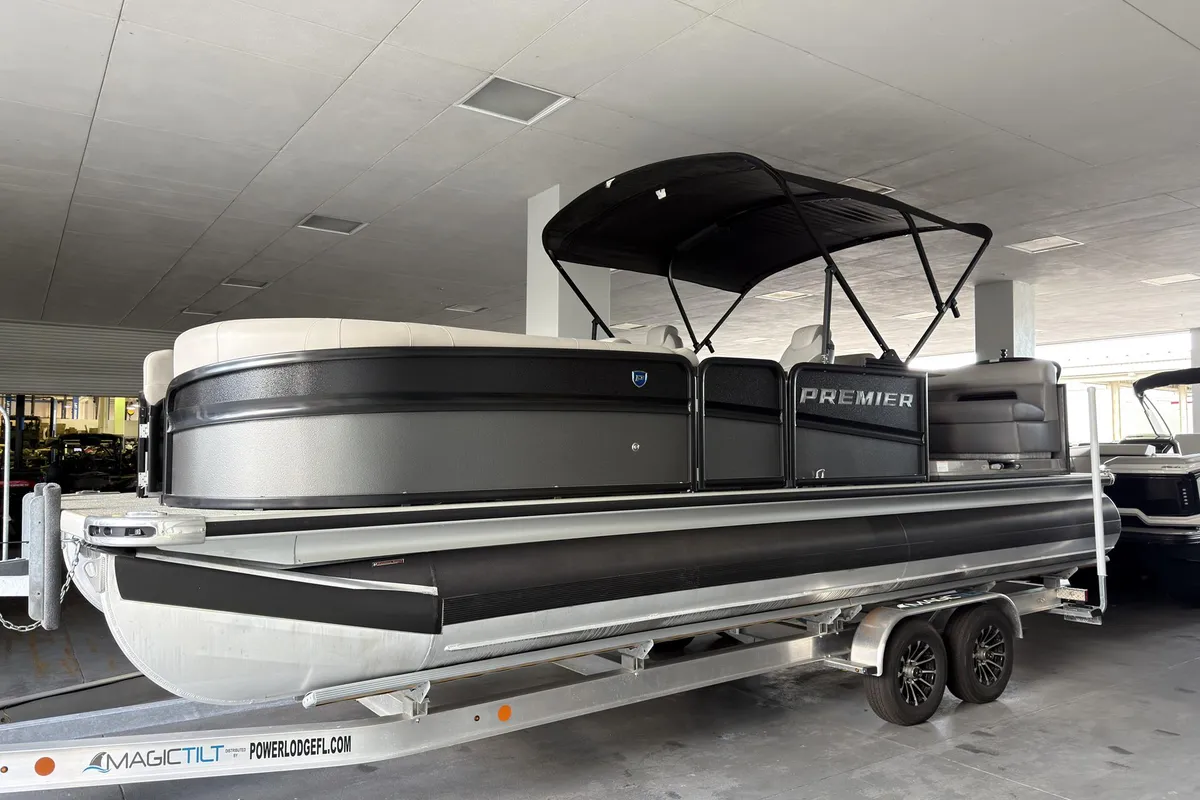
The 2025 Premier 250 Solaris REV on the floor uses what its listing calls the Revolution Booth layout — a stern social plan that no longer appears in Premier’s current floorplan naming, so check the seating plan against the hull in front of you, not the badge. The full write-up is in our Premier 250 Solaris REV review.
Three questions sort most buyers into a plan. Do people face each other, or face forward? Does anyone need to lie down? And is there a bar, or is there a place to stand and fish? Fishing pontoons exist and are popular in flat water, but nobody should buy a tritoon as a fishing boat here — if that is the priority, the Crownline 200 FS at $49,990 as listed does that job for a third of the money.
Capacity: read the plate, not the brochure
Premier lists a 17-person max capacity for its 25-foot Solaris floorplans; the 250 Solaris REV in the building is listed at 17, and the 270 Intrigue REV beside it at 19. Those are large numbers, and they are also legal maximums under ideal conditions rather than a comfortable Saturday.
The number that governs is stamped on the boat’s own capacity plate — find it before the guest list does. Also worth being honest with yourself about: most owners here carry four to eight people most of the time. Buy the length for the water and the layout for the people, not the seat count for the one birthday party.
Where it sleeps: lift, slip, or trailer
This is the decision that quietly determines whether you love the boat. A tritoon at 26 feet with an 8-foot-6-inch beam and 2,700 pounds of dry weight is a wide, heavy tow. It is legal and people do it, but almost nobody who owns one here trailers it regularly — they lift it, slip it, or rack it.
If you have a canal home with a lift, that is the whole answer, and it is why the pontoon market in Bonita, Naples, and Cape Coral looks the way it does. If you do not, price the storage before you price the boat — in Lee and Collier counties nothing else you pay for a boat recurs like storage does, and the bill starts the month you take delivery.
Two paperwork details follow from size and are easy to miss:
- The 26-foot registration break. Florida registers vessels by length class. A boat at 26 feet 5 inches — the 250 Solaris, for instance — lands in Class 2 rather than Class 1, per § 328.72, Fla. Stat. (2026). Not a large sum, but it surprises people at the counter.
- The trailer might need a title. Florida titles a trailer only at 2,000 pounds net weight or more, per § 319.20, Fla. Stat. (2026). A single PWC trailer is nowhere near that; a tandem-axle trailer built to carry a three-tube boat can cross it. Check the trailer’s net weight rather than assuming.
Both are covered properly in our registration and titling guide.
Power: the biggest line item nobody quotes
Premier rates the 25-foot Solaris plans for 300 to 450 horsepower depending on floorplan, and rates the Intrigue family higher still. Neither ALERA nor Balise publishes horsepower ratings at all.
That range is not a detail. Three hundred horsepower on a 2,700-pound tritoon is a comfortable cruiser that will pull a tube; the top of the rating is a genuinely quick boat, and the difference between them is tens of thousands of dollars. On every listing we stock, the outboard is the specification most likely to be missing — so make “which engine, how many hours, and what warranty” the first question rather than the last.
Fuel scales with it. The 250 Solaris on the floor carries 33 gallons with its PTX 28 package; the 270 Intrigue REV carries 47. Either is a day of cruising and anchoring rather than a weekend.
The three lines on the Power Lodge floor
Premier: the one with a spec sheet
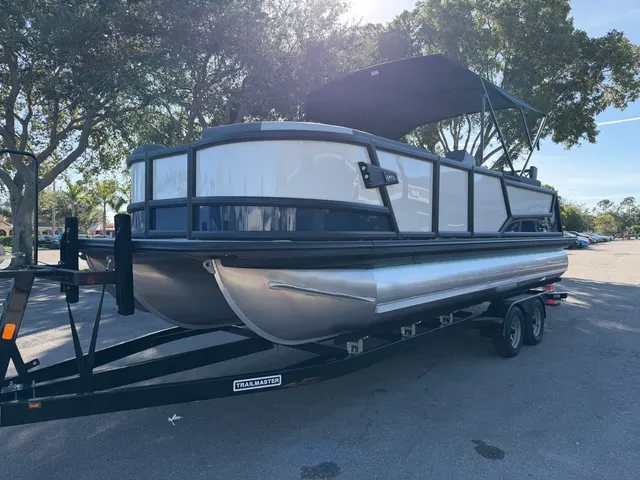
Premier Marine is the documented option, and by a distance. The Solaris and Intrigue line pages publish lengths, beams, weight ranges, capacities, floorplans, horsepower ratings, and standard equipment, and the floor units sit inside those published ranges. Two units: the 2025 250 Solaris REV at $167,869 as listed, and the 2025 270 Intrigue REV — 28 feet 5 inches, 3,000 pounds dry, 19 people, 47 gallons — at $208,411 as listed.
ALERA: the new one
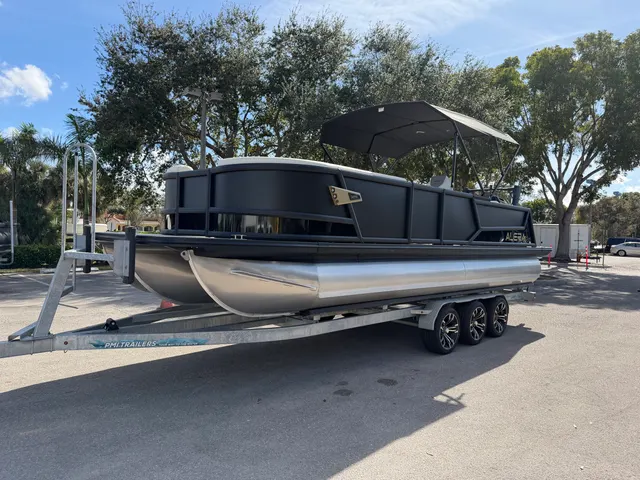
Alera Marine Group is a genuinely new premium builder, and its own site lists Model A, Model M, and Model G as coming soon with no published spec sheets. Two Model M boats are on the floor: the 2026 M23Q at 23 feet, listed at $116,560 against a $129,208 boat-show MSRP, and the 2026 M25L at 25 feet, listed at $127,600.
There is no third-party coverage of these boats yet, no owner history, and no published beam, capacity, fuel, or horsepower figures. That is not a knock — every builder starts somewhere, and being early on a good boat is how people end up with something nobody else has. It does mean the window sticker and the build sheet are the entire evidence base, and that you should ask directly about warranty terms and dealer support before you sign.
Balise: the one we cannot verify
A 2025 Balise HELIX 24C, a 24-foot aluminum pontoon, is also on the floor. We are not publishing its numbers. The brand’s own website is under construction with no specifications to check anything against, and the listing carries a retail figure that does not reconcile sensibly with its selling price along with a promotional line that expired months ago.
That combination is a reason to ask questions in person rather than a reason to avoid the boat. Get the current price, the window sticker, and the build sheet from the dealer directly, and treat anything else you read about it — here included — as unconfirmed.
What does a pontoon cost here?
Prices as listed on the Power Lodge floor on September 3, 2026. Model years vary; freight, prep, and Florida tax, title, and registration are additional on all of them.
| Boat | Model year | Length | As listed |
|---|---|---|---|
| ALERA M23Q | 2026 | 23 ft | $116,560, MSRP $129,208 |
| ALERA M25L | 2026 | 25 ft | $127,600 |
| Premier 250 Solaris REV | 2025 | 26 ft 5 in | $167,869, feed MSRP $167,896 |
| Premier 270 Intrigue REV | 2025 | 28 ft 5 in | $208,411 |
The honest observation about that table: this is a premium annex, not a pontoon department. Entry-level and mid-market pontoons exist across Florida in the $40,000 to $80,000 range; they are not what this floor carries. The least expensive boat of any kind under this roof is the Crownline 200 FS at $49,990 as listed, and it is a fiberglass center console rather than a pontoon.
One tax note that is worth real money at these prices: Florida’s 6 percent state rate applies to the whole purchase, while the county discretionary surtax reaches only the first $5,000 of a single item. The county-by-county arithmetic is in our sales tax guide.
Mistakes people make
Buying two tubes for three-tube water. The saving is real and so is the regret, on the first afternoon the bay stands up.
Assuming the boat is rigged for salt. None of the three builders here publishes a saltwater package. Assume nothing; get the build sheet.
Shopping the seat count. Sixteen seats sound like value and behave like weight. Buy for the eight people who are actually on board most weekends.
Ignoring where it will live. A boat 20 minutes away on a trailer is used a fraction as often as the same boat on a lift behind the house. Solve storage first.
Treating percentage claims as test data. Manufacturer figures with no stated baseline describe intent, not measured performance.
Leaving the engine question until last. It is the largest variable in both price and character, and on these listings it is frequently the one specification nobody has written down.
Where to go next
Start with the Premier 250 Solaris REV review for the one boat on the floor with a full published spec sheet behind it. If fishing is really the point, read the Crownline 200 FS review instead. And if you are not yet certain a boat is the right purchase at all, PWC or boat is the fork in the road worth settling first — the price of one tritoon here buys an entire fleet of personal watercraft.
The paperwork side lives in the registration and titling guide, and whoever drives needs the boating safety card if they were born on or after January 1, 1988. The rest of the water content is in The Boathouse.
Power Lodge Florida, 28470 S Tamiami Trail — live inventory, build sheets, and today's price.
Quick answers
- What is the difference between a pontoon and a tritoon?
- A pontoon rides on two aluminum tubes; a tritoon adds a third down the center. The third tube adds buoyancy and planing surface, lets the boat carry more engine, and steadies it in chop. It also adds cost and weight. On open Southwest Florida water, three tubes is usually the right answer.
- Can a pontoon boat go in salt water in Florida?
- Yes, and thousands do. What decides how well it ages is the rigging: anodes, hardware, and whether the boat was specified for salt when it was built. Ask for the build sheet rather than assuming, and settle the bottom-paint question before delivery if it will live in the water.
- How much does a pontoon boat cost in Southwest Florida?
- The premium end is what Power Lodge stocks. As of September 2026 the pontoons on the floor are listed from $116,560 for a 23-foot ALERA M23Q to $208,411 for a 28-foot 5-inch Premier 270 Intrigue REV. Entry-level pontoons exist in this market; they are not what this floor carries.
- Can you take a pontoon boat in the Gulf?
- A tritoon handles a calm Gulf morning and the passes on this coast routinely. It is still a flat-decked boat with a lot of windage, and it is the wrong tool for running offshore or crossing open water once the afternoon sea breeze has built. Watch the forecast, not the boat.
- What size pontoon do I need for a family of eight?
- A 23-foot boat handles eight people comfortably. The reason people here buy 25 and 26 feet instead is guests, gear, and chop — the extra length is bought for the days you carry 14, not the days you carry eight. The capacity plate on the boat is the number that governs.
- Does a pontoon boat need a lift in Florida?
- Not legally, but practically it decides how much you use it. A 26-foot tritoon is a wide, heavy tow, and boats that live on a lift behind the house get used on weeknights while boats on trailers get used on holidays. If you have no lift or slip, price rack or marina storage before you price the boat.