Review · The Boathouse
Kawasaki Jet Ski Ultra 310X Review: 310 Horsepower and the Deepest Hull in the Class
The deepest hull, the biggest tank, and more than a thousand pounds ready to ride — the machine on our floor that cares least about what the Gulf is doing at four in the afternoon.
By The Outpost CrewUpdated 7 min read
How this review was built: from Kawasaki's published specs, professional road tests, owner reports, and what the Power Lodge crew sees on the showroom floor and in the service bay — not a first-hand test ride. Prices are MSRP unless the live listing below says otherwise.How we review →
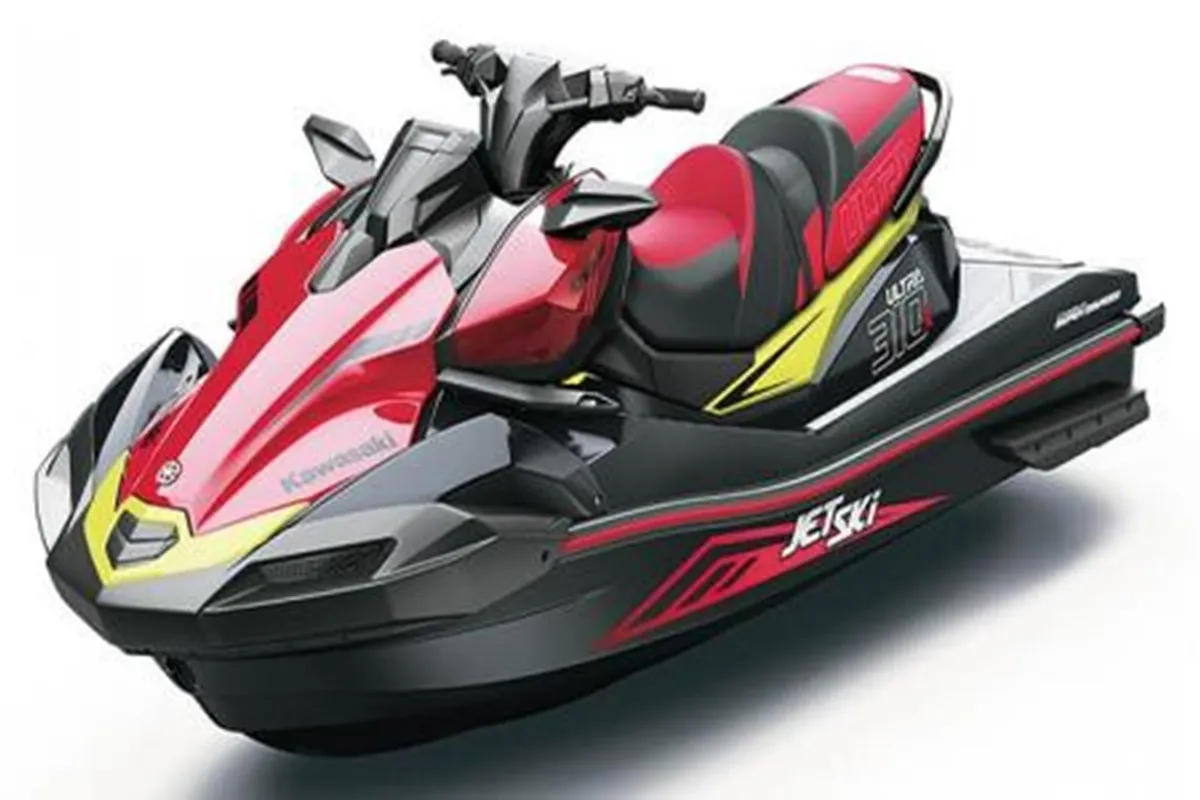
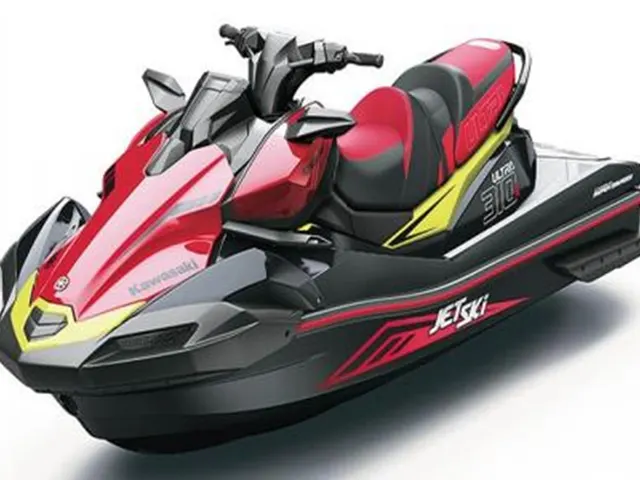
The Kawasaki Jet Ski® Ultra 310X is the biggest hammer in the personal watercraft (PWC) category. A 1,498cc supercharged inline-four making a published 310 horsepower, a deep-V hull Kawasaki designed for ocean water, a 21.1-gallon tank, and 44.5 gallons of storage — wrapped in a machine that weighs about 1,032 pounds ready to ride.
The one thing to know: the horsepower is not the reason to buy it. Every flagship in this class is limited to about 67 mph, so the Ultra is not faster than a Sea-Doo GTX Limited or a Yamaha FX. What it has instead is hull depth and weight, and those are what decide how an afternoon in the Gulf actually feels.
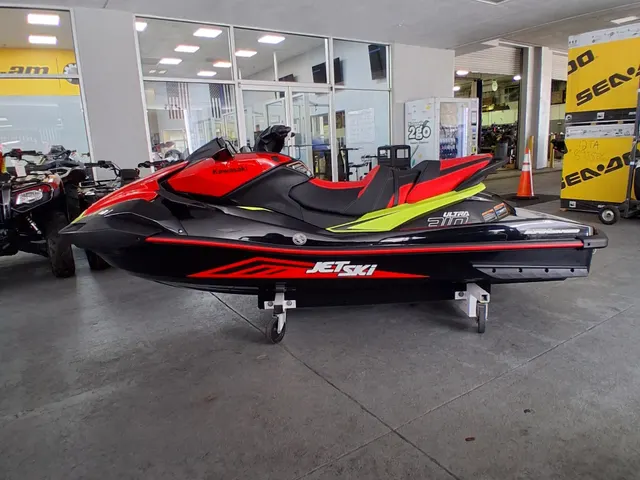
Two 2025 units sit on the Power Lodge floor in Ebony/Neon Red, listed at $14,499 as of September 2026 against a $19,199 MSRP recorded in the dealer feed for that model year.
What the Kawasaki Ultra 310X is
Kawasaki builds one full-size PWC platform and sells it in a few trims. The Ultra 310X is the middle of that family — the 310LX and LX-S sit above it with audio and additional equipment, and Power Lodge does not stock those, so they are context rather than an option here.
The platform itself was fully redesigned for the 2022 model year, and jetdrift’s review of the current generation singles out what changed: the deep-V hull, a proper TFT display, a brake-and-reverse system, and dual gloveboxes contributing to 44.5 gallons of storage. That last figure ties the Yamaha FX for the most storage of anything on our floor, and the fuel tank beats everything outright.
Where Kawasaki has always differed from the other two is philosophy. Sea-Doo and Yamaha both build lighter machines and add features. Kawasaki builds a heavier machine and lets the mass do the work. Whether that is the right approach depends entirely on where you ride.
| Engine | 1,498cc supercharged inline-four, four-stroke |
|---|---|
| Horsepower | 310 hp, published by Kawasaki |
| Boost | 16.8 psi |
| Pump | 160 mm |
| Hull | Deep-V, designed for an ocean environment |
| Length × width × height | 135.4 in × 47 in × 46.5 in |
| Weight | 890.8 lb dry; 1,031.9 lb curb |
| Seating | 3 riders; 496 lb rated load |
| Fuel capacity | 21.1 gal |
| Storage | 44.5 gal |
| Display | 7-inch TFT |
| Ride modes | Four power modes, launch control, Kawasaki Smart Reverse |
| Top speed | About 67 mph, limited (jetdrift) |
| Listed at Power Lodge, September 2026 | $14,499 (2 units, 2025 model year) |
| MSRP recorded in the dealer feed, 2025 model year | $19,199 |
Source: Power Lodge unit sheet (kawasaki.com was unreachable to automated fetch, September 2026). Specs and pricing are the manufacturer's published figures and can change by model year.
Engine and performance: 310 horsepower and what it is for
Kawasaki, unlike Yamaha, publishes horsepower, and 310 trails only Sea-Doo’s 325s in the building. The engine is an inline-four rather than the three-cylinder Rotax or the four-cylinder Yamaha, running 16.8 psi of boost through a 160 mm pump.
Since the top speed is capped at about 67 mph like everything else in the class, the power shows up in two places. The first is acceleration under load: jetdrift reports 0 to 60 mph in roughly 4.5 seconds on a machine that weighs over 1,000 pounds ready to ride, which means three adults aboard does not flatten the performance the way it does on a lighter, less powerful hull. The second is holding speed into wind and chop, which is the part nobody puts in a brochure and everybody notices on the way home.
The bill arrives at the fuel dock. A supercharged 1,498cc four is thirsty, and the 21.1-gallon tank exists because it has to. jetdrift’s range figure for the platform — roughly 100 to 110 miles — is a cruising number, and hard riding will take a serious bite out of it. Higher-octane fuel is the norm on supercharged machines; check the owner’s manual for the specific requirement rather than taking anyone’s word for it, ours included.
On the water: the deepest hull in the class
The Ultra’s hull is the reason it exists. Kawasaki designed it as a deep-V for ocean water, and in Southwest Florida terms that means the machine is at its best exactly where recreation hulls stop being fun — outside the passes on an afternoon when the sea breeze has had a few hours to build, or running the beach south toward Naples in a two-foot slop.
Weight compounds the effect. At about 1,032 pounds curb, the Ultra does not get deflected; it goes through. Riders who came to it from a lighter machine consistently describe the composure in rough water as the thing they noticed first — a widely reported theme rather than something we can point to a specific thread for, since the owner forums that would supply the receipts were unreachable during this research pass. Our standard for that distinction is on How we review.
The same weight is the machine’s honest drawback and it is not a small one. On a crowded ramp on a Saturday, over 1,000 pounds plus a trailer is a two-person job and an argument for a properly matched tow vehicle. In tight canal water, this is the least nimble machine we sell. And the 496-pound load rating, while class-typical, is the practical limit on three adults regardless of what the seat suggests.
What makes the long days work is the equipment. Four power modes let you dial the machine down for a newer rider — genuinely useful on 310 horsepower. Kawasaki Smart Reverse handles docking and low-speed maneuvering. The 7-inch TFT is a real display. And the storage-and-fuel combination — 44.5 gallons and 21.1 gallons respectively — means the Ultra can plan a day that other machines have to shorten.
What reviewers and owners say
jetdrift’s review of the current Ultra platform is the substantive sourced assessment available: it praises the post-redesign package specifically for the deep-V hull, the TFT screen, the brake and reverse system, and the storage, and it supplies the acceleration and range figures cited above.
Dedicated professional tests of the 310X trim itself are a gap, and several outlets that cover this segment closely could not be reached during research. That is worth stating rather than papering over.
Owner sentiment on the Kawasaki four runs consistently in two directions at once: a strong reliability reputation for the engine, and complete agreement that the machine is heavy at the ramp and thirsty at the pump. Both fit everything else known about the platform, and both are commonly repeated themes rather than sourced claims.
Living with an Ultra 310X in Southwest Florida
The salt routine is universal: flush after every ride in salt or brackish water, then rinse the hull and the trailer. Our salt-water maintenance guide has the sequence. On a supercharged machine, the service intervals in the manual deserve the same respect as the flush.
Trailering is the part of ownership that changes most with this machine. Over 1,000 pounds curb plus trailer weight puts you in a different bracket than a recreation machine — check your vehicle’s rating honestly, use a trailer with bunks in good condition, and plan for help on a steep or crowded ramp. Our trailering and launching guide is worth reading before you buy rather than after.
The upside of all that mass is range and comfort. This is the machine on the floor best suited to a long run — Bonita out toward Sanibel, or a day that ends at the Ten Thousand Islands — and our guide to where to ride in Southwest Florida covers which of those water is worth the trip.
Recalls and known issues
None found for the Kawasaki Jet Ski Ultra 310X in the U.S. Coast Guard recall database as of September 2026, based on a spot-check of uscgboating.org’s recall listing. The manufacturer filter in that database is unreliable, so read that as a point-in-time check rather than a clean record.
Personal watercraft carry a HIN rather than a VIN. On a carryover model year in particular, have the dealer run the specific hull’s HIN for open campaigns before delivery.
Price and what is on the floor
Two 2025 Kawasaki Ultra 310X units are listed at $14,499 as of September 2026, in Ebony/Neon Red. The dealer feed records a $19,199 MSRP for that model year and trim.
That listing puts a 310-horsepower flagship at a number that otherwise buys a mid-range recreation machine — a 2026 Yamaha VX Cruiser HO lists at $14,899, for comparison. What it does not buy is a way around the ownership facts above: this is still the heaviest and thirstiest machine on the floor, and it should be bought by someone who wants that hull, not only that number. Freight, prep, and Florida tax, title, and registration are additional.
Both units are 2025 carryover machines on the current-generation platform, which is the same hull, engine, and electronics Kawasaki sells today.
How does the Ultra 310X compare?
The three-way flagship shopping list in this building is the Ultra, the Yamaha, and the top Sea-Doo, and they are genuinely different machines.
The Yamaha FX Cruiser SVHO at $21,599 as listed matches the Ultra’s 44.5 gallons of storage and brings a 7-inch Connext screen with GPS mapping; on weight, mind the basis — Yamaha publishes only a 948-pound dry figure, against the Kawasaki’s 890.8 dry and 1,032 curb. The Kawasaki counters with 310 published horsepower against Yamaha’s unpublished estimate, and 2.6 more gallons of fuel.
The Sea-Doo GTX 230 at $18,149 as listed is the value flagship: same 67 mph, 230 published horsepower, and about 60 fewer pounds dry, with iBR braking and the iDF debris-clearing pump that Kawasaki has no equivalent for. It is the easier machine to live with and the less capable one in genuinely rough water. The GTX Limited 325 is the direct luxury rival at $22,549 to $22,949 as listed.
If the class itself is still an open question, the PWC buyer’s guide lays out the segments, and our three-brand comparison covers how the manufacturers differ before you get to individual models.
Highs
- 310 published horsepower at a recreation-machine price
- Deep-V hull designed for ocean water
- 21.1-gallon tank, the largest in the class
- 44.5 gallons of storage
- Four power modes let you dial it down for a newer rider
- Strong reliability reputation for the supercharged four
Lows
- About 1,032 lb curb — over a thousand pounds at every ramp
- Two-person launch on most ramps
- Supercharged four is thirsty, tank size notwithstanding
- Least nimble machine on the floor in tight water
- Specs come from the dealer sheet — kawasaki.com was unreachable for verification
- Only two units, both 2025 carryover
Live inventory and today's price on both units.
Quick answers
- How fast is a Kawasaki Jet Ski Ultra 310X?
- About 67 mph — the limited top speed every flagship personal watercraft observes, per jetdrift's coverage of the Ultra platform. The same review reports 0 to 60 mph in roughly 4.5 seconds. The 310 in the name is horsepower, not miles per hour.
- How much does a Kawasaki Ultra 310X weigh?
- About 890.8 pounds dry and 1,031.9 pounds curb, per the dealer unit sheet. Mind the basis when you compare: Yamaha publishes only dry weights, and an FX is actually heavier dry at 948 pounds. Either way, over a thousand pounds ready to ride is the main thing to plan for at the ramp and behind the tow vehicle.
- Is the Kawasaki Ultra 310X supercharged?
- Yes. It uses a 1,498cc supercharged inline-four running 16.8 psi of boost, per the unit sheet, for a published 310 horsepower — second on the floor only to Sea-Doo's 325-horsepower machines.
- How far can a Kawasaki Ultra 310X go on a tank?
- jetdrift puts the Ultra platform at roughly 100 to 110 miles of range on its 21.1-gallon tank, the largest fuel capacity in the class. Ridden hard, a supercharged engine will cut that considerably.
- How much is a Kawasaki Ultra 310X?
- Power Lodge lists two 2025 units at $14,499 as of September 2026. The dealer feed records a $19,199 MSRP for that model year. Freight, prep, and Florida tax, title, and registration are additional.