Buyer's Guide · The Boathouse
Sea-Doo vs Yamaha vs Kawasaki: The Honest PWC Brand Comparison From a Dealer That Sells All Three
We sell all three, so we have no dog in this fight. Here is what each brand actually does differently, and which rider each one fits.
By The Outpost CrewUpdated 8 min read
Yamaha at Power Lodge →Sea-Doo at Power Lodge →Kawasaki at Power Lodge →
Power Lodge sells Sea-Doo®, Yamaha, and Kawasaki out of the same building, which means we have no reason to tell you one of them is best. None of them is. They are three engineering philosophies with different price bands, and the right one depends entirely on what your Saturday looks like.
The short version: Sea-Doo brings the most feature technology and publishes its horsepower. Yamaha brings the lowest running costs and the most storage in the touring class. Kawasaki brings one very focused machine built for water the other two would rather avoid.
What follows is what each brand actually does differently, with the honest gaps in the record marked as gaps.
How to think about a brand decision
You mostly should not make one. In this category, the model matters far more than the badge — a Sea-Doo GTI and a Sea-Doo RXP-X share a logo and nothing else that affects your day.
Where brand does matter is in three places. Control systems differ: braking, reverse, and pump protection are engineered per brand and you cannot retrofit them. Hull families differ: each brand’s ladder puts different equipment on different rungs at different prices. And published data differs, which affects your ability to compare at all.
Everything else — reliability, resale, “which one lasts” — is where the internet does its worst work, and where we are going to be careful below.
Sea-Doo: the technology-led brand
Sea-Doo, built by BRP, is the feature leader in this category, and the features are not decorative.
Engines. The Rotax 1630 ACE is a 1,630cc three-cylinder that Sea-Doo tunes to a published 130, 170, 230, or 325 horsepower across the range. Sea-Doo publishes those figures, which makes its machines the easiest in the category to compare honestly. For the 2027 model year the flagship trio — RXP-X, RXT-X, and GTX Limited — moved to 350 horsepower, which makes the 325-horsepower machines currently in stock the outgoing top specification.
Braking and pump protection. iBR — Intelligent Brake and Reverse — is the system Sea-Doo brought to the category first, and it remains the most polished implementation of a left-hand lever that both reverses and decelerates. iDF, the Intelligent Debris-Free system, reverses the impeller to clear seagrass or rope out of the pump from the seat. In Southwest Florida grass flats, that second one is not a gimmick.
Hulls. Two families matter here. The GTI recreation line uses a lighter Polytec hull and carries 40.3 gallons of storage — the most in its class. The GTX touring line uses the fiberglass ST3 hull at 135.8 inches with a 10.25-inch touchscreen, LinQ accessory points on the swim platform, and, oddly, less storage at 26.1 gallons. The Polytec-versus-fiberglass durability argument is a permanent fixture on Seadooforum and has been for years; what the threads actually show is a long-serviceable platform culture rather than a verdict.
On the floor: GTI SE 130 at $14,099, GTI SE 170 at $14,699, GTX 170 at $17,149, GTX 230 at $18,149, GTX Limited 325 at $22,549–22,949, FishPro Trophy 170 at $21,899–22,649, Wake 170 from $15,649, Wake Pro 230 at $18,599, RXT-X 325 at $20,999, and RXP-X 325 at $21,099 — all as listed, September 2026.
Fits the rider who wants the most technology per dollar, rides grass flats, packs heavily for recreation days, or wants a purpose-built fishing or wake machine.
Yamaha: the running-cost brand
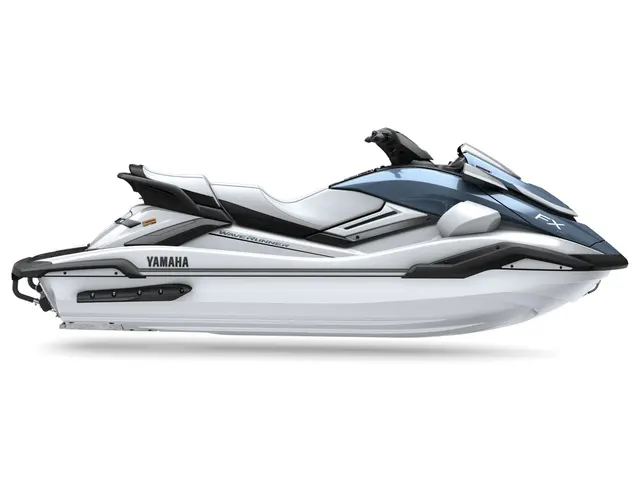
Yamaha’s WaveRunner® line takes the opposite approach: fewer headline features, smaller engines doing more work, and the lowest cost of ownership in the category.
Engines. Three of them. The 1,049cc TR-1 HO triple is the value engine, estimated by jetdrift at about 125 horsepower and roughly 53 mph. The 1,898cc 1.9-liter is the largest-displacement naturally aspirated engine in any PWC by Yamaha’s own claim, worth about 200 horsepower estimated and roughly 65 mph. The supercharged 1,812cc SVHO tops the range at an estimated 250 horsepower and the 67-mph limit.
The catch is stated above and worth repeating: Yamaha does not publish horsepower. Every figure in that paragraph is jetdrift’s estimate. If you like arguing from spec sheets, this is genuinely irritating.
The compensation is fuel. jetdrift’s testing of the 1.9-liter in the GP application put it near 13 to 14 gallons per hour at wide-open throttle against 20-plus for the supercharged SVHO — and the smaller TR-1 sits below both. Over a few Florida seasons that gap is the strongest argument Yamaha makes.
Braking. RiDE is Yamaha’s dual-throttle system: left lever reverses at the dock and decelerates at speed. It does the job. iBR is generally regarded as the more refined of the two; riders who have only used RiDE rarely notice a gap.
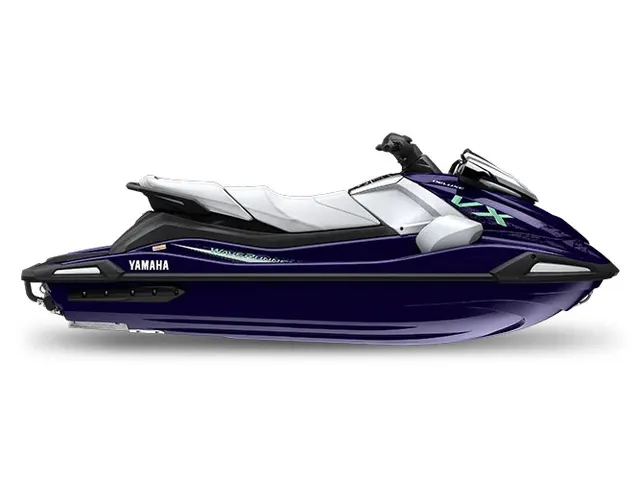
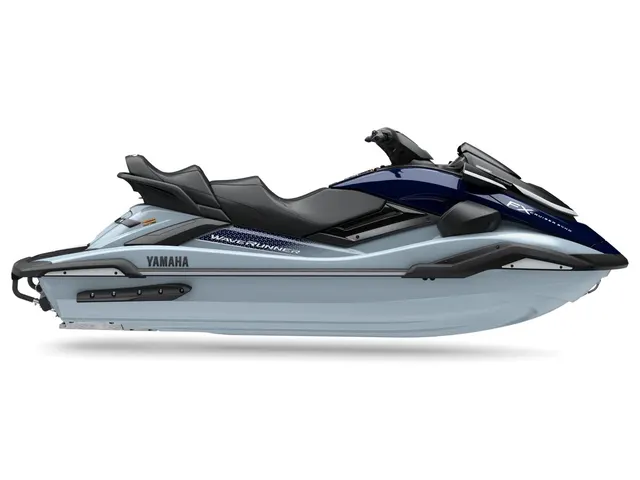
Hulls. The VX recreation family at 132 inches with 30.1 gallons of storage; the FX touring family with 44.5 gallons — the most storage of any machine we stock, beating every Sea-Doo; and the GP performance family. The VX Deluxe alone accounts for 19 units on our floor.
On the floor: JetBlaster PRO 3-Up at $11,799–12,399, VX Deluxe at $12,899–13,499, VX Cruiser at $13,999, VX Cruiser with Audio at $14,599, VX Limited at $14,499–15,199, VX Cruiser HO at $14,899, VX Limited HO at $16,699, GP HO with Audio at $16,699, FX HO with Audio at $17,799, GP SVHO with Audio at $18,299, FX Cruiser SVHO at $21,599, and FX Limited SVHO at $22,199 — as listed, September 2026. A used 2021 GP1800R SVHO is also here with its price withheld online; see today’s price at Power Lodge.
Fits the rider who counts fuel, wants the cheapest path to a full-size three-seat hull, or needs maximum touring storage.
Kawasaki: one machine, aimed at the ocean
Kawasaki’s Jet Ski® line is the narrowest of the three and the least interested in being all things to all people. What we stock is the Ultra 310X, and it is a specialist.
Engine. A 1,498cc supercharged inline-four making a published 310 horsepower — the only four-cylinder in this comparison, and a published figure only Sea-Doo’s 325-horsepower flagships beat. It runs 16.8 psi of boost through a 160mm pump.
Hull and capacity. A deep-V hull that Kawasaki describes as built for an ocean environment, at 135.4 inches long and 47 inches wide. The tank is 21.1 gallons, the largest here by nearly three gallons, and storage is 44.5 gallons, tying Yamaha’s FX for the most we stock. jetdrift’s coverage of the current Ultra platform reports roughly 67 mph, a 0-to-60 time near 4.5 seconds, and a 100-to-110-mile range.
The trade. Curb weight is 1,031.9 pounds — 890.8 dry — which is the heaviest machine in this comparison by a wide margin. That is exactly what makes it composed in rough water and exactly what makes it a two-person job at the ramp. Kawasaki’s Smart Reverse handles reverse and slowing, and the machine carries a 7-inch TFT display, four power modes, and launch control.
Note on sourcing: Kawasaki’s own site could not be reached during this research pass, so the specifications above come from the dealer listing for the units in stock rather than from a manufacturer spec page. Verify against Kawasaki’s page before you treat any single number as final.
On the floor: two 2025 Jet Ski Ultra 310X units listed at $14,499 against a $19,199 MSRP as of September 2026 — the widest gap between MSRP and listed price in our PWC stock.
Fits the rider who runs outside the passes regularly, wants range and rough-water composure above all, or wants the most published horsepower per dollar available right now.
Which PWC brand is the most reliable?
This is the section where most brand comparisons make things up, so here is what we actually have.
Owner sentiment we can see, hedged appropriately: Yamaha’s VX family carries a long-standing reputation for being unexciting and durable, built on low running costs rather than on any published durability data. Sea-Doo owners on the forums we could reach generally regard the modern supercharged 1630 as considerably more durable than the early 1503-based supercharged engines that gave the category its maintenance reputation — though those threads are about older machines, and we are not going to stretch them into a claim about a new one. Kawasaki’s inline-four has a strong reputation among offshore riders.
All three of those are themes, not measurements. The owner forums we would normally quote directly were unreachable during this research pass, so treat none of it as a citation. Our standard for this kind of thing is on How we review.
The question that usually rides along with reliability is resale, and it has even less data behind it. We do not have sourced resale figures for these three brands, so we are not going to publish a ranking. Anyone who tells you confidently which PWC brand holds value best in Southwest Florida is guessing, and the variables that actually move a used price here — hours, flush history, salt exposure, whether it was covered — are owner variables, not badge variables.
What is genuinely brand-adjacent and worth weighing: parts and service. A machine bought from a local dealer that services the line is materially easier to own than one bought three hours away, and that is true of all three of these.
What it costs, by brand
| Brand | Listed range, September 2026 | Braking and reverse | Publishes horsepower |
|---|---|---|---|
| Yamaha | $11,799–22,199 | RiDE | No |
| Sea-Doo | $14,099–22,949 | iBR, plus iDF debris clearing | Yes |
| Kawasaki | $14,499 | Smart Reverse | Yes |
Every figure is a listed price on our floor as of September 2026, before freight, prep, and Florida tax, title, and registration. Manufacturer MSRPs for the 2027 model year sit higher on most of these lines.
Mistakes people make with brand comparisons
Comparing an estimate to a published figure. Yamaha’s horsepower numbers are third-party estimates and Sea-Doo’s and Kawasaki’s are not. A 130-hp Sea-Doo and a “125-hp” Yamaha are not measured the same way.
Treating forum sentiment as data. Threads skew toward problems, older machines, and people who are already annoyed. They are useful for spotting patterns and useless for ranking brands.
Buying a brand for a feature on a different model. iDF is not on every Sea-Doo. Audio is not on every Yamaha. Check the specific unit.
Ignoring the ramp. An 890-pound dry weight and a 545-pound one are the same category of vehicle and completely different Saturdays. The trailering and launching guide covers what that actually means.
Where to go next
The segment-by-segment breakdown — Rec-Lite through fishing — is in the PWC buyer’s guide. The single most common cross-brand decision on our floor is settled in VX Deluxe vs GTI SE 130, and the touring version is GTX 230 vs FX Cruiser SVHO. First-time buyers should start with the beginner picks. Everything on the water lives in The Boathouse.
Live inventory and today's price across Sea-Doo, Yamaha, and Kawasaki.
Quick answers
- Which is better, Sea-Doo or Yamaha?
- Neither, as a brand. Sea-Doo publishes horsepower, offers iBR braking and the iDF debris system, and holds the most storage in the recreation class. Yamaha undercuts it on price and running costs and holds the most storage in the touring class. Pick the model, not the badge.
- Are Kawasaki Jet Skis still made?
- Yes. The heart of Kawasaki's current watercraft line is the Jet Ski® Ultra platform — a 1,498cc supercharged inline-four making a published 310 horsepower in a deep-V hull. The lineup is narrower than Sea-Doo's or Yamaha's and aimed squarely at rough open water.
- Which personal watercraft brand is the most reliable?
- There is no sourced data that settles this. All three build four-stroke engines with strong reputations, and naturally aspirated models of any brand ask less of you than supercharged ones. In salt water, how faithfully the machine gets flushed matters more than the badge.
- Why does Yamaha not publish horsepower?
- Yamaha simply does not release horsepower figures for its WaveRunners. Every horsepower number you see for a Yamaha is a third-party estimate — jetdrift's, in this guide. Sea-Doo and Kawasaki both publish theirs, which makes cross-brand comparison lopsided.
- Which brand has the best braking system?
- Sea-Doo's iBR is generally considered the most refined; the company brought braking to the category first. Yamaha's RiDE and Kawasaki's Smart Reverse do the same job on a left-hand lever. The meaningful gap is between having one and not having one.