Review · The Trailhead
Yamaha Raptor 700 Review (and 700R SE): The Big-Bore Sport ATV That Refuses to Retire
A 686cc single with a clutch lever, a shift pedal, and nothing to haul anything with. Two decades on, it is still the machine the sand asks for.
By The Outpost CrewUpdated 8 min read
How this review was built: from Yamaha's published specs, professional road tests, owner reports, and what the Power Lodge crew sees on the showroom floor and in the service bay — not a first-hand test ride. Prices are MSRP unless the live listing below says otherwise.How we review →
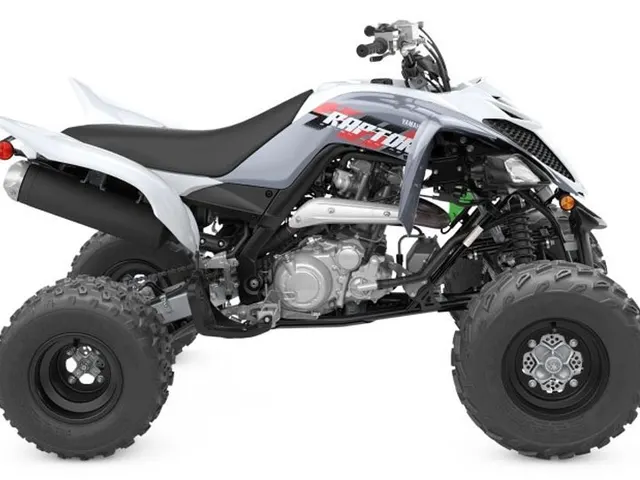
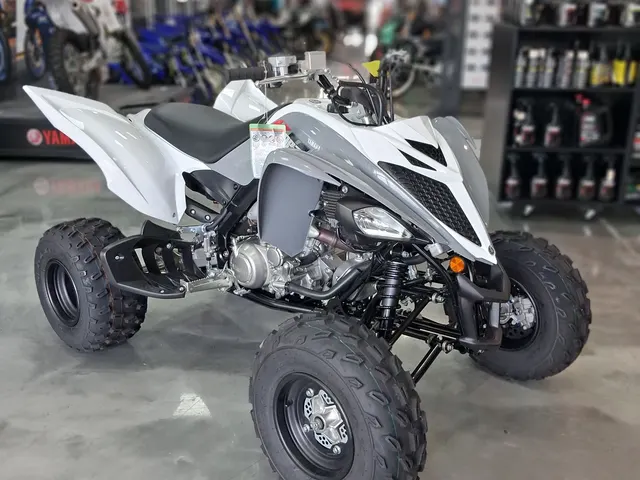
The Raptor 700 is a 686cc single-cylinder sport quad with a clutch lever, a shift pedal, a reverse gear, and no ability whatsoever to carry, tow, or winch anything. It exists to be ridden hard on sand and fire road, and in a category most of the industry walked away from, Yamaha kept building it. Three are on the Bonita Springs floor as of September 2026.
That refusal to retire is the interesting part. Every serious enthusiast test of the current machine we could locate — Outdoor Life’s dune review and SlashGear’s head-to-head — compares the Raptor against Yamaha’s own YFZ450R, because that is most of what is left to compare it to. The big-bore sport quad has become an argument Yamaha mostly has with itself.
If you want a machine that does jobs, this page is the wrong one; go read the Rancher instead. If you want the thing that made you want a quad in the first place, keep reading.
What the Yamaha Raptor 700 is
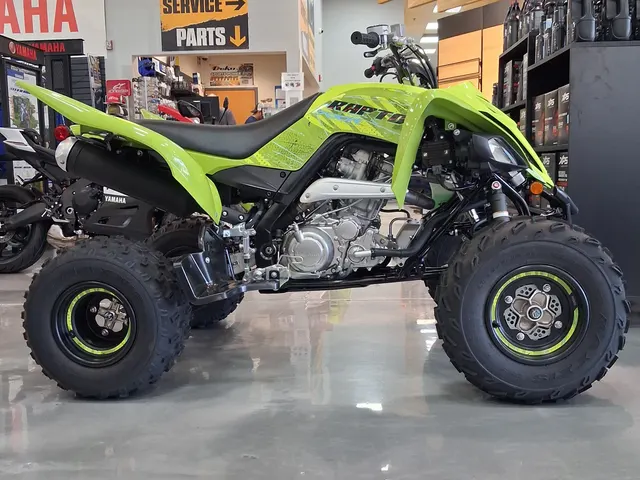
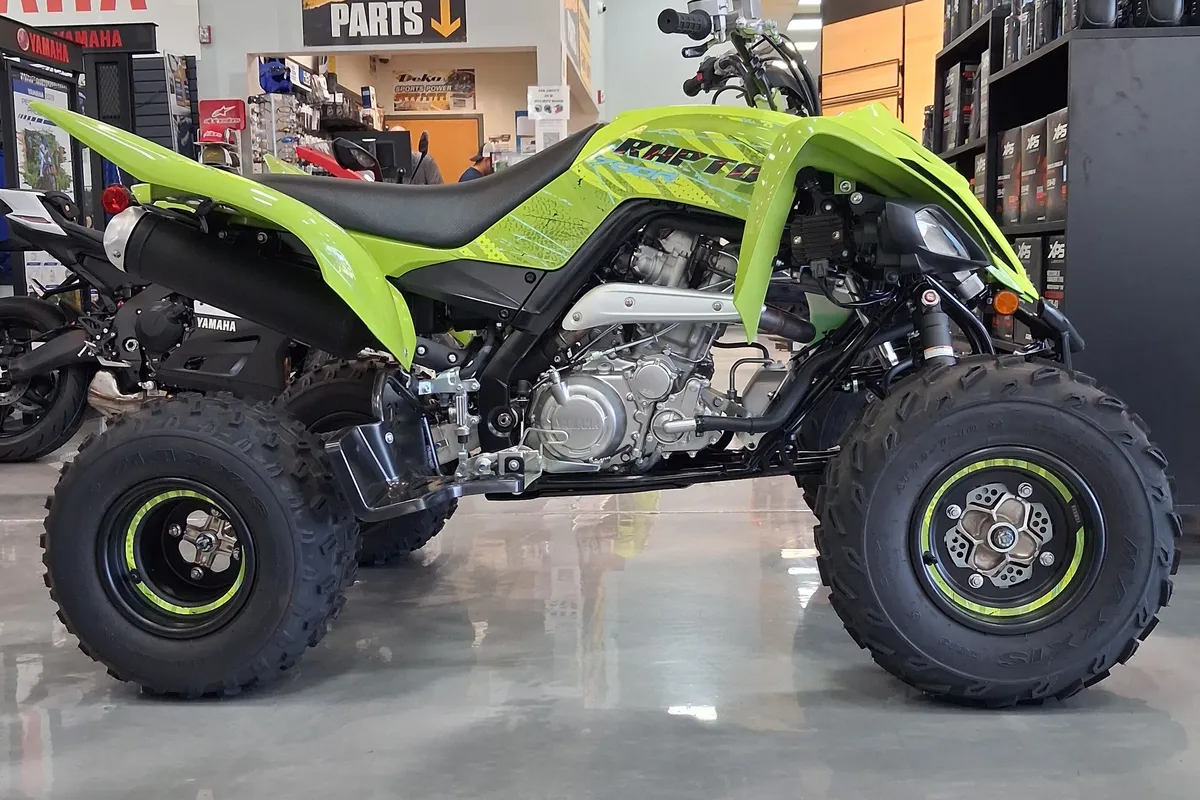
A single-seat, two-wheel-drive, chain-driven sport ATV — the recreation tier, with none of the utility hardware. No racks, no hitch, no winch, no power steering, no four-wheel drive. Yamaha builds it in two trims: the base Raptor 700 and the Raptor 700R SE, which is the same machine with better shocks and a GYTR grab bar.
In Yamaha’s ladder it sits above the 112cc Raptor 110 youth quad and beside the 449cc YFZ450R SE, which is the racier, higher-strung one. Across the floor the nearest thing to it is Can-Am’s Renegade X MR 1000R, and “nearest” is doing a lot of work — the Renegade is four-wheel drive, belt-driven, snorkeled, and built for mud holes. The Raptor is the light, mechanical, two-wheel-drive one.
| Engine | 686cc single-cylinder, four-stroke, liquid-cooled, fuel-injected |
|---|---|
| Power | Yamaha publishes no horsepower figure |
| Transmission | Five-speed manual with reverse |
| Drive | Two-wheel drive, chain final drive |
| Suspension travel | 9.1 in front / 10.1 in rear |
| Ground clearance | 9.4 in |
| Wet weight | 422 lb |
| Seat height | 32.7 in |
| Wheelbase | 50.4 in |
| Tires | Maxxis AT22 x 7-10 front / AT20 x 10-9 rear |
| Racks and towing | None — no racks, no hitch, no tow rating |
| EPS / winch | Neither offered on either trim |
| MSRP by trim | $10,199 Raptor 700 / $11,199 Raptor 700R SE (2027 models) |
Source: yamahamotorsports.com. Specs and pricing are the manufacturer's published figures and can change by model year.
Engine and performance: what 686cc does that 449cc does not
One big cylinder, liquid-cooled and fuel-injected, and Yamaha declines to publish a power figure — so treat any number you are handed as a guess. The character is legible from the rest of the sheet anyway. Six hundred eighty-six cubic centimeters pushing 422 pounds wet, through five gears you choose yourself, is a torque-first machine rather than a rev-first one.
Outdoor Life’s dune test of the current Raptor describes exactly that: enough low- and mid-range grunt to lug third gear up a face where a smaller engine would need two downshifts and a running start. Their summary is that the Raptor is the clear choice for the casual and comfort-minded rider, which sounds like faint praise and is not — it is the difference between a machine you ride all day and one that rides you.
SlashGear’s comparison of the two Yamaha sport quads adds the practical half: the Raptor is roughly three inches wider than the YFZ450R, has more low-end for bigger riders, and has reverse. That last item is worth more in real life than it sounds on paper. A sport quad without reverse means every misjudged line ends with you off the machine and pushing.
The five-speed is a conventional manual with a lever and a pedal. Nothing shifts itself, nothing slips, and there is no belt anywhere in the driveline — the chain and the gearbox are the entire story. If the transmission question is what brought you here, the whole argument is on CVT belt versus gear drive, explained.
Raptor 700 versus Raptor 700R SE: what the extra $1,000 buys
Identical engine, identical gearbox, identical wheel travel. What Yamaha changes on the SE is the damping and the dress:
| Raptor 700 | Raptor 700R SE | |
|---|---|---|
| Shocks | Standard units | Fully adjustable piggyback, high- and low-speed compression, rebound, threaded preload |
| Front grab bar | Standard | GYTR |
| Heel guards | Standard | GYTR |
| Graphics and color | Base | SE-specific |
| MSRP (2027) | $10,199 | $11,199 |
Whether that is worth $1,000 comes down to one question: are you going to turn the knobs? High- and low-speed compression adjustment is genuinely useful on chopped-up sand, and threaded preload lets you set sag for your actual weight rather than the factory’s guess at it. If you will do that once and then ride, take the SE. If the shocks will stay exactly where they left Japan, the base machine is the same quad.
On the trail and in the sand
Nine and one-tenth inches of front travel, 10.1 inches at the rear, and 9.4 inches of ground clearance is a lot of suspension for a machine this light, and the 32.7-inch seat height puts you on top of it rather than in it. That is the sport-quad seating position, and it is why an afternoon on one is tiring in a way an afternoon on a utility quad is not.
Southwest Florida gives the Raptor exactly the ground it wants. Sugar sand, graded fire roads, the wide-open sections of the state’s public riding areas — all of it rewards a light machine with a manual gearbox and a wide power band. Where to point the trailer is a separate question with a separate page: where to ride an ATV or UTV in Southwest Florida, and the Big Cypress ORV permit guide if that is the direction you are heading.
What the Raptor is not built for is water. Two-wheel drive, an exposed chain, a low airbox, and no snorkel means the mud-park lanes belong to somebody else’s machine. Owners who insist on going anyway should read the mud and sand setup guide first and then be honest about which quad they are actually shopping for.
The stock Maxxis tires are a compromise both directions — fine on hardpack, adequate in sand, unremarkable in either. Paddles on the rear are the single most transformative change anyone makes to one of these, and they are also the change that makes it a trailer-only machine.
What reviewers say
Both of the tests we could source ran the Raptor against the YFZ450R, which tells you something about the state of the class.
Outdoor Life’s verdict is that the Raptor is plusher over chop and the more comfortable machine for a full day, and calls it the clear choice for riders who are not chasing lap times. SlashGear’s comparison lands in the same place from a different angle: the 686cc single suits bigger and less aggressive riders, the wider track makes it steadier, and the reverse gear makes it the more practical of the two.
Owner sentiment is where this page has to stop short. The Yamaha forums and subreddits were unreachable during this research pass, so rather than characterize an owner base we could not read, we are leaving that section out. If you want that picture, ask three Raptor owners at a Saturday ride and you will have it in ten minutes.
Living with a chain-drive sport quad in Southwest Florida
The Raptor’s ownership list is short and it is not the same list a utility machine gives you.
The chain is the maintenance item. It is exposed, it sits low, and sand is grinding paste. A Raptor ridden in sand wants the chain cleaned and lubricated far more often than the manual’s baseline interval implies, and slack checked before it is a problem rather than after. This is the trade for having no belt and no driveshafts: fewer parts, but the ones you have live outdoors.
The air filter is the second one. A single big cylinder inhaling dune air will load a filter fast, and a restricted filter on a fuel-injected engine is a performance complaint before it is a service item. Check it more often than you think you need to.
There is no recovery hardware. No winch mount, no rack to strap a jack to, no hitch. Plan your day around that — ride with someone, carry a strap, and do not go looking for a hole alone.
It cannot help you after a storm. A 422-pound sport quad with no bed and no tow rating is a poor hurricane tool, which is worth knowing if this is your only machine. Our hurricane prep guide assumes something with a rack.
Florida titles it as an off-highway vehicle — title, no plate — and the details are on our OHV title and registration page.
Recalls and known issues
None found for the Yamaha Raptor 700 in the CPSC recall database as of September 2026 — in fact our search of the SaferProducts recall data returned no Yamaha ATV campaign since 2010. Off-highway vehicles are recalled through the Consumer Product Safety Commission rather than NHTSA, so search cpsc.gov and saferproducts.gov, and register the VIN with Yamaha so a notice reaches you rather than the previous owner.
Price and what is on the floor
MSRP for the 2027 models is $10,199 for the Raptor 700 and $11,199 for the 700R SE. On the Bonita Springs floor as of September 2026 there are two 2026 Raptor 700s listed at $9,999 and one 2026 700R SE listed at $11,199. Freight, prep, and Florida sales tax are separate — the math is on our sales tax guide.
How it compares
Inside Yamaha’s range the real decision is against the YFZ450R SE: 449cc, no reverse, race-oriented suspension, and a machine that gets better the harder you ride it. The Raptor is the one that is better the rest of the time. Below both sits the 112cc Raptor 110 for kids, which we cover in the youth ATV guide.
Across the floor, the honest alternative is the Can-Am Renegade X MR 1000R at $17,949 as listed for the 2026 model — 91 published horsepower, four-wheel drive, factory snorkels, 30-inch tires, and a winch. It is a completely different purchase for a completely different Saturday, and it costs $8,000 more as listed.
The comparison nobody makes out loud but everybody should: for Raptor money you could have a utility quad that tows, carries, and winches. If you can only own one machine and you have acreage, buy the utility quad. If you already have a truck and a mower and this is the fun one, buy the Raptor. The ATV versus UTV guide is where that decision gets made properly.
Highs
- 686cc of low- and mid-range torque in a 422-lb machine
- Reverse gear on a sport quad, which the YFZ450R does not have
- Geared, chain-driven driveline with no CVT belt
- SE trim adds genuinely adjustable piggyback shocks
Lows
- No racks, hitch, winch, power steering or four-wheel drive
- Exposed chain in a state made largely of sand
- Stock tires are a compromise in both directions
- Two-wheel drive keeps it out of the deep stuff entirely
Base and 700R SE on the floor in Bonita Springs, with live pricing.
Quick answers
- How much horsepower does the Yamaha Raptor 700 have?
- Yamaha does not publish a horsepower figure for the Raptor 700, so any number you are quoted is an estimate. What the company does publish is 686cc from a single liquid-cooled cylinder and a 422-pound wet weight, which is the ratio that actually describes the machine.
- What is the difference between the Raptor 700 and the Raptor 700R SE?
- Suspension and dress. The engine, gearbox, and wheel travel are identical. The SE gets fully adjustable piggyback shocks with high- and low-speed compression, rebound and threaded preload, a GYTR front grab bar and heel guards, and its own graphics. MSRP for the 2027 models is $10,199 against $11,199.
- Does the Yamaha Raptor 700 have reverse?
- Yes. The five-speed manual gearbox has a reverse gear, which is unusual on a sport quad and one of the practical reasons the Raptor outsells the racier YFZ450R. Backing off a trailer or out of soft sand does not become a two-person job.
- Is the Raptor 700 good in sand?
- It is the machine the class is built around. Outdoor Life ran the current Raptor in Oregon dunes and found the low- and mid-range torque strong enough to lug third gear up faces, and the ride plusher over chop than the YFZ450R. Paddle tires are a bolt-on for anyone serious about it.
- How much does a Yamaha Raptor 700 cost?
- MSRP for the 2027 models is $10,199 for the Raptor 700 and $11,199 for the 700R SE. On the Bonita Springs floor as of September 2026 there are two 2026 Raptor 700s listed at $9,999 and one 2026 700R SE at $11,199. Freight, prep and tax are separate.